Blog
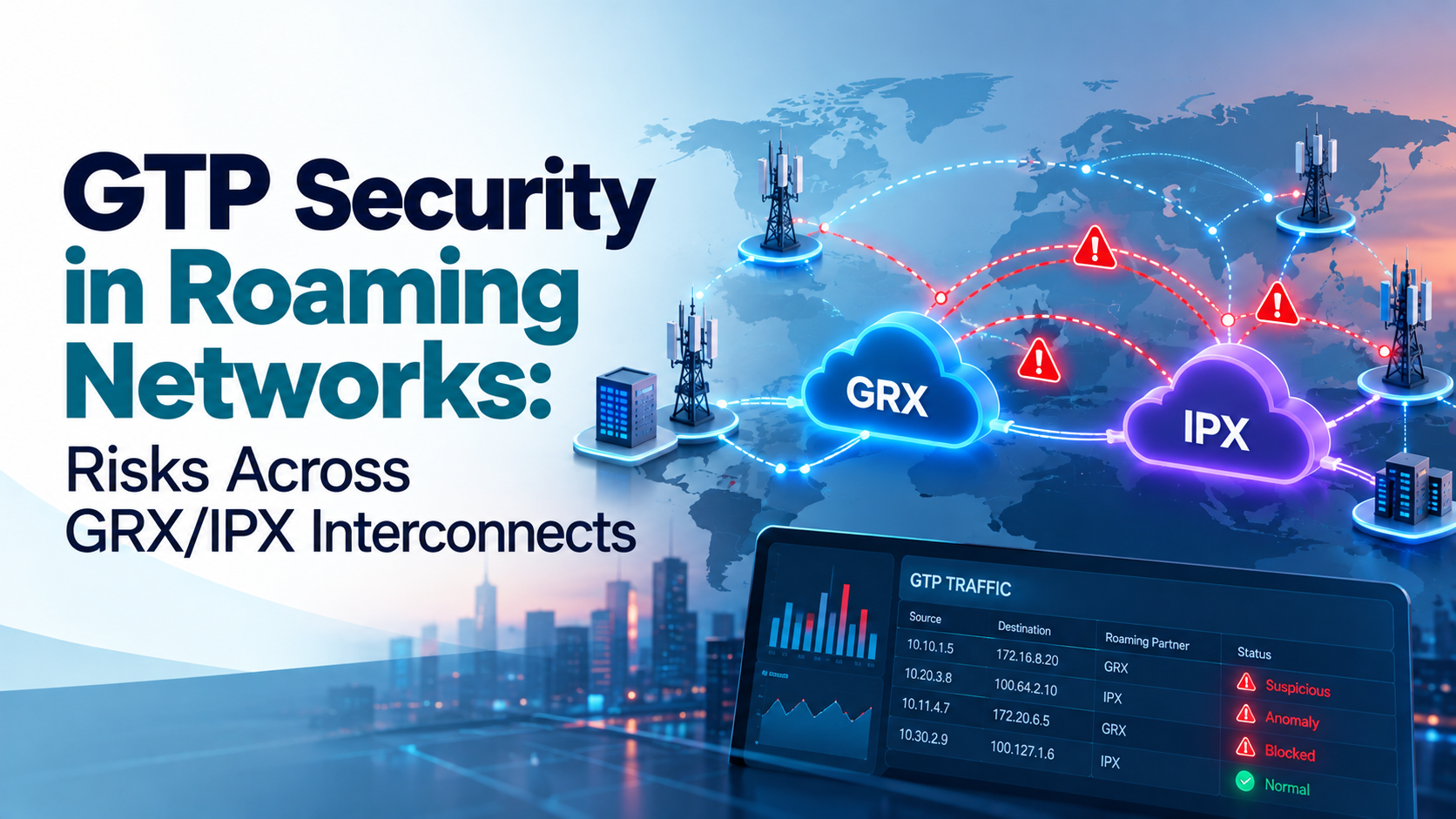

Mobile roaming allows subscribers to use voice and data services when they connect to a network outside their home operator's coverage area. Behind this convenience, telecom operators must exchange signaling and data traffic across interconnected networks, service providers and roaming partners.
The GPRS Tunneling Protocol (GTP) supports important functions in mobile core networks, including session management and user-data transport on relevant interfaces. However, connections between operators introduce additional trust boundaries that must be secured.
GTP roaming security helps protect these interconnections against unauthorized signaling, protocol misuse and weaknesses that could affect subscriber services, network availability or revenue. This article explores the risks associated with GRX/IPX connectivity and the security measures telecom operators should consider.
GTP roaming security refers to the controls, monitoring and assessment activities used to protect GTP communications associated with roaming services.
When a subscriber roams, the home and visited networks must coordinate relevant functions to provide connectivity. Depending on the roaming architecture, traffic may cross operator-controlled network boundaries and be carried through a GRX or IPX provider.
GTP-C supports control-plane procedures such as session creation, modification and deletion, while GTP-U carries user-plane traffic on applicable interfaces. The security requirements differ according to the network architecture, interface and protocol version.
Effective GTP security in roaming aims to ensure that communications are permitted, correctly handled and consistent with the intended relationship between network peers. It also helps operators identify weaknesses before they can be exploited.
GRX and IPX networks support connectivity between telecom operators, particularly for roaming and related services. Although their precise services and architectures vary, both can form part of the path through which traffic moves between organizations.
GPRS Roaming Exchange (GRX) networks provide IP connectivity for roaming-related services between mobile operators. GRX security involves protecting this connectivity through appropriate access restrictions, routing controls, traffic filtering, monitoring and operator-specific security policies.
IP Exchange (IPX) networks provide managed interconnection services for telecom operators and service providers. IPX security includes securing the relevant interconnects, controlling permitted communication, monitoring traffic and maintaining appropriate separation between services and network participants.
Neither GRX nor IPX connectivity should automatically be treated as proof that every message traversing the connection is legitimate. Operators remain responsible for implementing and validating security controls at their own network boundaries.
Roaming requires cooperation between organizations, but excessive trust can create security gaps. If an operator accepts traffic based on broad assumptions about a partner or interconnect, unauthorized messages may reach network elements.
GTP vulnerabilities in roaming can arise when peer restrictions, access policies or message-validation controls are incomplete. Operators should verify that each connection is authorized for its intended purpose and that trust is not broader than necessary.
Roaming-related interfaces may expose critical network functions to traffic originating outside the operator's direct administrative control.
Weak GTP roaming interface security can result from unnecessary exposure, overly permissive filtering rules, insufficient peer validation or outdated configurations.
Operators should document their relevant interfaces, restrict access to approved peers and verify that traffic is permitted only where required by the network architecture.
Traffic from an approved interconnect may still contain unexpected, malformed or inappropriate messages. Network controls must therefore assess more than the origin of a packet.
Protocol-aware filtering, message validation and context-appropriate security rules can help restrict traffic that violates established policies. Operators should verify that these controls distinguish legitimate roaming procedures from unauthorized or invalid activity.
If security teams lack visibility into roaming-related traffic, unusual signaling patterns or repeated policy violations may go unnoticed.
Monitoring should cover relevant firewall decisions, peer activity, protocol validation failures and unusual traffic volumes. Correlating these events with network changes and operational records helps teams distinguish genuine threats from legitimate roaming activity.
Weak roaming controls can contribute to service misuse, unauthorized data activity or disputes involving roaming usage and charging. The actual impact depends on the vulnerability, network architecture and whether other controls prevent exploitation.
Telecom revenue leakage is not necessarily caused by GTP vulnerabilities alone, but gaps in signaling validation, session handling or related controls may increase exposure. Operators should assess the end-to-end relationship between network security, service authorization and charging processes.
A practical security strategy should combine network restrictions, protocol-aware controls and ongoing validation.
Document the connections between the home network, visited networks, GRX/IPX providers and relevant core network elements. Identify which peers may communicate, which interfaces they require and what traffic is expected.
Apply least-privilege principles so that each connection has only the access needed for its approved purpose.
Review access lists, permitted message types, filtering policies and peer-validation mechanisms. Confirm that controls align with the operator's roaming architecture and relevant protocol requirements.
Test both allowed and prohibited traffic through authorized procedures. This helps identify overly permissive rules and configuration errors that could weaken protection.
Establish visibility into relevant signaling events, rejected traffic, validation failures and unusual activity. Define alerting and escalation procedures so that security teams can investigate potential incidents promptly.
Where appropriate, correlate GTP-related events with other network security logs and operational information to establish context and assess potential impact.
A review should consider the operator's own interfaces, configurations, peer relationships and monitoring controls, rather than assuming that a provider-managed interconnect eliminates all risk.
A structured GTP security assessment can examine exposed interfaces, message handling, access restrictions and configuration weaknesses. Authorized security testing can then validate selected findings within a defined scope.
Roaming fraud prevention requires coordination between network security, roaming operations, fraud management and charging teams. Security controls should support the detection of suspicious activity while ensuring that legitimate subscriber services remain available.
Operators should establish clear investigation processes for unusual usage patterns, unexpected signaling behavior and events that may indicate unauthorized data usage. Technical findings should be correlated with relevant service and charging evidence before conclusions are drawn.
Routine configuration reviews are useful, but they may not reveal every weakness in a roaming environment. A comprehensive assessment should consider the operator's network design, trust boundaries, GTP interfaces, security policies and monitoring coverage.
GTP security testing can help validate whether controls behave as intended and identify weaknesses that require remediation. Depending on the agreed scope, the assessment may include:
These activities support telecom roaming security by helping operators understand where controls may be insufficient and prioritize improvements based on risk.
Learn more about GTP Security Testing Explained or explore Matrix Shell's Signaling Security Testing services.
Roaming interconnections are essential to mobile service delivery, but they also create trust boundaries that require careful protection. Effective GTP roaming security combines restricted access, peer validation, protocol-aware filtering, monitoring and regular security assessment.
By strengthening GRX security, IPX security and roaming interface controls, operators can reduce unnecessary exposure and improve their ability to identify suspicious signaling and potential fraud risks.
A layered approach—supported by ongoing monitoring, authorized GTP security testing and collaboration between security and roaming teams—helps operators protect mobile core services while maintaining reliable roaming connectivity.