Blog
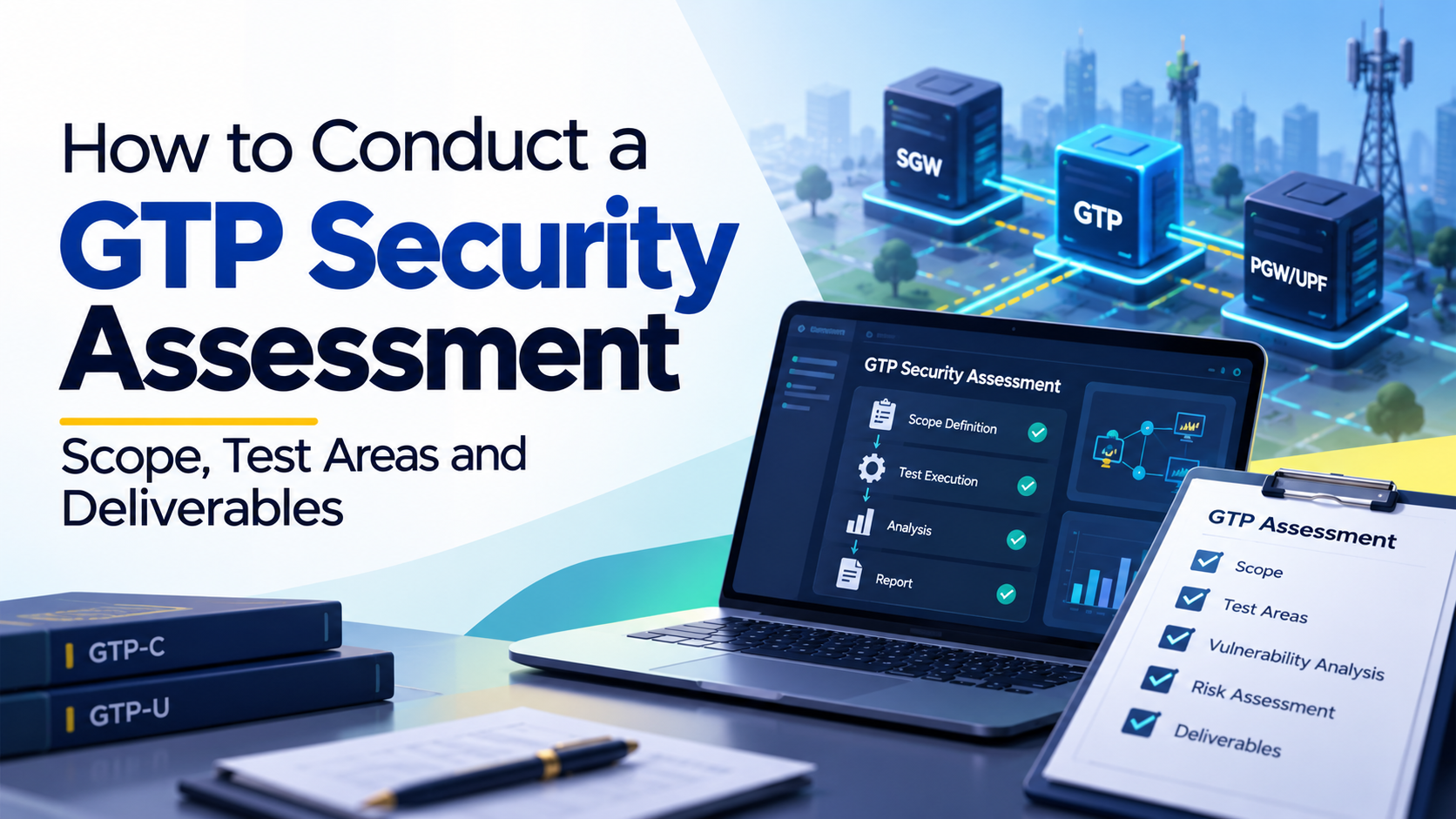

Mobile operators depend on the GPRS Tunnelling Protocol (GTP) to support subscriber sessions and data communication across mobile packet-core networks. However, weaknesses in interface exposure, message validation, access controls, and network configuration can introduce security risks that affect service availability and operational resilience.
A GTP security assessment helps telecom operators identify these weaknesses, evaluate their potential impact, and determine which security controls need improvement. Rather than focusing on a single vulnerability, an assessment examines how GTP interfaces, network elements, configurations, and signaling policies work together.
This guide explains how to conduct GTP security testing, define an assessment scope, validate security controls, analyze findings, and deliver actionable recommendations.
A GTP security assessment is a structured review of the security posture of network elements and interfaces that use GTP. It may combine configuration reviews, interface testing, message-validation checks, access-control assessments, and controlled security testing.
The scope depends on the operator's architecture and objectives. For example, an assessment may focus on GTP interfaces within a 4G LTE Evolved Packet Core (EPC), operator interconnections, or specific network functions that process GTP signaling and user-plane traffic.
Related activities include GTP security testing, a GTP vulnerability assessment, a GTP security audit, and GTP penetration testing. These activities overlap, but their depth and objectives may differ. An audit typically reviews compliance with defined controls, while penetration testing investigates whether weaknesses can be exploited within an explicitly authorized scope.
A successful assessment begins with clear objectives and boundaries. Before testing starts, operators and assessors should agree on the network components, interfaces, environments, and methods included in the engagement.
Scope definition should cover:
The assessment should also establish written authorization, points of contact, escalation procedures, and safeguards for production services. These measures help ensure that testing remains controlled and aligned with operational requirements.
The next step is to understand where GTP operates and how traffic moves through the network. Assessors should review architecture diagrams, interface inventories, routing information, relevant configurations, and approved peer lists.
The discovery phase should identify exposed interfaces, undocumented connectivity, unnecessary access paths, and differences between intended and actual network configurations.
This stage is particularly important for GTP interface testing, because the security of an interface depends on its purpose, reachability, and trust boundaries.
The outcome should be an agreed inventory of in-scope assets and communication paths, providing a foundation for the remaining tests.
A practical GTP security assessment checklist should cover several complementary areas.
Determine whether GTP interfaces are reachable only from approved sources and whether routing or firewall rules permit unnecessary connectivity.
Assess whether network elements handle unexpected, malformed, or unauthorized messages appropriately. Review relevant message fields, session context, and protocol-specific validation behavior.
Examine whether communication is restricted to authorized network elements and peers. Review source-address restrictions, peer allowlists, segmentation, and applicable authorization policies.
Review firewall rules, signaling filters, security policies, and relevant network-element configurations. Identify overly permissive rules, inconsistent policies, and controls that are not aligned with approved network requirements.
Evaluate whether the operator can detect unusual signaling patterns, repeated validation failures, unexpected session events, or excessive traffic. Review alerting, logging, and response procedures.
Together, these checks assess whether the operator's GTP security controls address both preventive and detective requirements.
GTP v1/v2 security testing should reflect the protocol versions, interfaces, and network functions present in the assessment scope.
GTPv1 is used for relevant user-plane tunneling and certain legacy control-plane applications, while GTPv2-C is used for control-plane session management in LTE EPC environments. The versions and roles being tested should therefore be documented explicitly rather than treated as interchangeable.
Testing may examine message handling, peer restrictions, session-context validation, and responses to unexpected traffic. Any active testing should be performed within approved boundaries, with production impact considered before execution.
A broader telecom penetration testing engagement may include GTP alongside other telecom protocols, interconnections, and supporting network controls. The testing plan should clearly distinguish GTP-specific checks from wider signaling security activities.
Not every configuration difference or unexpected response represents an exploitable vulnerability. Findings should be validated against the expected network behavior, available evidence, and applicable security requirements.
For each confirmed finding, assessors should document:
Risk ratings should consider exploitability, exposure, potential impact, and existing safeguards. This helps operators prioritize issues that pose the greatest risk to network security and service continuity.
A professional GTP security audit or assessment should produce clear, actionable deliverables rather than a list of technical observations alone.
Typical deliverables include:
Recommendations should be specific to the operator's architecture. They may include reducing interface exposure, strengthening peer restrictions, improving message validation, correcting configuration gaps, enhancing monitoring, and updating filtering policies.
Operators can strengthen their security posture by applying the following practices:
These GTP security best practices should be integrated into the operator's wider telecom security program and adapted to the network's operational requirements.
A structured GTP security assessment helps telecom operators understand how interface exposure, message validation, access controls, and configuration weaknesses may affect their mobile core networks.
By defining the scope, discovering interfaces, testing relevant controls, validating findings, and delivering prioritized remediation recommendations, operators can make informed decisions about reducing GTP-related risks.
Matrix Shell Technologies' Signaling Security Testing service page is a relevant starting point for organizations exploring telecom signaling security assessments. A well-scoped engagement can help identify security gaps and establish practical next steps for improving network resilience.