
Blog
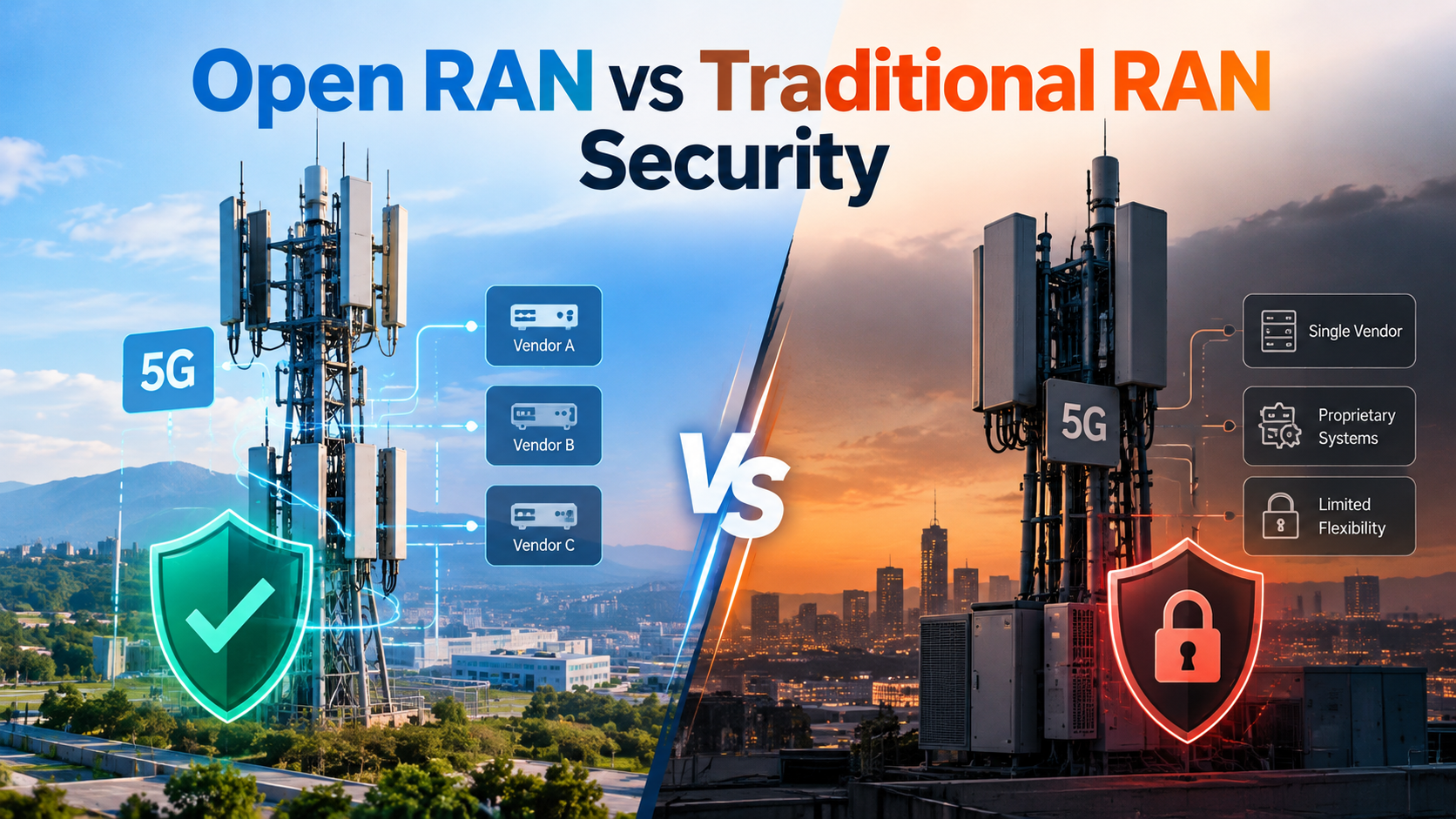

Radio Access Network (RAN) security is becoming increasingly important as telecom operators and enterprises deploy 5G, private 5G, and more disaggregated network architectures.
Traditional RAN typically relies on tightly integrated components, often supplied as a more vertically integrated solution. Open RAN, by contrast, introduces greater disaggregation, standardized interfaces, virtualization, and multi-vendor integration.
These architectural differences can change the security assumptions, interfaces, dependencies, and testing requirements of the network.
For organizations deploying private networks, understanding the differences between Open RAN security and traditional RAN security is therefore important when designing private 5G RAN security, conducting RAN security testing, and defining appropriate controls.
Traditional RAN generally uses integrated RAN components from a smaller number of vendors, with defined interfaces between major network elements.
Open RAN separates functions and introduces standardized interfaces between components. This can provide greater flexibility in vendor selection and network architecture, but it can also introduce additional integration points that security teams need to assess.
The security question is therefore not simply whether one architecture is secure or insecure. Both require appropriate controls, secure configurations, vulnerability management, monitoring, and testing.
Private 5G RAN security refers to protecting the RAN infrastructure deployed as part of a dedicated enterprise 5G network.
It includes:
5G RAN security therefore forms an important layer of broader private RAN security.
For enterprises, the RAN may also connect industrial devices, IoT systems, edge infrastructure, applications, and OT environments. This means 5G radio access network security should be assessed in the context of the entire deployment.
Traditional RAN environments still require comprehensive security controls.
Key areas include:
The relative integration of traditional RAN components does not remove the need for security testing.
Security teams should still identify vulnerabilities, validate configurations, and test whether security controls work as intended.
Matrix Shell's RAN Security Testing service covers 2G, 3G, 4G, 5G, VoLTE, VoWiFi, and Open RAN deployments, including validation of authentication, encryption, integrity protection, and traffic policies.
Open RAN security introduces additional areas for assessment because the architecture can involve multiple components, vendors, software layers, and standardized interfaces.
Security teams should examine:
O-RAN security should therefore consider not only the security of individual components but also the security of interactions between those components.
The key principle is simple: every additional interface or integration point should be identified, understood, and appropriately protected.
The attack surface can differ based on the architecture and implementation.
This does not mean Open RAN is inherently less secure. Rather, its architecture can create different security requirements and testing priorities.
Both architectures can experience vulnerabilities.
Common private 5G RAN vulnerabilities include:
Open RAN deployments can additionally require close attention to component-to-component interfaces and integration dependencies.
A RAN vulnerability assessment identifies potential weaknesses across RAN components, configurations, interfaces, software, and security controls.
For traditional RAN, this may include:
For Open RAN, the assessment can additionally examine:
The objective is to build a complete picture of the security exposure before deciding which weaknesses require deeper validation.
RAN penetration testing takes vulnerability assessment a step further.
Instead of simply identifying a potential weakness, controlled testing attempts to validate whether the weakness can be exploited within an authorized scope.
Testing can include:
For Open RAN, penetration testing should also consider the interfaces and interactions between disaggregated components.
Testing should be carefully scoped to avoid unnecessary impact on live network operations.
5G radio security remains important regardless of whether the deployment uses traditional or Open RAN architecture.
Security teams should validate:
The radio interface remains an important part of the RAN attack surface, even when the underlying architecture becomes more disaggregated.
A practical RAN cybersecurity strategy should combine preventive controls with continuous validation.
Ensure that only authorized devices, administrators, and network components can access protected resources.
Limit administrative and system privileges according to clearly defined requirements.
Harden gNBs, radio components, management systems, and associated network functions.
Secure interfaces between RAN components and between RAN and Core infrastructure.
Maintain software and firmware inventories and address known vulnerabilities.
Separate critical management, enterprise, IoT, and OT environments where appropriate.
Monitor authentication events, configuration changes, administrative activity, and unusual traffic.
A practical 5G RAN testing lifecycle can be structured as:
Discover → Assess → Test → Remediate → Retest
Testing should focus on:
Testing should cover the same fundamental controls while adding:
Matrix Shell's RAN testing scope includes Open RAN alongside traditional 2G–5G, VoLTE, and VoWiFi environments.
Organizations deploying either architecture should:
For complex telecom environments, laboratory-based testing can provide an additional layer of validation. Matrix Shell's 5G Security Lab provides controlled testing capabilities covering protocols, APIs, interfaces, configuration review, and vulnerability identification.
The security strategy should be determined by the actual architecture and deployment requirements rather than by the RAN model alone.
Organizations should evaluate:
Enterprises deploying private 5G should ensure that the selected security program covers both the wireless access layer and the components behind it.
Open RAN and traditional RAN have different architectural characteristics, but both require strong security controls and continuous validation.
Open RAN security places additional emphasis on interfaces, disaggregated components, software, multi-vendor integration, and orchestration. Traditional RAN security continues to require strong protection for gNBs, base stations, radio interfaces, management systems, software, and RAN-to-Core communication.
For private deployments, private 5G RAN security should be approached as an end-to-end discipline covering architecture, 5G base station security, gNB security, 5G radio security, interfaces, connected devices, and enterprise integration.
Combining RAN vulnerability assessment, RAN penetration testing, configuration reviews, monitoring, and continuous 5G RAN testing helps organizations understand their exposure and validate that security controls remain effective as their networks evolve.





