Blog
.png)
5G has transformed telecom networks — faster speeds, lower latency, and massive device connectivity. But behind all this innovation lies a critical reality: the Radio Access Network (RAN) is now more complex — and more vulnerable — than ever before.
With Open RAN, virtualization, and multi-vendor ecosystems, the attack surface has expanded significantly. That's why 5G RAN security testing is no longer optional — it's a foundational requirement.
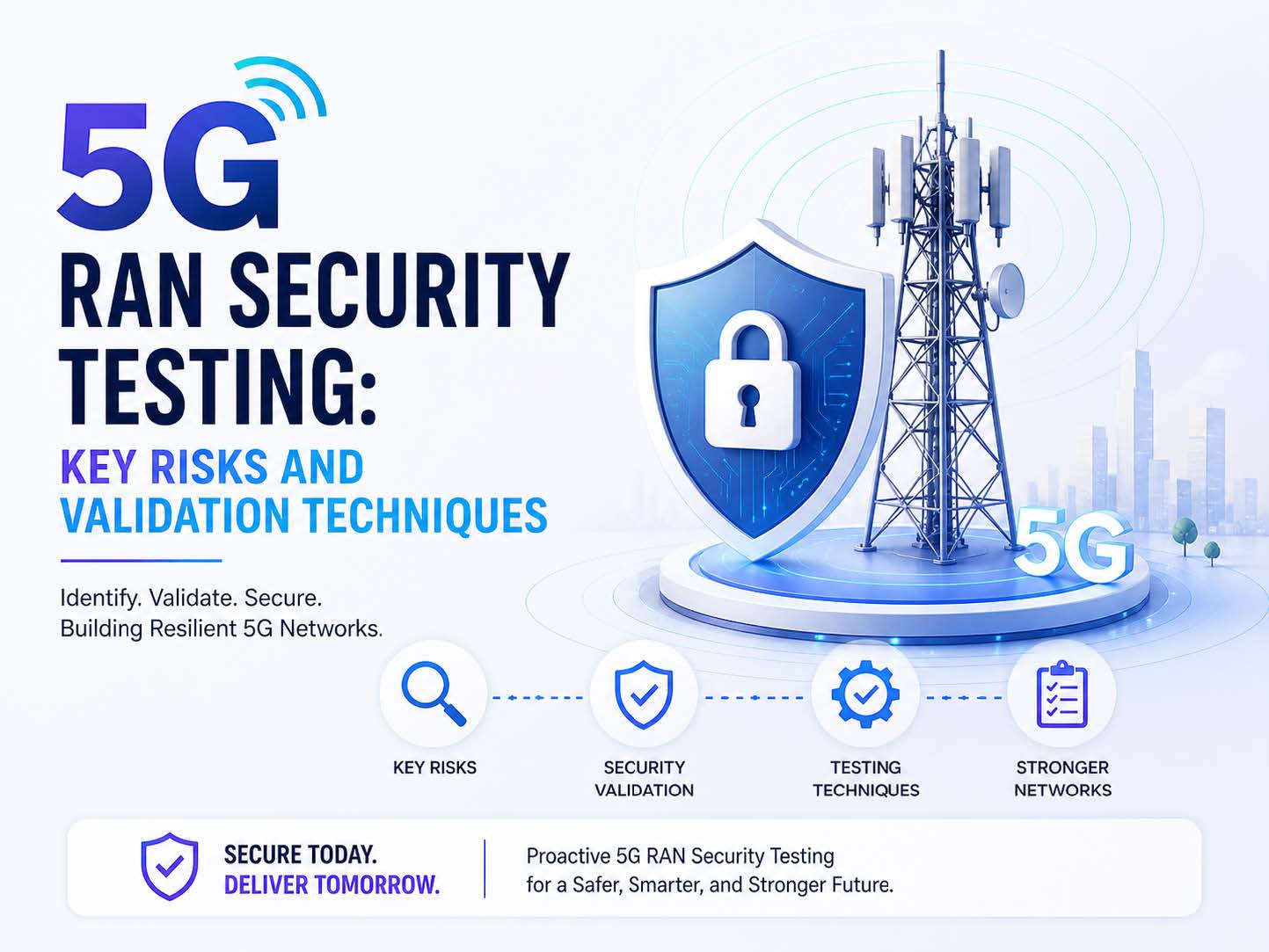
5G RAN security testing is the process of identifying vulnerabilities, validating security controls, and ensuring resilience within the radio access layer of 5G networks. It includes:
The goal is to ensure that the first point of network access is secure, reliable, and resilient against attacks.
Unlike previous generations, 5G RAN is disaggregated (Open RAN), cloud-native and virtualized, and highly interconnected. According to ENISA, 5G architecture introduces new threat vectors due to increased interfaces, virtualization, and software-based components.
Key Insight: 5G improves performance — but also expands the mobile network attack surface, especially at the RAN layer.
Open RAN introduces multiple vendors, open interfaces, and cloud-based components — significantly increasing exposure to attacks. Studies show that Open RAN increases attack surfaces due to disaggregation, open-source components, and new interfaces.
5G improves authentication, but vulnerabilities still exist — including identity spoofing, unauthorized access, and weak validation mechanisms. Research has identified weaknesses in 5G authentication flows that can expose user identity and network access.
Even with encryption, misconfigurations can expose data, downgrade attacks can bypass protections, and legacy integration creates security gaps.
Many 5G deployments rely on 4G LTE cores and legacy protocols, meaning vulnerabilities from older networks can still impact 5G. Research confirms that many 4G vulnerabilities are inherited in early 5G deployments.
5G RAN depends on virtual machines, containers, and cloud infrastructure — introducing misconfiguration risks, API vulnerabilities, and infrastructure-level attacks.
Attackers can manipulate signaling messages, disrupt control plane operations, and impact overall network availability.
Every user device connects through RAN. If compromised, the entire network is exposed and subscriber data is at risk.
RAN vulnerabilities affect connectivity, call quality, and data performance — making security failures immediately visible to subscribers.
Modern RAN includes Open RAN components, AI-driven controllers, and distributed architectures. Security must keep pace with this complexity.
Identify weak interfaces, misconfigurations, and exposure points across the radio access layer.
Validate identity verification mechanisms, encryption protocols, and integrity protection to ensure secure authentication in telecom networks.
Test RAN signaling flows, protocol behavior, and communication integrity to detect manipulation risks.
Focus on multi-vendor interoperability, interface security, and cloud-based components. Studies show that security validation frameworks are essential to ensure Open RAN components are resilient against attacks.
Ensure secure voice communication, protection against interception, and session integrity across modern voice services.
Evaluate network behavior under stress, traffic routing policies, and anomaly detection capabilities.
Continuous Security Testing — Conduct regular telecom network security testing and ongoing vulnerability assessments to stay ahead of emerging threats.
Follow GSMA & 3GPP Guidelines — Industry standards ensure consistency and improve compliance and overall security posture.
Secure Multi-Generation Networks — Ensure protection across 2G, 3G, 4G, and 5G simultaneously to close inherited vulnerability gaps.
Strengthen Encryption & Integrity — Protect data in transit and prevent tampering at every layer of the RAN stack.
Real-Time Monitoring & Detection — Identify anomalies early and prevent large-scale attacks before they escalate.
5G is redefining telecom networks — but it's also redefining security challenges. The Radio Access Network sits at the center of this transformation, acting as both an enabler and a risk point.
By adopting proactive 5G RAN security testing strategies, telecom operators can ensure secure deployments, protect subscriber data, and build resilient next-generation networks.