Blog
.png)
Every telecom network relies on signaling — the invisible layer responsible for authentication, routing, and communication between network elements. Whether it's a call, SMS, or mobile data session, signaling protocols quietly handle everything behind the scenes.
But here's the problem: these same protocols are now one of the most exploited attack surfaces in telecom networks. From legacy SS7 to modern 5G APIs, telecom signaling security has become a critical priority for operators worldwide.
Signaling protocols were originally designed for trusted environments — where only legitimate telecom operators had access. That assumption no longer holds true.
According to ENISA, signaling systems across telecom networks present a medium to high level of risk, requiring urgent attention from operators. Modern research further shows that both legacy and new protocols — SS7, Diameter, GTP, and 5G SBA — are actively exploited by attackers.
Key Insight: Signaling vulnerabilities are not isolated — they exist across 2G, 3G, 4G, and 5G networks, making them a persistent and evolving risk.
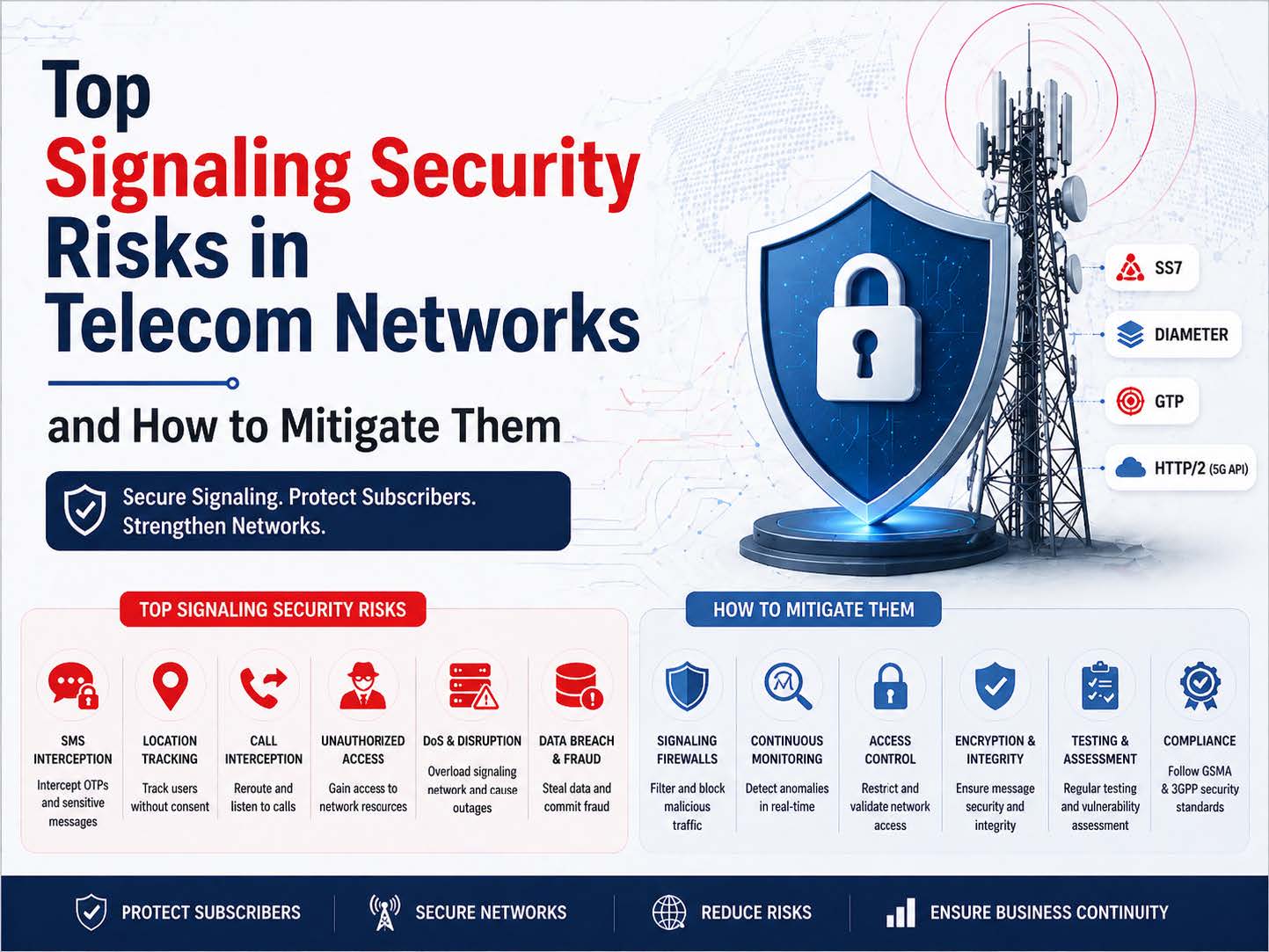
One of the most well-known threats. Attackers exploit signaling protocols like SS7 to intercept OTP messages, bypass two-factor authentication, and gain unauthorized access to accounts. SS7's lack of authentication and encryption makes such attacks possible.
Signaling requests can be used to track user location in real time and monitor subscriber activity. This directly impacts subscriber data protection in telecom networks and creates serious compliance risks.
Attackers can manipulate signaling messages to reroute calls, record conversations, and disrupt communication flows. Studies confirm that signaling vulnerabilities enable interception and manipulation of telecom traffic.
GTP, used for mobile data transport, can be exploited to hijack sessions, intercept data traffic, and launch denial-of-service attacks. These risks highlight the need for GTP security testing (GTP v1 & v2) in telecom environments.
Diameter, used in 4G networks, inherits similar risks as SS7 — including weak validation, lack of end-to-end security, and exposure to interconnect attacks. This makes signaling network vulnerability testing essential.
With 5G, signaling has moved to HTTP/2-based APIs. This introduces new risks including API abuse, unauthorized access, and service disruption. ENISA highlights that API exposure significantly increases the telecom attack surface in 5G environments.
Attackers can flood signaling networks with malicious requests, causing service outages, network congestion, and business disruption — directly impacting telecom network continuity.
Most signaling protocols were built on a simple assumption: "All network participants are trusted." This results in no strong authentication, limited message validation, and minimal encryption. Research confirms that these trust-based designs are the primary reason behind modern signaling vulnerabilities.
Securing telecom signaling requires a structured, proactive approach.
Operators must adopt continuous signaling security testing, regular signaling vulnerability assessments, and real-world attack simulations. This helps identify weaknesses before attackers can exploit them.
Firewalls for SS7, Diameter, and GTP can filter malicious signaling messages, block unauthorized access, and monitor abnormal traffic. Industry solutions support GSMA guidelines for signaling protection.
Focus on control plane security in telecom by validating signaling requests, monitoring network behavior, and restricting unauthorized access.
Ensure secure communication channels, message validation, and protection against tampering — improving telecom encryption and message integrity across the network.
For 5G environments, implement strong API authentication, monitor API traffic, and perform HTTP/2 security testing to reduce exposure in service-based architectures.
Follow GSMA signaling security frameworks and 3GPP telecom security standards — these provide a strong foundation for telecom protocol security.
Telecom networks are constantly evolving. New threats emerge due to increased interconnectivity, API-driven architectures, and hybrid network environments. Research shows that signaling attacks occur continuously, with thousands of attempts detected daily in real-world networks.
Telecom signaling systems are no longer just operational components — they are critical security boundaries. As networks evolve, attackers continue to exploit signaling vulnerabilities across legacy and modern protocols.
By adopting continuous signaling security testing, strong validation mechanisms, and standards-based frameworks, telecom operators can protect their networks, secure subscriber data, and ensure long-term resilience.