Blog
.png)
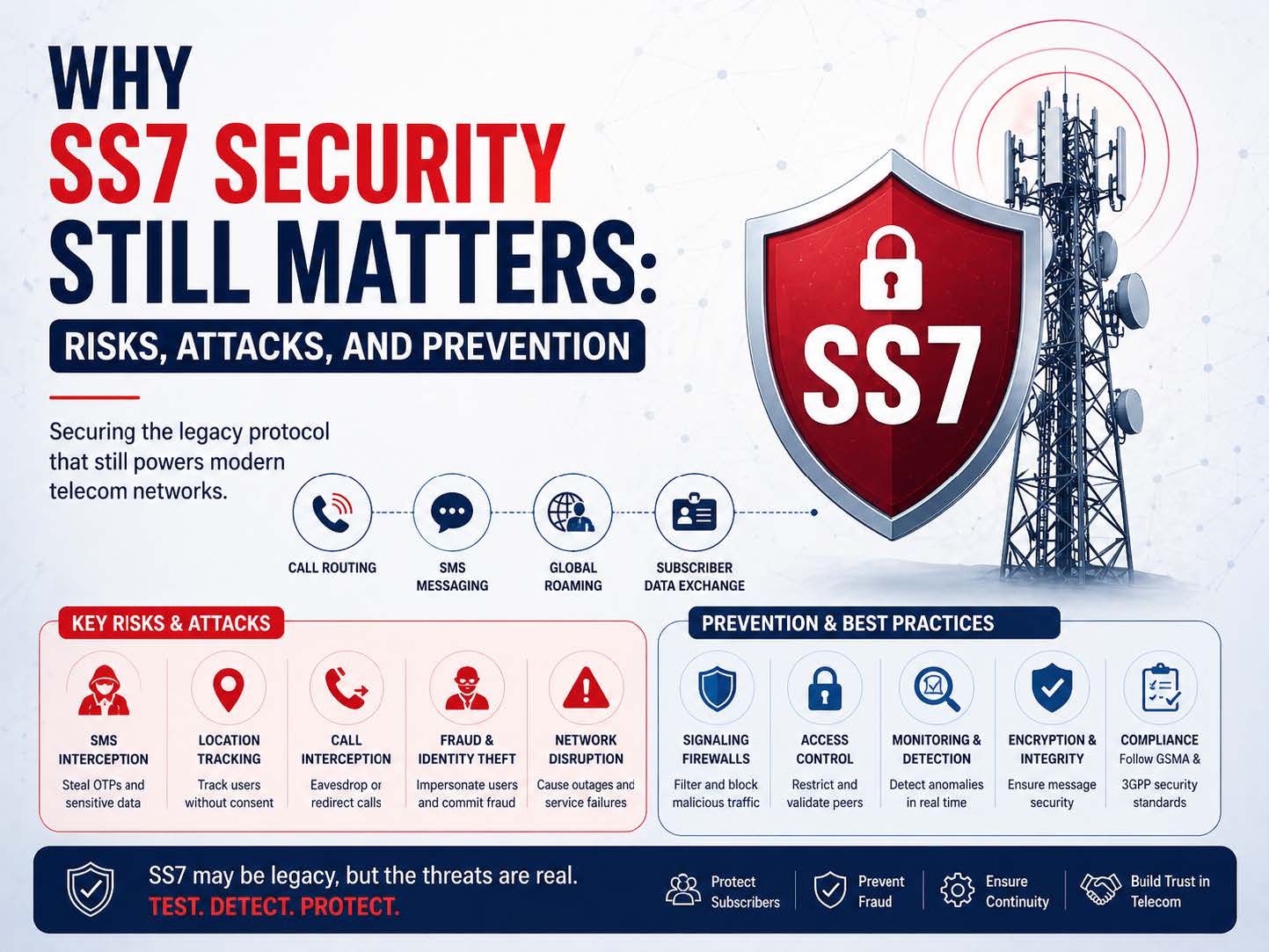
Telecom networks have evolved rapidly — from 2G to 5G, from hardware-based systems to cloud-native architectures. Yet, one protocol still quietly powers global connectivity: SS7 (Signaling System No. 7).
Despite being decades old, SS7 continues to handle critical functions like call routing, SMS delivery, and roaming. And that's exactly why it remains a major security concern.
Even today, telecom signaling security cannot be fully addressed without understanding and securing SS7.
SS7 is the signaling protocol used to:
It acts as a bridge between telecom operators worldwide. However, SS7 was designed in an era where networks trusted each other by default — a model that no longer works in today's threat landscape. Research shows that SS7 lacks built-in authentication and encryption, making it vulnerable to misuse.
Key Insight: SS7 is not outdated — it is still active and widely used, which makes its vulnerabilities highly relevant today.
Even as networks adopt 5G, SS7 remains in use due to:
Studies confirm that SS7 is still used to interconnect telecom providers globally, exposing networks to potential attacks if not secured properly.
One of the most widely exploited SS7 vulnerabilities. Attackers can intercept OTP messages, bypass two-factor authentication, and gain access to financial accounts. SS7 attacks have been used to reroute SMS messages and compromise sensitive systems.
Using SS7 queries, attackers can track user location in real-time and monitor movement patterns — creating serious concerns around subscriber data protection in telecom networks.
Attackers can reroute calls, record conversations, and manipulate communication flows. Technical reports show SS7 can be exploited to intercept calls and messages through unauthorized signaling requests.
SS7 vulnerabilities enable billing fraud, identity spoofing, and unauthorized network access. Because SS7 trusts incoming requests, attackers can impersonate legitimate network elements.
Unlike traditional cyberattacks, SS7 attacks don't require direct access to user devices. Instead, attackers:
Research shows that attackers can manipulate subscriber profiles and routing information through SS7 signaling.
SS7 was built on a simple assumption: "All network participants are trusted." This means there is no strong authentication, no message validation, and no built-in encryption. This design flaw is the root cause of most telecom signaling threats today.
Even in modern networks, SS7 does not operate in isolation:
Research highlights that legacy and modern protocols together create a broader attack surface across telecom networks.
Securing SS7 requires a proactive, layered approach.
Operators must conduct continuous signaling security testing, signaling vulnerability assessments, and real-world attack simulations. This helps identify weaknesses before attackers do.
Specialized firewalls can filter malicious signaling messages, block unauthorized requests, and monitor traffic patterns. GSMA guidelines recommend signaling firewalls as a key defense mechanism.
Even though SS7 lacks native encryption, additional security layers can protect communication and message integrity checks can significantly reduce risk.
Telecom operators should follow GSMA FS.11 (signaling firewall guidelines) and 3GPP security frameworks — the standards that define best practices for telecom protocol security.
SS7 vulnerabilities are not static. They evolve due to:
Industry insights show telecom protocols require continuous testing aligned with GSMA and 3GPP standards to remain secure.
SS7 may be a legacy protocol, but its impact on modern telecom security is very real. As long as global telecom networks rely on SS7 for interoperability and fallback, its vulnerabilities will remain a critical risk.
By adopting proactive signaling security strategies, continuous testing, and modern protection mechanisms, telecom operators can reduce exposure and build more secure, resilient networks.