Blog
.png)
Every mobile connection begins at the Radio Access Network (RAN) — the layer that connects users' devices to the telecom core. Whether it's a call, video stream, or IoT communication, RAN is where traffic first enters the network. And because of that, it has become one of the most critical — and most exposed — security layers in telecom.
Today, RAN security testing is essential for telecom operators to protect networks from vulnerabilities, ensure subscriber safety, and maintain service reliability.
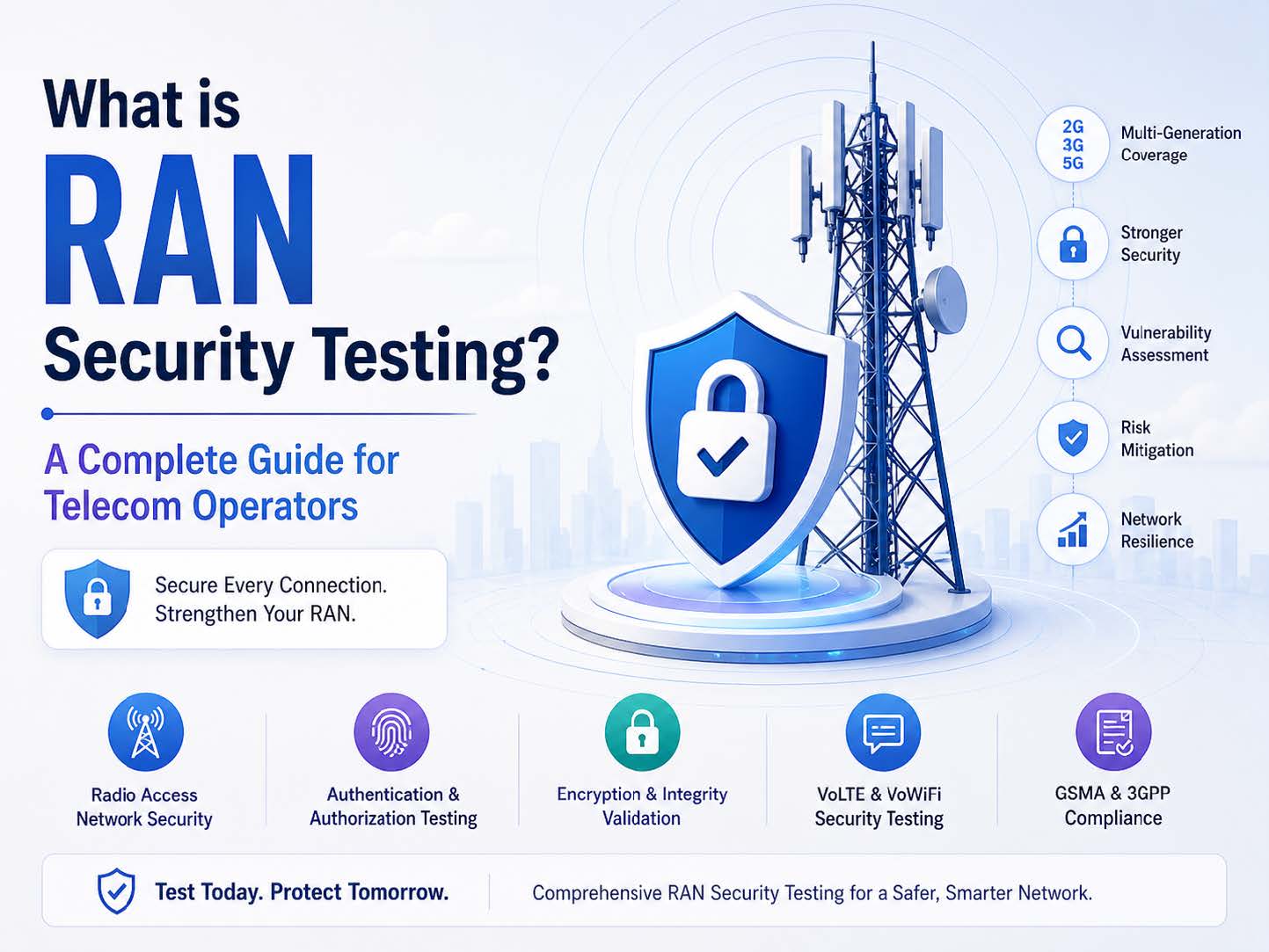
RAN security testing is the process of identifying vulnerabilities and validating security controls within the radio access network layer of telecom infrastructure. It involves testing:
The goal is straightforward: detect and fix vulnerabilities before attackers exploit them. RAN acts as the gateway between user devices and the core network, making it a critical component for secure mobile communication.
RAN is not just another network layer — it's the entry point for all mobile traffic. This means any vulnerability at RAN can expose the entire network, attackers can target devices, signaling, and infrastructure simultaneously, and security failures here directly impact subscribers. As telecom ecosystems evolve with 5G and IoT, the importance of securing RAN continues to grow.
Key Insight: If the RAN layer is compromised, everything connected to it is at risk — from user data to core network operations.
Ensures that only authorized devices connect to the network and that identity verification mechanisms are secure. This is critical for mobile network authentication security.
RAN security testing validates data encryption during transmission and integrity protection of signaling messages. 5G security frameworks emphasize securing communication across RAN interfaces to prevent tampering.
Testing ensures proper handling of signaling messages and protection against protocol misuse — supporting signaling protocol security testing across telecom environments.
RAN testing evaluates traffic routing policies, resource allocation mechanisms, and network response to abnormal traffic patterns.
Modern services like VoLTE and VoWiFi require secure session handling and protection against interception and spoofing.
With Open RAN and 5G comes more interfaces, more vendors, and more integration points — increasing the mobile network attack surface. Open RAN introduces flexibility but also expands potential security risks due to its open and disaggregated architecture.
If authentication is compromised, unauthorized devices can access the network, leading to increased fraud and misuse.
Without proper encryption, data can be intercepted and subscriber privacy compromised.
Improper traffic policies can lead to service disruption, unauthorized access, and network instability.
Operators manage 2G/3G legacy networks, 4G LTE infrastructure, and 5G advanced architectures simultaneously — creating unique challenges in multi-generation RAN security testing.
Identify weaknesses across interfaces, protocols, and configurations throughout the radio access network.
Test authentication flows, encryption mechanisms, and overall network behavior to confirm controls are functioning as intended.
Simulate real-world scenarios including unauthorized access, traffic manipulation, and service disruption to uncover exploitable gaps.
Monitor network activity, anomalies, and potential threats on an ongoing basis to stay ahead of emerging risks.
Open RAN introduces a disaggregated architecture, a multi-vendor ecosystem, and cloud-based components. While this improves flexibility, it also expands the attack surface and introduces new vulnerabilities. Industry standards like GSMA NESAS and 3GPP aim to ensure secure development and deployment of telecom equipment in these environments.
Implement Continuous Testing
RAN security is not a one-time process. Operators must adopt continuous telecom network security testing and regular vulnerability assessments.
Follow GSMA & 3GPP Guidelines
Industry frameworks provide security standards, testing methodologies, and compliance requirements that form the foundation of a strong RAN security posture.
Secure Multi-Generation Networks
Ensure consistent security controls across 2G, 3G, 4G, and 5G simultaneously.
Strengthen Authentication & Encryption
Enforce strong identity validation and protect data integrity at every layer.
Monitor Traffic & Behavior
Detect anomalies early and prevent attacks before they escalate.
5G introduces open interfaces, cloud-native architecture, and API-driven communication. These advancements improve performance — but also increase risk. Security testing ensures secure deployment, stable performance, and compliance with telecom standards in these next-generation environments.
RAN is no longer just a connectivity layer — it's a critical security boundary. As telecom networks evolve, operators must adopt proactive RAN security testing strategies to identify vulnerabilities, protect subscriber data, and ensure network reliability.
By doing so, they can build secure, scalable, and future-ready telecom infrastructure.