Introduction: From Standards to Real Security
Telecom security today isn’t just about tools—it’s about standards.
As networks evolve from legacy systems to 5G and Open RAN, operators face a growing challenge:
How do you ensure consistent security across such a complex environment?
This is where GSMA guidelines play a critical role.
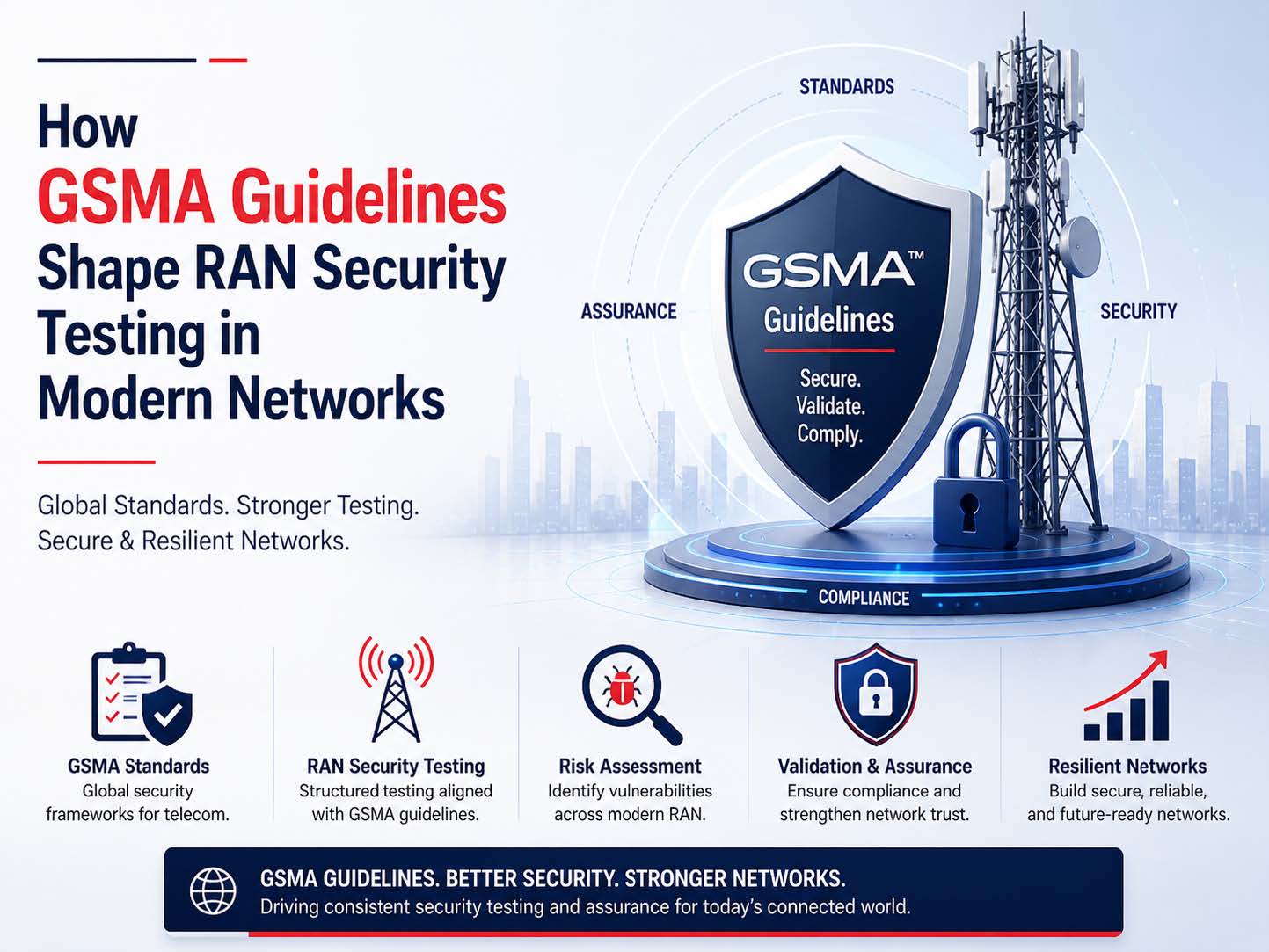
They don’t just define security—they shape how RAN security testing is performed, validated, and standardized across global telecom networks.
Why GSMA Guidelines Matter in RAN Security
Telecom networks are interconnected ecosystems involving:
- Multiple operators
- Multiple vendors
- Multiple technologies (2G → 5G)
Without standardized security frameworks, each network would follow different practices—creating gaps.
The GSMA 5G Security Guide highlights the need for structured security approaches across evolving telecom architectures and identifies new attack vectors introduced by modern technologies.
Key Insight
GSMA doesn’t just recommend security—it defines how telecom security should be implemented and tested globally.
What Are GSMA Security Guidelines in Telecom?
GSMA provides a set of frameworks and best practices that guide:
- Telecom network security testing
- Authentication and encryption standards
- Vulnerability assessment methodologies
- Compliance and certification
One of the most important frameworks:
NESAS (Network Equipment Security Assurance Scheme)
- Jointly developed with 3GPP
- Defines security requirements for telecom equipment
- Standardizes testing and validation processes
Industry reports confirm that GSMA and 3GPP collaborate to establish common security baselines and certification mechanisms for telecom infrastructure.
How GSMA Guidelines Influence RAN Security Testing
1. Standardized RAN Security Validation
GSMA ensures that:
- All vendors follow consistent testing methodologies
- Security controls are validated against global benchmarks
This strengthens RAN security validation across networks.
2. Structured RAN Vulnerability Assessment
Instead of random testing, GSMA frameworks define:
- What to test
- How to test
- What risks to prioritize
This improves RAN vulnerability assessment accuracy.
3. Alignment with 3GPP Security Standards
GSMA guidelines work alongside 3GPP specifications like:
- SCAS (Security Assurance Specifications)
- Network function security requirements
These define security test cases and requirements for telecom network functions, ensuring consistent evaluation.
4. Certification of Telecom Equipment
With NESAS:
- Vendors must meet predefined security standards
- Equipment is tested before deployment
This ensures secure telecom infrastructure from the start.
GSMA’s Role in Securing Modern RAN Architectures
Open RAN introduces:
- Multi-vendor ecosystems
- Open interfaces
- Cloud-native deployments
GSMA frameworks help mitigate these risks by:
- Enforcing security requirements
- Supporting certification programs
- Encouraging zero-trust approaches
Research shows Open RAN significantly increases attack surfaces due to disaggregation and open interfaces.
2. Supporting Multi-Generation Security
GSMA guidelines ensure security across:
- 2G / 3G (legacy)
- 4G LTE
- 5G advanced networks
This enables multi-generation RAN security testing.
3. Enhancing Authentication & Encryption Standards
GSMA defines best practices for:
- Authentication in telecom networks
- Encryption in RAN communication
- Integrity protection telecom systems
These are critical for protecting subscriber identity and data.
Key Areas Where GSMA Shapes RAN Security Testing
1. Authentication Testing
Ensures:
- Secure device identity verification
- Prevention of unauthorized access
2. Encryption & Integrity Validation
Ensures:
- Secure data transmission
- Protection against tampering
3. Interface Security Testing
Focuses on:
- Open interfaces (especially in Open RAN)
- Interoperability risks
4. Traffic Policy & Behavior Validation
Ensures:
- Secure routing policies
- Controlled network behavior
5. VoLTE & VoWiFi Security Testing
Ensures:
- Secure voice communication
- Protection against interception
Why GSMA-Based RAN Testing is Critical Today
1. Increasing Network Complexity
Modern telecom networks are:
- Distributed
- Virtualized
- Multi-vendor
Security must be standardized to remain effective.
2. Growing Attack Surface
Cloud-native and Open RAN deployments increase:
- Exposure points
- Security risks
Studies highlight that cloud-based and Open RAN environments introduce new internal and external threat vectors.
3. Need for Global Interoperability
Telecom networks must:
- Work seamlessly across countries
- Maintain consistent security
GSMA ensures this alignment.
Best Practices for GSMA-Aligned RAN Security Testing
1. Adopt NESAS-Based Testing
- Validate vendor equipment
- Ensure compliance before deployment
2. Implement Continuous Testing
- Regular radio access network security testing
- Ongoing vulnerability assessments
3. Focus on Multi-Layer Security
- RAN layer
- Core network
- API and cloud layers
4. Secure Open RAN Deployments
- Validate interfaces
- Monitor vendor interactions
- Apply zero-trust principles
5. Combine Standards with Real-World Testing
Standards define the baseline—but real-world testing ensures resilience.
How Matrix Shell Aligns with GSMA Security Frameworks
Telco Security Wiz by Matrix Shell enables:
- GSMA-aligned RAN security testing
- Advanced radio access network security testing
- Multi-generation validation (2G → 5G)
- Compliance with GSMA and 3GPP standards
👉 Explore Telco Security Wiz

.png)