Blog
.png)
Behind every mobile call, SMS, or data session, there's a hidden layer that makes everything work—telecom signaling.
This signaling layer acts as the "control system" of mobile networks, managing authentication, routing, and subscriber data exchange. But while it powers connectivity, it has also become one of the most targeted areas in telecom cybersecurity.
Today, telecom signaling security is no longer just a technical concern—it's a business-critical priority for operators looking to protect their networks, revenue, and subscribers from modern threats.
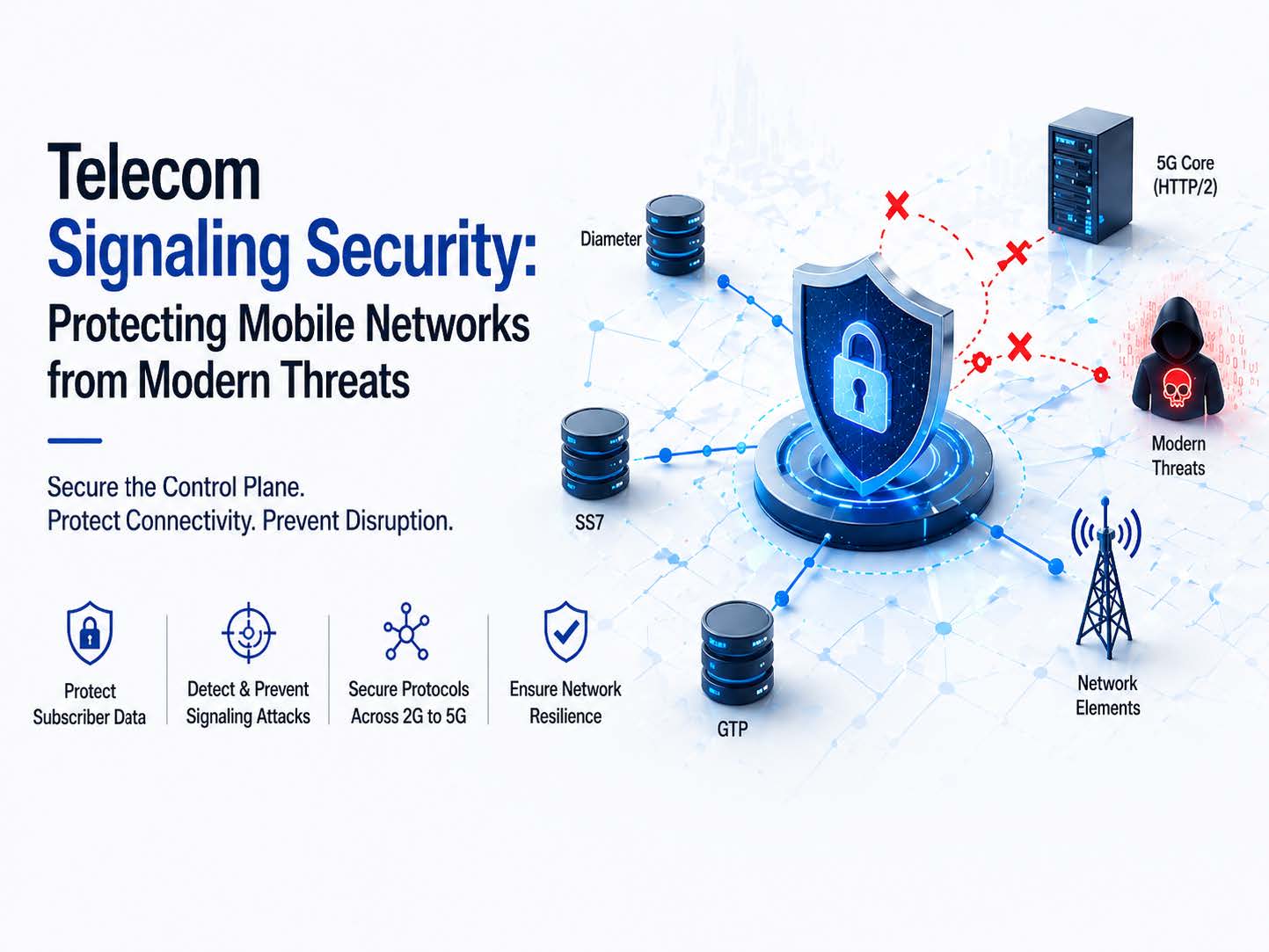
Telecom signaling refers to how networks communicate internally using protocols like:
These protocols enable everything from call routing to subscriber authentication. However, many of these systems were originally built on a trusted network model, where operators assumed all participants were legitimate.
According to ENISA, this trust-based design has led to a medium to high level of risk in signaling systems, requiring immediate attention from telecom operators.
As telecom networks evolved from 2G to 5G, signaling became more complex—but not necessarily more secure.
Protocols like SS7 were never designed with modern threats in mind. GSMA notes that SS7 lacks strong authentication and encryption, making it vulnerable to:
Even newer protocols like Diameter and GTP inherit similar issues. Vulnerabilities exist across Diameter signaling messages, GTP session management, and cross-network interactions. Attackers today actively exploit SS7, Diameter, and GTP signaling vulnerabilities to gain unauthorized access to mobile networks.
Modern signaling attacks are no longer theoretical—they are actively exploited.
Attackers exploit SS7 vulnerabilities to intercept OTPs and bypass authentication systems. This directly impacts subscriber data protection in telecom networks.
Unauthorized signaling requests can reveal real-time user locations without consent, creating major privacy and compliance concerns.
Signaling overload or malicious requests can:
Telecom networks experience continuous signaling-based attacks targeting critical infrastructure.
Attackers combine vulnerabilities across protocols—SS7 into Diameter into 5G, and GTP into the core network—making control plane security in telecom more complex than ever.
To defend against these risks, telecom operators must go beyond basic monitoring. This is where signaling security testing becomes essential.
Testing helps detect weaknesses in:
Security testing enables operators to:
Testing ensures authentication flows are secure, subscriber data is not exposed, and network trust is maintained.
Telecom security frameworks (GSMA, 3GPP) require continuous signaling vulnerability assessment, protocol-level testing, and risk-based validation.
5G introduces a new architecture built on Service-Based Architecture (SBA), API-driven communication, and HTTP/2-based signaling. While this improves flexibility, it also introduces API security risks in 5G networks.
ENISA highlights that 5G security depends heavily on proper implementation of signaling and control plane protections aligned with 3GPP standards.
Modern telecom networks require a proactive approach. Operators must implement:
This ensures telecom network disruption prevention, stronger authentication systems, and improved mobile network security testing outcomes.
Telecom signaling systems are no longer just operational layers—they are critical security boundaries.
As networks evolve, attackers are increasingly targeting signaling protocols to exploit trust gaps and disrupt services.
By adopting proactive telecom signaling security testing, operators can protect subscriber data, prevent network disruption, and build resilient telecom infrastructure for the future.