Blog
.png)
Every time a user browses the internet on mobile data, streams a video, or uses an app — there's an invisible system ensuring that data flows seamlessly across the network. That system is powered by GPRS Tunneling Protocol (GTP).
While most discussions around telecom security focus on authentication or signaling, GTP operates deeper inside the network — handling how user data travels between network nodes. And that's exactly why it has become a major target.
Today, GTP security testing is critical for protecting telecom core networks from data interception, fraud, and service disruption.
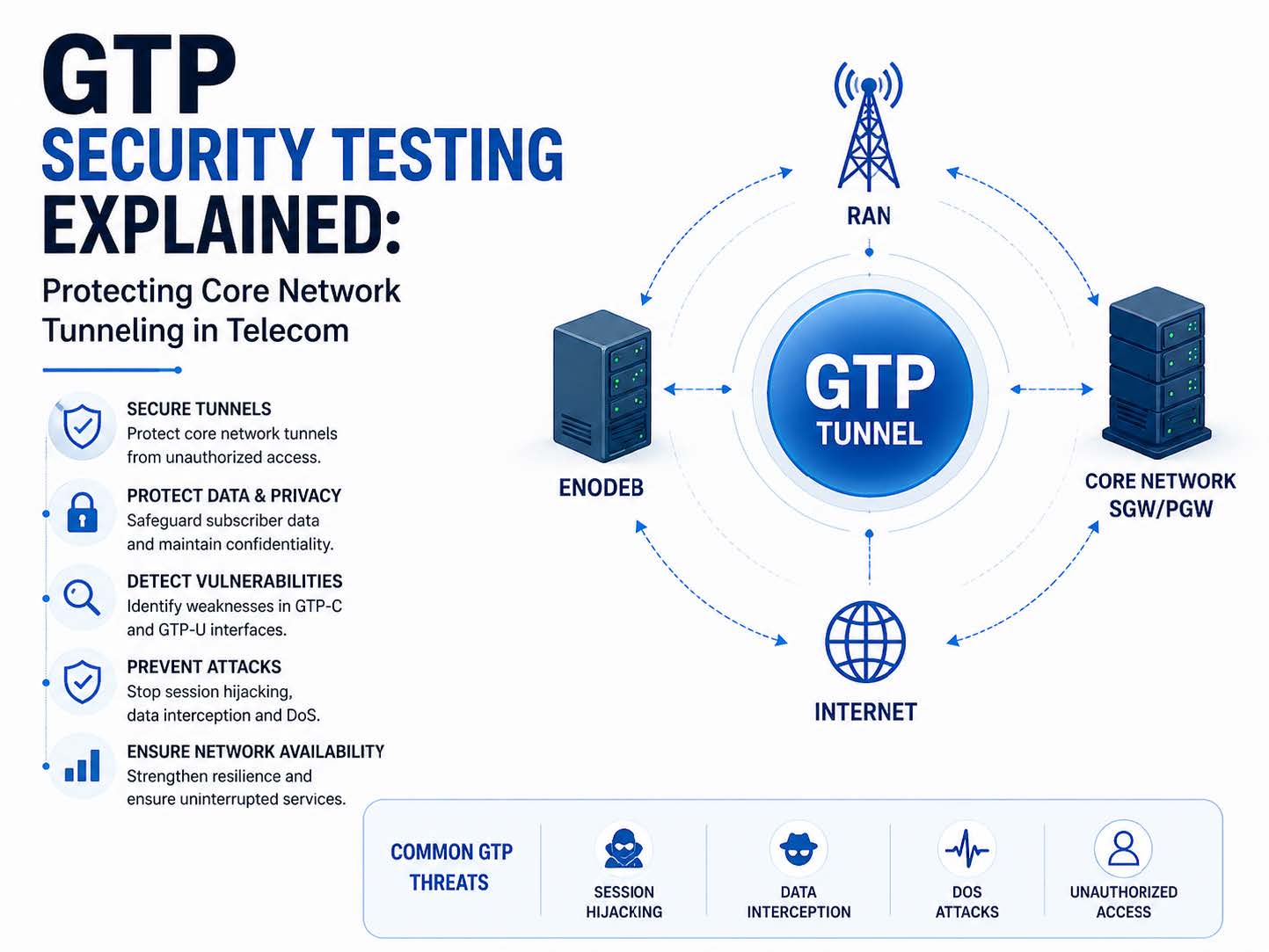
GTP is the protocol responsible for tunneling user data between different parts of the mobile network — from base stations to core network gateways.
It plays a central role across:
Technically, GTP consists of:
As defined in telecom standards, GTP enables seamless mobility by ensuring users stay connected even when moving across network locations.
Unlike newer protocols, GTP was not originally designed with strong security controls. In fact, studies show that:
This makes it highly vulnerable to exploitation. Research indicates that a large number of telecom networks remain exposed to GTP-based attacks, including fraud and denial-of-service scenarios.
Key Insight: GTP is not just a data transport protocol — it is a critical security blind spot in telecom networks.
Attackers can manipulate GTP control messages to take over active sessions, redirect traffic, or impersonate subscribers. This happens by injecting or replaying GTP-C messages.
By crafting malicious GTP requests, attackers can create fake sessions, bypass billing systems, and access network resources without authorization.
Since GTP-U carries raw user data, attackers can intercept traffic, inject malicious packets, and redirect user sessions — directly impacting subscriber data protection in telecom networks.
Flooding GTP requests can overload core network elements, disrupt services, and impact entire regions. Reports show that GTP-based DoS attacks can significantly degrade network performance.
GTP does not natively provide strong authentication, encryption, or traffic validation — making it inherently vulnerable unless additional protections are applied.
The impact goes beyond technical risks.
Business Impact:
Customer Impact:
Network Impact:
GTP security testing is the process of identifying vulnerabilities in GTP-based communication within telecom networks. It involves:
This is a key part of telecom network security testing.
Testing uncovers misconfigured gateways, weak access controls, and unintended exposure points within the network.
It helps stop session hijacking, fraudulent access, and data interception before they cause damage.
By validating GTP-C behavior, operators can improve control plane security in telecom environments.
GTP testing aligns with GSMA FS.20 guidelines and 3GPP security frameworks — the standards that define how operators should secure GTP communication.
To reduce risk, telecom operators should adopt the following practices:
Continuous Security Testing
Network Segmentation & Access Control
GTP Firewall Deployment
Traffic Monitoring & Analytics
Encryption & Integrity Controls
Even though GTP lacks native encryption, additional layers can help ensure telecom encryption and message integrity.
Even in 5G networks, GTP is still widely used — especially in hybrid architectures. This means:
Studies show that GTP vulnerabilities continue to affect modern 5G deployments due to shared infrastructure.
GTP plays a foundational role in telecom networks — but also represents one of the most overlooked security risks. As networks evolve, operators must go beyond traditional security approaches and adopt proactive GTP security testing strategies.
By doing so, they can protect subscriber data, prevent network disruption, and ensure long-term resilience in modern telecom ecosystems.