Blog
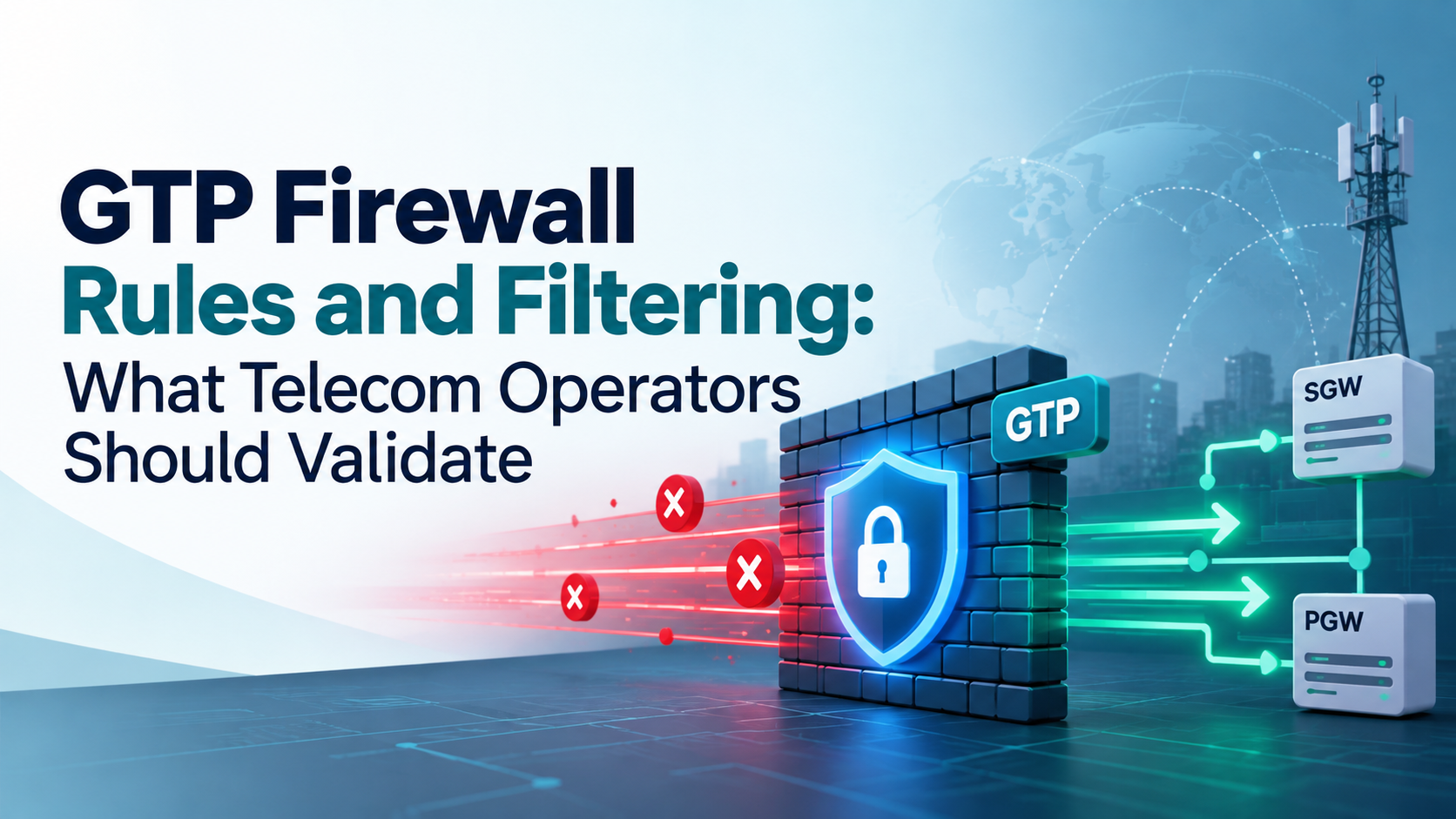

Telecom operators depend on reliable signaling and data connectivity to deliver mobile services. In 4G LTE networks, the GPRS Tunneling Protocol (GTP) supports communication between core network elements, making its security an important part of mobile core network protection.
However, deploying a GTP firewall is only one part of the solution. Its effectiveness depends on whether firewall rules accurately reflect the operator’s network architecture, trusted connections and permitted signaling behavior.
GTP firewall rules determine which traffic is allowed, which messages require validation and which communication attempts should be rejected or investigated. Incorrect or overly permissive rules can leave network interfaces exposed, while overly restrictive policies may disrupt legitimate services.
This guide explains the key GTP filtering rules and security checks telecom operators should validate to strengthen GTP firewall protection.
A GTP firewall acts as a protocol-aware security control that can inspect GTP traffic and enforce policies according to its supported capabilities. Unlike basic network filtering, protocol-aware inspection can evaluate GTP message attributes and apply controls specific to the protocol.
Effective GTP firewall security helps operators reduce unauthorized access, restrict unexpected signaling and improve visibility into potentially malicious activity.
Poorly configured rules can create several risks:
A well-maintained mobile core firewall should therefore combine network-level restrictions with appropriate protocol validation, monitoring and regular configuration reviews.
Peer allowlisting is a foundational element of GTP firewall configuration. Operators should define which network peers are authorized to communicate across each protected interface.
Validation should include:
GTP peer validation should not rely on source IP addresses alone where stronger identity or trust controls are supported and appropriate. A message from an expected address is not automatically legitimate.
GTP message filtering helps control which protocol messages are permitted in a particular network context.
Operators should validate that rules allow messages required for legitimate network functions while restricting unexpected or inappropriate message types. The applicable rules differ depending on the interface, protocol version and network role.
For example, GTP-C supports control-plane procedures such as session creation, modification and deletion, whereas GTP-U carries user-plane data. Filtering policies should reflect these different purposes rather than treating all GTP traffic as equivalent.
Rules should be checked against the operator’s architecture and relevant protocol specifications. Incorrect message restrictions can affect service availability, so testing must cover legitimate signaling flows before changes are deployed.
GTP traffic filtering should reflect where traffic originates, where it is going and why the communication is required.
Operators should review:
These checks help reduce the exposed attack surface and prevent traffic from reaching network elements that do not need to receive it.
A telecom signaling firewall should enforce policies suited to the signaling relationships and trust boundaries of the operator’s environment.
GTP protocol filtering should assess more than whether a packet comes from a permitted source. Where supported, the firewall should validate protocol structure, required fields and message attributes against the applicable rules.
Operators should check how the firewall handles:
Validation behavior should be documented and tested. Operators must also consider legitimate protocol variations and vendor-specific requirements to avoid unnecessary service interruptions.
Even sound filtering policies can become ineffective when configuration changes are not properly managed.
During a GTP firewall configuration review, operators should examine rule order, default actions, duplicate policies, broad permissions and temporary exceptions.
A useful approach is to:
The goal is to ensure that GTP filtering rules remain aligned with the actual network architecture rather than gradually expanding into overly permissive policies.
Firewall rules help enforce policy, but operators also need visibility into how traffic behaves.
GTP signaling monitoring can help identify repeated policy violations, unexpected peer activity, unusual message volumes and other suspicious patterns.
Operators should confirm that relevant events are logged, alerts reach the appropriate security teams and monitoring systems retain sufficient context for investigation.
GTP anomaly detection can support the identification of deviations from normal traffic behavior. Combined with GTP traffic analysis, it helps security teams investigate potential threats and improve their understanding of network activity.
Effective GTP security monitoring should balance useful detection with alert quality. Excessive false positives can make genuine incidents harder to identify.
Configuration reviews should be supported by authorized security testing. Operators should verify that permitted traffic continues to function and that prohibited traffic is handled as intended.
Testing may include approved checks of peer restrictions, message validation, interface exposure, rule enforcement, logging and alert generation.
Findings should be documented with their impact, evidence, recommended remediation and retest results. This process helps confirm whether the implemented GTP security controls work as expected.
Before approving a GTP firewall policy or configuration change, operators can use this checklist:
GTP firewall protection is an important preventive control, but firewall configuration alone cannot establish the security of an entire mobile core network.
A broader assessment examines exposed interfaces, protocol handling, network configuration, trust relationships and potential weaknesses that may exist beyond the firewall. Authorized penetration testing can help validate whether identified weaknesses are exploitable within the agreed scope.
For this reason, GTP firewall security should be supported by periodic security reviews, vulnerability assessments, controlled testing and continuous monitoring.
To understand the wider testing process, explore GTP Security Testing Explained or learn about Matrix Shell’s Signaling Security Testing services.
Well-defined GTP firewall rules help telecom operators restrict unauthorized traffic, validate signaling messages and protect critical mobile core network interfaces.
By reviewing allowlists, permitted message types, interface-specific filtering, peer validation, configuration exceptions and monitoring behavior, operators can improve the effectiveness of their firewall policies.
The strongest approach combines carefully configured filtering with regular security assessments, authorized testing and ongoing monitoring. This helps operators identify gaps, validate their defenses and maintain a more resilient mobile core network.