Blog
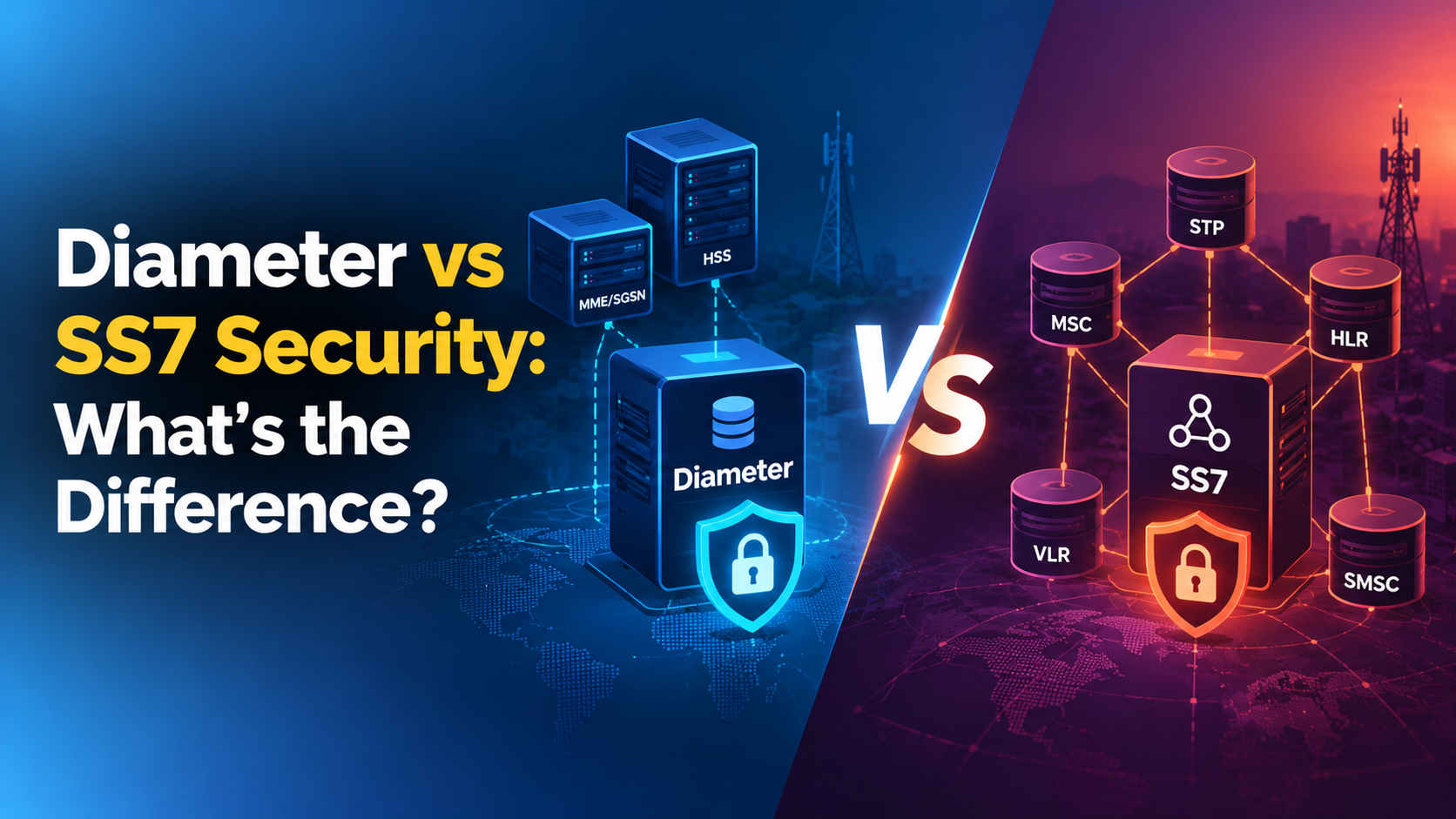

Mobile networks rely on signaling protocols to authenticate subscribers, manage mobility, route communications, and exchange information between network functions. Two important protocols in this area are Signaling System No. 7 (SS7) and Diameter.
SS7 has traditionally supported 2G and 3G mobile networks, while Diameter plays a central role in 4G/LTE networks. Although Diameter introduced a more modern, IP-based signaling architecture, it did not eliminate signaling security risks.
Understanding Diameter vs SS7 security helps telecom operators identify protocol-specific vulnerabilities, protect subscriber information, and plan security controls across legacy and modern network environments.
This guide compares SS7 and Diameter security, explains their major differences, and explores how SS7 Diameter 5G security considerations affect operators transitioning to 5G.
SS7 is a signaling protocol suite used by telecommunications networks to exchange information required for call routing, SMS delivery, mobility management, and other services.
SS7 security focuses on protecting this signaling from unauthorized access, manipulation, and abuse.
Common SS7 security risks include:
Historically, SS7 networks relied heavily on trusted relationships between telecommunications operators. As connectivity expanded and signaling became accessible through more interconnection environments, weaknesses in trust and filtering created opportunities for abuse.
Effective SS7 security requires appropriate signaling firewalls, filtering policies, monitoring, access restrictions, and regular security assessments.
Diameter is an IP-based protocol framework used in 4G/LTE networks for authentication, authorization, accounting-related functions, and communication between network elements.
It supports several LTE interfaces, including S6a for communication between the Mobility Management Entity (MME) and Home Subscriber Server (HSS).
Diameter security focuses on protecting these signaling exchanges from unauthorized requests, message manipulation, information exposure, and service disruption.
Common Diameter security risks include:
Diameter supports security mechanisms for peer communication, but secure deployment depends on appropriate configuration, authorization, filtering, and monitoring.
The important distinction is that SS7 and Diameter have different architectures and attack surfaces, but both require strong signaling security controls.
It is not accurate to declare one protocol universally more secure than the other based on protocol design alone.
Diameter was developed for IP-based network environments and supports capabilities such as peer authorization and secure transport options. However, these capabilities must be implemented and configured correctly.
SS7 operates within a different signaling architecture and has well-documented risks associated with trust relationships and signaling access.
The actual security posture of either protocol depends on factors such as:
For operators, the better question is not simply which protocol is more secure, but whether the signaling environment is appropriately protected against its relevant threats.
1. Subscriber Location Tracking
SS7 vulnerabilities can allow attackers with suitable signaling access to abuse mobility-related procedures and obtain subscriber location information.
Diameter environments can also expose location-related information if access controls or signaling restrictions are inadequate.
In both cases, operators should restrict unauthorized requests and monitor unusual signaling patterns.
2. Subscriber Information Exposure
SS7 and Diameter signaling can support functions involving subscriber identities and network-related information.
Weak access controls may expose this information to unauthorized parties.
Diameter security controls should focus on authorized peers, application restrictions, message validation, and protection of subscriber-related signaling.
3. Message Manipulation
Both protocols can be abused when signaling messages are not appropriately validated or restricted.
The specific attack methods differ because SS7 and Diameter use different message structures and network procedures.
Operators should implement protocol-aware filtering and validate signaling against expected behavior.
4. Denial-of-Service Attacks
Excessive signaling requests can affect network availability.
SS7 and Diameter environments should monitor unusual traffic volumes, repeated requests, connection behavior, and other signs of signaling abuse.
Rate controls and filtering can help reduce risk, although no single control can prevent every denial-of-service scenario.
The transition to 5G introduces new network architecture and security requirements, but it does not automatically remove the risks associated with legacy signaling.
5G standalone core networks use service-based interfaces, including HTTP/2-based communication between network functions. The 5G architecture also introduces security mechanisms that differ from those used in earlier generations.
However, operators may continue to support 2G, 3G, or 4G services, roaming arrangements, and interworking between generations.
This makes SS7 Diameter 5G security an important consideration during migration.
Operators should consider:
Diameter security in 5G depends on the deployment and the network functions involved.
Diameter remains relevant in legacy LTE environments and may continue to support services or interworking arrangements as operators introduce 5G.
At the same time, 5G core security requires controls designed for its service-based architecture and interfaces.
Operators should avoid treating 5G security as simply an extension of Diameter security. Each protocol and interface requires controls appropriate to its design and deployment.
A practical strategy includes:
Whether protecting SS7, Diameter, or a mixed-generation environment, operators should adopt a layered security approach.
For SS7:
For Diameter:
Across network generations:
The comparison of Diameter vs SS7 security highlights an important principle: modernizing a network does not remove the need for protocol-specific security.
SS7 and Diameter have different architectures, interfaces, and threat patterns, but both can expose subscriber information or affect network availability when signaling controls are inadequate.
As operators move toward 5G, SS7 vs Diameter security remains relevant because legacy signaling may coexist with newer service-based interfaces.
A comprehensive SS7 Diameter 5G security strategy should address legacy exposure, LTE signaling, roaming, interconnects, and 5G-specific security requirements.
By combining appropriate firewalls, access controls, monitoring, and regular security testing, telecom operators can strengthen Diameter security in 5G environments while protecting the legacy services that remain in operation.