
Blog
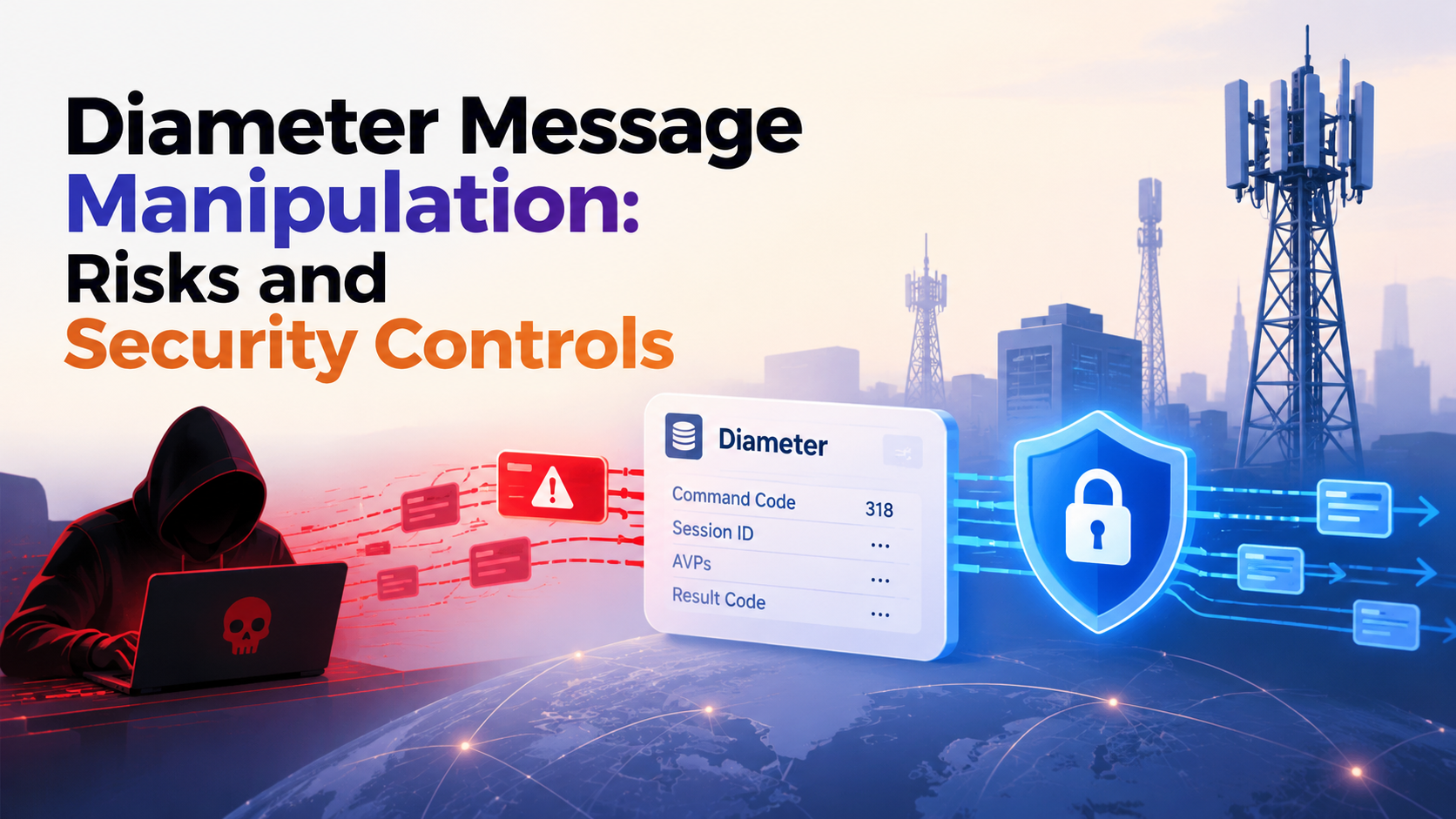

Diameter is a core signaling protocol used extensively in 4G/LTE networks for authentication, authorization, mobility management, subscriber services, and roaming. Its messages carry information that can influence how critical network elements process authentication, mobility, and subscriber-related requests.
This makes Diameter message manipulation an important security concern.
If Diameter messages are modified, forged, or generated without proper authorization, the resulting activity can potentially affect network behavior or expose sensitive information. These risks become particularly relevant when Diameter signaling crosses operator boundaries through roaming and interconnect networks.
The GSMA maintains dedicated Diameter Interconnect Security guidance that addresses potential Diameter-based attacks and countermeasures for LTE and 5G interconnection environments.
Diameter message manipulation refers to unauthorized modification, generation, or alteration of Diameter signaling messages or their parameters.
Diameter messages contain a header and a collection of Attribute-Value Pairs (AVPs). These fields communicate information between Diameter clients, agents, and servers.
Depending on the application, messages can contain information related to:
The security concern arises when an unauthorized party can influence these messages or cause network elements to accept signaling that should not be trusted.
RFC 6733 requires Diameter implementations to perform message validation, including validation of message headers and relevant routing AVPs when messages are relayed.
The potential impact depends on which message is manipulated, which AVPs are affected, which network element processes it, and what authorization controls exist.
Possible consequences can include:
Not every malformed or manipulated message will result in a successful attack. The actual risk depends on the operator's architecture, implementation, filtering, authentication, and monitoring controls.
This is why Diameter security vulnerabilities should be evaluated in the context of the complete signaling environment rather than a single protocol field.
Attribute-Value Pairs carry much of the information used by Diameter applications.
An attacker may attempt to manipulate:
RFC 6733 notes that Diameter AVPs can contain security-sensitive information, including location data, network addresses, cryptographic keys, and user-related information.
Therefore, AVP validation should be an important part of Diameter security testing.
Diameter messages contain information identifying their origin and intended destination.
If these values are not appropriately validated, an attacker may attempt to influence where a message appears to originate from or where it should be routed.
Security controls should verify:
The goal is to ensure that signaling is processed only when it comes from an authorized source and follows an expected routing path.
Diameter supports multiple applications and command types.
An attacker may attempt to generate unexpected combinations of:
The receiving network element should validate whether a particular peer is authorized to use the requested application and command.
RFC 6733 requires Diameter sessions to be routed only through authorized nodes that advertise the relevant supported applications.
Diameter spoofing and message manipulation are closely related but are not identical.
Diameter spoofing focuses on making a connection or signaling appear to originate from a trusted peer.
Message manipulation focuses on changing or generating signaling content.
An attacker may attempt to combine both approaches—for example, presenting itself as an authorized source while sending manipulated messages.
This is why peer authentication and message validation need to work together.
RFC 6733 requires peer authorization in addition to authentication: a peer may be authentic but still not be authorized to act in a particular Diameter role.
In LTE networks, Diameter is used across multiple interfaces and applications.
One important example is the S6a interface, which supports signaling between the MME and HSS.
A security assessment can evaluate whether unauthorized or manipulated signaling could affect:
Other Diameter interfaces may also need assessment depending on the operator's architecture.
Therefore, LTE Diameter vulnerabilities should not be assessed only at the transport layer. Application behavior and message validation are equally important.
Message manipulation can be connected to several broader Diameter attack vectors.
Unauthorized signaling
An attacker attempts to send requests that should only originate from an authorized network element.
Diameter spoofing
An attacker attempts to impersonate or appear to be a trusted Diameter peer.
Subscriber information exposure
Manipulated or unauthorized requests may attempt to obtain sensitive subscriber-related information.
Profile misuse
Unauthorized signaling may attempt to influence subscriber-related procedures.
Diameter DoS
Large volumes of manipulated or malformed messages may contribute to resource exhaustion or service disruption.
These scenarios demonstrate why message validation should be combined with access control and traffic filtering.
Diameter DoS, or Diameter denial of service, is primarily an availability concern.
Message manipulation can contribute to DoS risk when attackers generate excessive, malformed, or resource-intensive signaling.
Security testing can evaluate whether network controls can identify and respond to:
Operators can use rate controls, filtering, connection controls, monitoring, and alerting to reduce exposure.
A layered approach is generally more effective than relying on one security mechanism.
1. Strong Peer Authentication
Only approved Diameter peers should be able to establish trusted connections.
2. Peer Authorization
Authentication should be followed by authorization checks to confirm that the peer is permitted to perform the claimed Diameter role.
3. Protected Transport
RFC 6733 specifies that Diameter must not be used without TLS, DTLS, or IPsec protection.
4. Message Validation
Validate headers, routing information, commands, Application IDs, and AVPs.
5. Diameter Firewall and Filtering
Filter signaling based on trusted peers, applications, message types, AVPs, and network policy.
6. Network Segmentation
Restrict which systems can reach critical Diameter infrastructure.
7. Monitoring and Alerting
Monitor for unexpected peers, abnormal signaling volumes, invalid messages, and policy violations.
8. Regular Security Testing
Conduct vulnerability assessments and controlled penetration testing to validate whether security controls work as intended.
A Diameter security assessment can combine several testing activities.
Architecture Review
Identify Diameter nodes, peers, interfaces, applications, routing paths, and trust relationships.
Configuration Review
Check peer authentication, authorization, transport security, filtering, access control, and network exposure.
Message Validation Testing
Use controlled test messages to verify how network elements respond to unexpected or invalid signaling.
Diameter Vulnerability Assessment
Identify weaknesses in configurations, interfaces, implementations, and security controls.
Diameter Penetration Testing
Safely simulate approved attack scenarios to determine whether selected weaknesses can be exploited.
Testing should be carefully scoped, and dedicated test subscribers or controlled environments should be used wherever appropriate to minimize the risk to live services.
GSMA's Diameter security resources emphasize an integrated approach to identifying and mitigating Diameter-related risks, including regular analysis and appropriate interconnect controls.
Diameter message manipulation is a significant security consideration because Diameter messages can influence authentication, mobility, subscriber, and network functions.
The risk becomes greater when weak peer authentication, insufficient message validation, inadequate filtering, or excessive trust exists between interconnected networks.
A strong defense therefore requires multiple layers: peer authentication, authorization, protected transport, message and AVP validation, Diameter filtering, monitoring, vulnerability assessment, and controlled penetration testing.
For telecom operators, understanding the relationship between Diameter security vulnerabilities, Diameter attack vectors, Diameter spoofing, message manipulation, and Diameter DoS is essential for building a more resilient LTE signaling environment.
Recommended internal links
For the final published version, I recommend adding:
Recommended SEO journey:
Message Manipulation → Diameter Attack Vectors → Diameter Vulnerabilities → Diameter Security Testing → Service
I have kept these as anchor recommendations rather than inventing Matrix Shell URLs.





