Blog
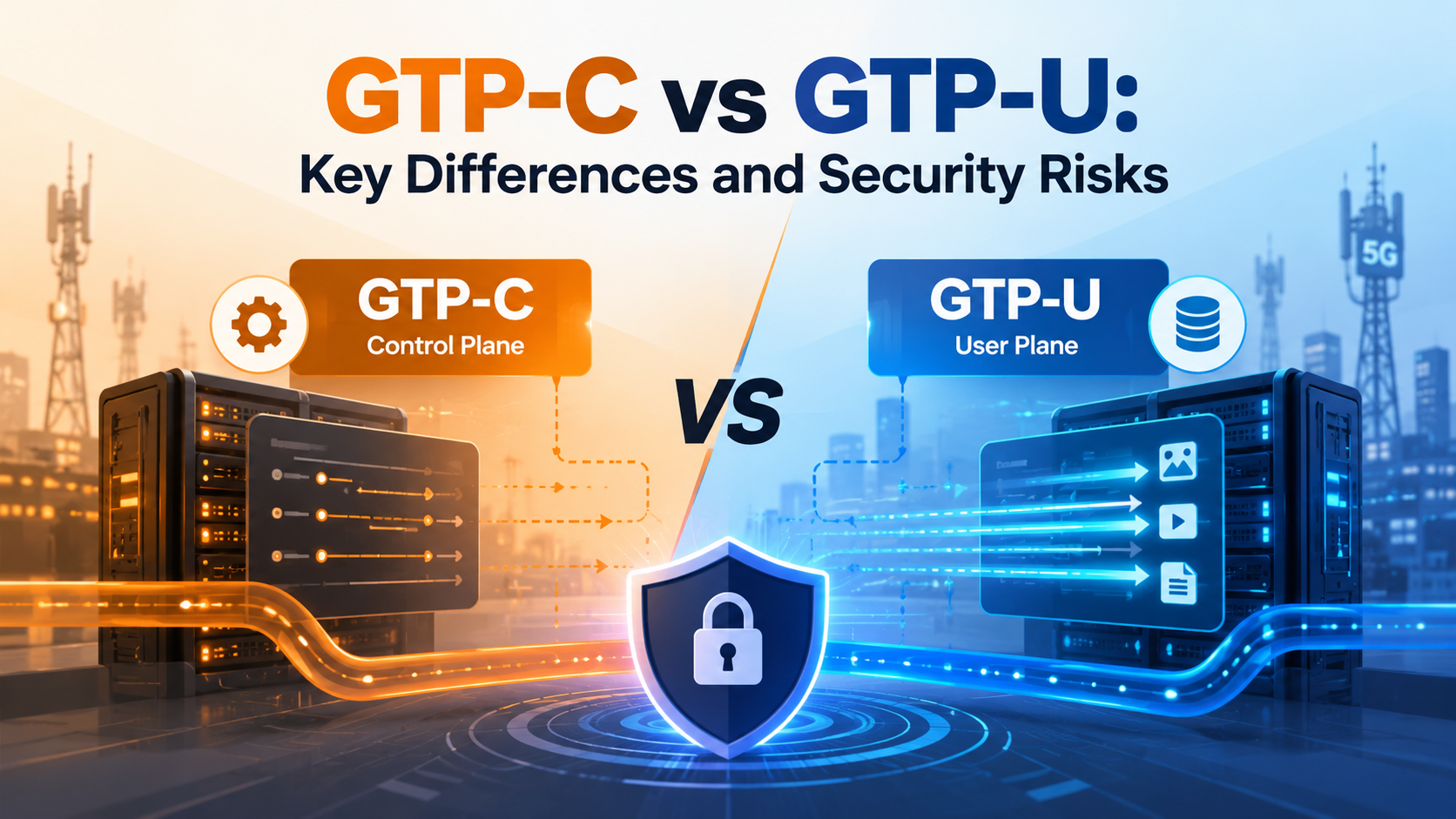

GPRS Tunnelling Protocol (GTP) plays a critical role in mobile networks by supporting subscriber data sessions, mobility and connectivity. In 4G LTE networks, GTP helps transport user data and manage the control signaling required to establish and maintain data sessions. However, understanding GTP security requires looking at two important components: GTP-C and GTP-U.
Although both belong to the GTP protocol family, they perform different functions and present different security considerations. Understanding GTP-C vs GTP-U, GTPv1 vs GTPv2, and GTP in 4G LTE helps telecom operators identify weaknesses and strengthen mobile core network security.
This article explains their differences, common vulnerabilities and the importance of GTP security testing.
GPRS Tunnelling Protocol is used in mobile network architectures to exchange control messages and carry encapsulated user traffic between network nodes. It supports packet-data services across several generations of mobile networks, including 4G LTE and relevant 5G network interfaces.
GTP establishes logical tunnels between network endpoints. These tunnels help associate traffic with the appropriate subscriber session and network context.
GTP has two important components:
Both are essential to network operation, but their responsibilities differ. Consequently, GTP control plane security and GTP user plane security require controls suited to their respective functions.
GTP-C and GTP-U work together, but they do not perform the same job. GTP-C manages session-related signaling, while GTP-U transports user traffic through established tunnels.
GTP-C communicates control messages between relevant mobile core network elements. These messages help establish subscriber sessions, manage tunnel information and modify or release existing sessions.
Weaknesses in GTP-C handling can potentially allow unauthorized or malformed requests to affect session management, consume network resources or interfere with subscriber connectivity.
GTP-C vulnerabilities may arise from insufficient peer validation, inadequate message filtering, incorrect configuration or improper handling of session information.
Operators should validate which network peers can send control messages and whether incoming requests are appropriate for the interface, session and network context.
GTP-U carries encapsulated user traffic between network nodes. In LTE, it is used on interfaces such as S1-U between the radio access network and the serving gateway, and S5/S8 user-plane paths between core network gateways.
GTP-U vulnerabilities can arise when tunnel endpoints are insufficiently protected, traffic is accepted from unauthorized sources or packets are not adequately validated.
Potential consequences include unauthorized traffic injection, tunnel misuse, service disruption and exposure of traffic-handling weaknesses. Actual impact depends on the network architecture, implementation and controls in place.
GTP-C and GTP-U therefore require complementary security measures. Protecting control signaling alone does not address every user-plane risk, and protecting data tunnels does not eliminate weaknesses in session management.
GTPv1 and GTPv2 are protocol versions associated with different control-plane and user-plane specifications. It is important not to treat the version numbers as interchangeable across these components.
GTPv1-C is associated with earlier GTP control-plane implementations, while GTPv2-C was introduced for the evolved packet system used in LTE. Both may be present in networks that support legacy and newer architectures.
GTP-U, by contrast, is specified as GTPv1-U for the relevant user-plane interfaces, including interfaces used in LTE and specified 5G systems.
For telecom operators, the practical distinction is important:
The appropriate assessment scope depends on the network topology, deployed interfaces, supported releases and interworking requirements.
GTP security risks can affect subscriber sessions, service availability and operator revenue. Common areas to investigate include:
1. Insufficient peer validation: If incoming signaling is not adequately restricted to authorized network elements, unauthorized sources may attempt to send GTP messages.
2. Weak message validation: Improper handling of message fields, identifiers or unexpected requests may create opportunities for protocol misuse.
3. Session-handling weaknesses: Incorrect validation of session context or tunnel information can increase the risk of unauthorized session manipulation.
4. Inadequate interface filtering: Network interfaces that accept unnecessary or inappropriate traffic can increase the attack surface.
5. Limited monitoring: Without suitable logging and traffic analysis, suspicious signaling patterns may remain undetected.
These risks do not automatically indicate that a network is vulnerable. Their significance must be established through architecture review, configuration checks and authorized security testing.
A structured GTP security assessment helps operators understand whether their deployed controls are effective across both control-plane and user-plane interfaces.
A comprehensive assessment may include:
GTP security testing should cover GTP-C and GTP-U wherever they are relevant to the agreed scope. Testing should be authorized, controlled and designed to avoid disruption to live subscriber services.
Matrix Shell's Signaling Security Testing service can be used as the next step for organizations seeking to evaluate signaling security risks in their telecom environments.
Effective GTP security requires a layered approach. Telecom operators should restrict signaling to authorized peers, validate messages against expected network behavior, apply appropriate interface filtering and review configurations regularly.
Monitoring should also help identify unusual signaling activity, unexpected traffic sources and patterns that warrant investigation. Periodic security assessments can validate whether existing controls remain effective as networks, roaming relationships and interconnection requirements change.
GTP remains relevant to modern mobile network environments, including specified 5G interfaces. Operators should therefore assess the GTP components present in their actual deployments rather than assuming that newer network generations remove all GTP-related risks.
Understanding GTP-C vs GTP-U is essential to identifying security risks across mobile core networks. GTP-C manages control signaling and session-related procedures, while GTP-U carries encapsulated user traffic. GTPv1 and GTPv2 also have different roles depending on the protocol component and network interface.
By reviewing GTP control plane security, GTP user plane security, peer validation, session handling and filtering, operators can identify weaknesses before they become operational problems.
A structured GTP security assessment helps turn these findings into actionable improvements that protect subscriber connectivity, service reliability and operator revenue.
Strengthen your signaling security: Explore Matrix Shell's Signaling Security Testing services to learn how a structured assessment can help identify and address GTP-related risks.