Blog

Modern mobile networks rely on signaling protocols to authenticate subscribers, manage mobility, exchange policy information, and support communication between network elements. In 4G/LTE networks, the Diameter protocol became a core signaling framework for these functions.
Understanding Diameter protocol architecture is important for telecom operators, network engineers, security teams, and anyone working with LTE core networks. The architecture defines how Diameter clients, servers, agents, applications, messages, and Attribute-Value Pairs (AVPs) work together.
This guide explains what is Diameter protocol, how Diameter in LTE is structured, how Diameter 4G nodes communicate, and how Diameter AVP values carry information between network elements.
Diameter protocol is an authentication, authorization, and accounting (AAA) protocol designed for IP-based networks. It evolved from RADIUS and provides a more extensible framework for exchanging signaling information between network elements.
In mobile networks, Diameter is used extensively within the 4G/LTE core to support functions such as:
Unlike a single-purpose signaling interface, Diameter provides a common protocol framework that can support different applications and interfaces.
This flexibility is one reason Diameter in LTE became fundamental to the EPC architecture.
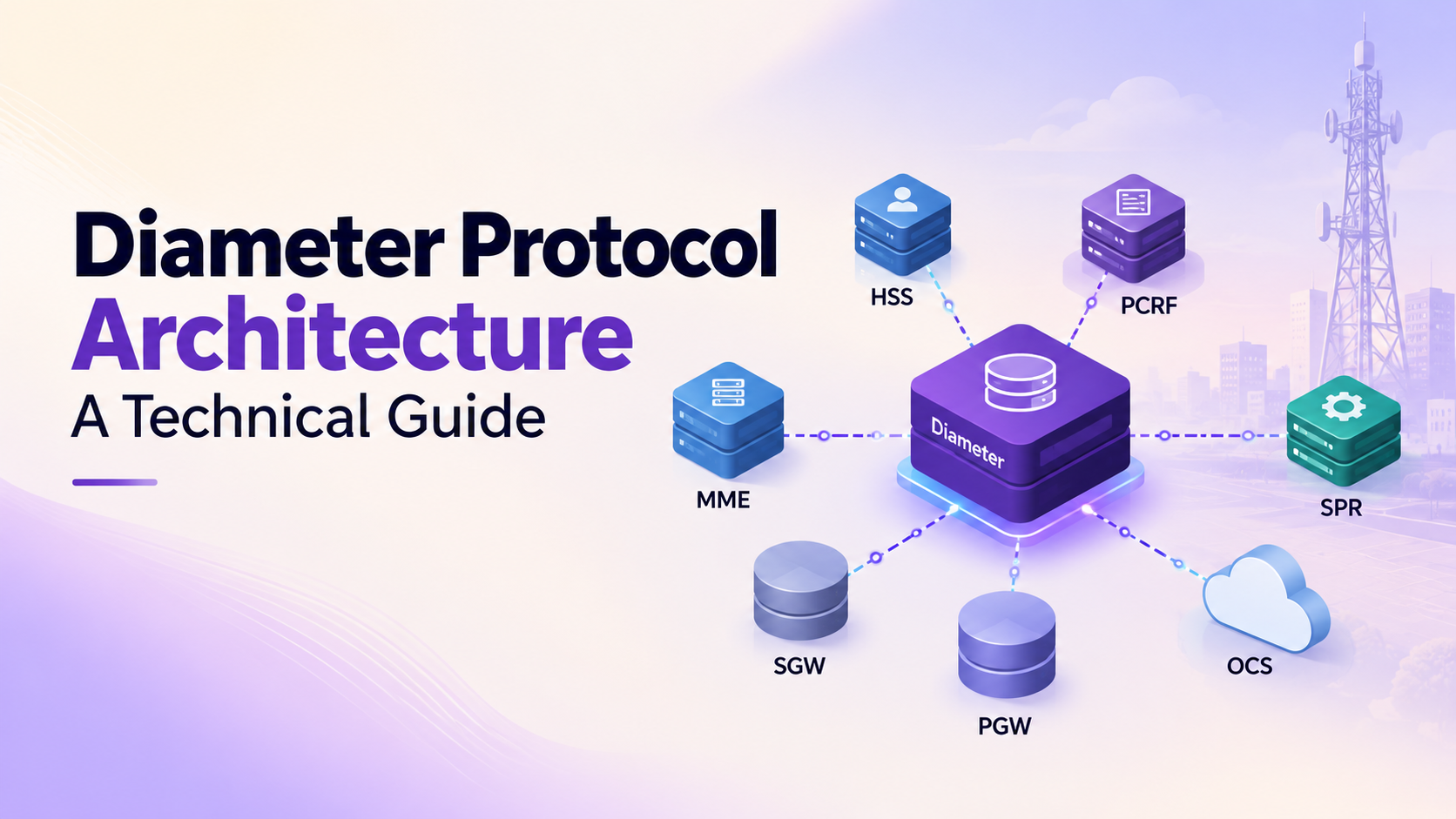
The Diameter protocol architecture consists of several logical components that work together to exchange signaling messages.
The main components include:
These components allow network elements to communicate while supporting authentication, routing, policy, charging, and subscriber-related operations.
A Diameter client is typically a network element that initiates a request.
For example, in an LTE network, an MME can act as a Diameter client when it sends authentication or subscriber-related requests toward the HSS over the S6a interface.
The client generates a Diameter request and receives a corresponding response.
A Diameter server processes Diameter requests and provides the information or authorization required by the requesting network element.
In LTE, the Home Subscriber Server (HSS) is an important example. The HSS maintains subscriber-related information and supports authentication and authorization functions.
The client-server relationship therefore enables network elements to exchange subscriber and authentication information through Diameter signaling.
A Diameter agent can sit between Diameter peers and help route or process signaling traffic.
Common types include:
A Diameter Edge Agent (DEA) can also be deployed at network boundaries to control Diameter traffic between trusted and external networks.
This becomes particularly important for Diameter 4G roaming and interconnect environments, where signaling may cross operator or network-provider boundaries.
Diameter peers are network elements that communicate directly using Diameter.
A peer relationship establishes how two Diameter nodes communicate and exchange messages.
In practical deployments, peer configuration and authorization are important because unauthorized or incorrectly configured peers can create security and routing risks.
The Diameter base protocol provides the underlying communication framework, while Diameter applications define how it is used for specific network functions.
Examples of Diameter applications in LTE include:
This application-based architecture allows Diameter to support different functions while maintaining a common protocol foundation.
Diameter communication is based on request and answer messages.
A typical exchange follows this basic sequence:
Network Element A → Diameter Request → Network Element B
Network Element B → Diameter Answer → Network Element A
The request contains information needed by the receiving node to process the operation. The answer communicates the result.
For example, during an LTE authentication procedure, an MME may send a Diameter request to the HSS. The HSS processes the request and returns the required subscriber or authentication information.
A Diameter AVP (Attribute-Value Pair) is one of the most important building blocks of Diameter messages.
An AVP contains information associated with a specific attribute.
Conceptually, it can be represented as:
AVP = Attribute + Value
Examples of information carried through AVPs can include:
Diameter messages can contain multiple AVPs, allowing complex signaling information to be exchanged within a structured message.
Because AVPs can carry sensitive subscriber and network information, their validation and handling are important from a security perspective.
To understand Diameter in LTE, consider the S6a interface.
A simplified flow is:
UE → eNodeB → MME → Diameter/S6a → HSS
The MME communicates with the HSS using Diameter signaling to support subscriber authentication and mobility-related functions.
The process broadly involves:
This illustrates how Diameter 4G architecture connects signaling functions across different components of the LTE core.
Diameter supports routing between network elements using information contained in Diameter messages.
Important routing-related information can include:
Diameter agents can use this information to determine where a message should be forwarded.
This becomes particularly important in large operator environments and roaming scenarios, where messages may pass through multiple Diameter nodes or intermediary networks.
The architecture of Diameter directly influences the security of an LTE network.
A poorly secured Diameter environment can expose risks involving:
Security therefore needs to be considered across the entire architecture—not only at individual Diameter nodes.
Operators should evaluate peer configuration, transport security, message validation, AVP handling, routing controls, access control, monitoring, and interconnect security.
A structured Diameter security assessment can help identify weaknesses across these areas.
Understanding Diameter protocol architecture provides the foundation for understanding how 4G/LTE signaling operates.
From Diameter clients and servers to agents, applications, messages, and Diameter AVP, each component contributes to the exchange of signaling information across the LTE core.
For telecom operators, understanding Diameter in LTE and Diameter 4G architecture is also essential from a security perspective. The same interfaces and signaling paths that enable authentication, mobility, charging, and roaming can introduce risks if they are improperly configured or insufficiently protected.
A clear understanding of the architecture therefore provides the starting point for evaluating Diameter vulnerabilities, interconnect exposure, and overall Diameter security.

Case Study