
Blog
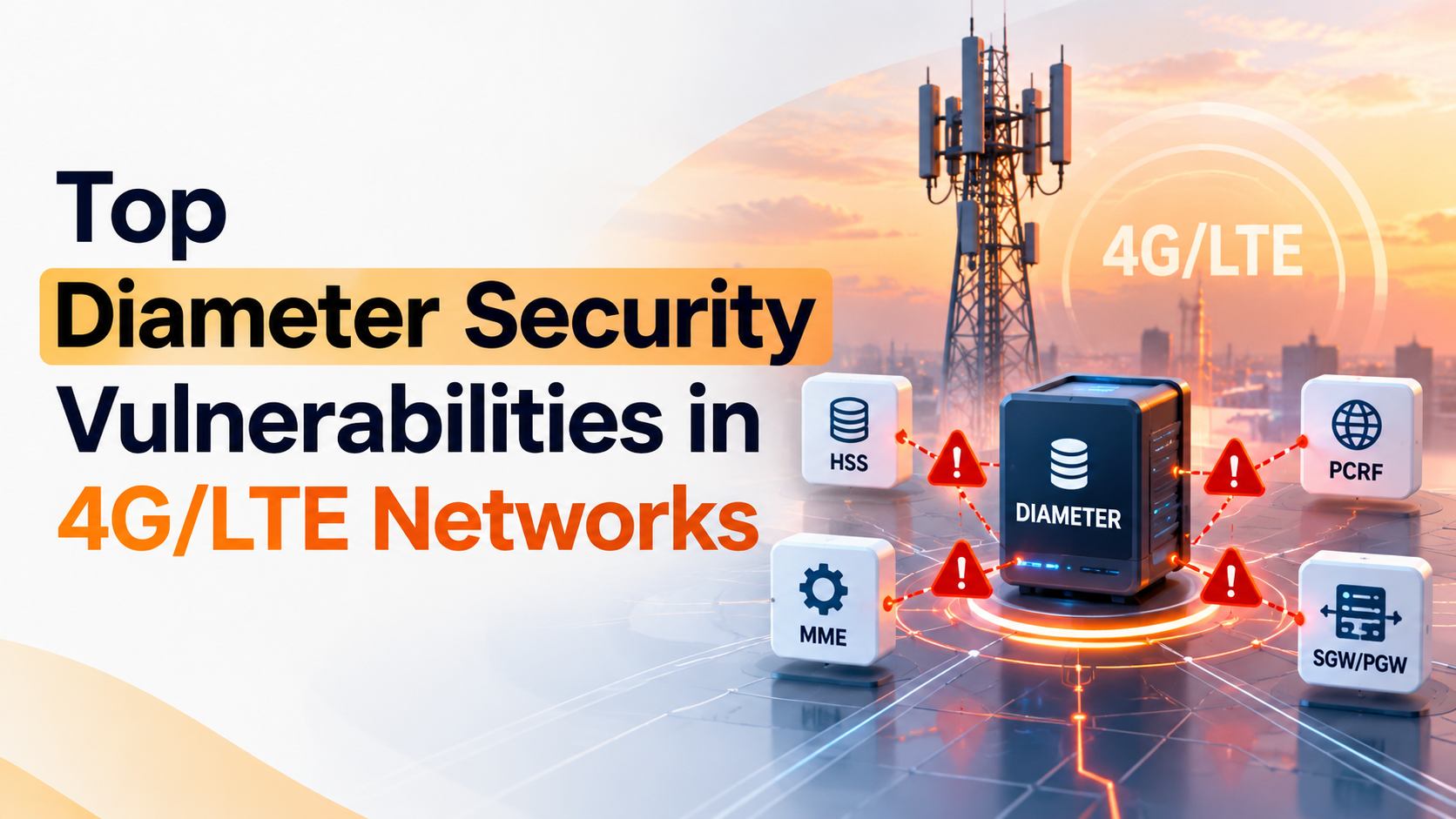

Diameter is a core signaling protocol used extensively in 4G/LTE networks for authentication, authorization, mobility management, subscriber services, and roaming. It was designed to provide stronger capabilities than older signaling technologies, but its security depends heavily on how operators configure, protect, and monitor Diameter signaling.
This is why Diameter security vulnerabilities remain an important concern for telecom operators.
The potential exposure becomes particularly significant when Diameter signaling crosses operator boundaries through roaming and interconnect environments. GSMA maintains dedicated guidance on Diameter Interconnect Security, covering potential Diameter-based attacks and countermeasures for LTE and 5G interconnections.
So, what are the most important vulnerabilities and Diameter attack vectors operators should understand?
Diameter is not inherently an insecure protocol. The IETF Diameter specification requires protected transport using TLS, DTLS, or IPsec. However, security can still be weakened by implementation choices, configuration gaps, excessive trust between peers, insufficient filtering, or inadequate validation of signaling messages.
In practice, the security of a Diameter environment depends on multiple layers:
A weakness in any of these areas can create an opportunity for abuse.
Diameter message manipulation occurs when an attacker is able to interfere with signaling messages or cause a network element to process unexpected or unauthorized information.
Potentially affected information can include:
The risk is particularly important because Diameter messages can trigger actions within critical network elements.
RFC 6733 specifies validation requirements for Diameter messages, including validation of message headers and relevant routing AVPs when messages are relayed.
Security testing should examine whether:
This makes message validation an important part of Diameter security testing.
Diameter spoofing refers to attempts to make a message or connection appear to originate from a trusted Diameter peer or authorized network element.
Because Diameter environments rely on relationships between network elements, weak peer authentication or authorization can increase this risk.
Potential attack scenarios may involve:
RFC 6733 requires Diameter peers to establish secured communications and includes peer authorization requirements.
Operators can strengthen controls through:
A Diameter security assessment can help determine whether these controls are correctly implemented.
Another important category of Diameter security vulnerabilities involves unauthorized access to signaling functions.
An attacker who gains access to a Diameter environment may attempt to send requests that should only originate from specific network elements.
The consequences depend on the interface, application, and permissions involved.
Security testing should therefore determine:
This is especially important for externally connected Diameter environments.
Diameter signaling can carry information associated with subscribers and network services.
Weak access controls, inadequate filtering, or improper message validation could create opportunities for unauthorized access to subscriber-related information.
Potential risks may involve:
A Diameter assessment should evaluate whether sensitive information can be requested outside the intended authorization model.
The goal is not simply to identify whether information exists in signaling messages, but whether unauthorized parties could gain access to it.
Some Diameter attack vectors can involve mobility-related signaling and location information.
In an inadequately protected environment, unauthorized signaling may potentially be used to obtain information associated with a subscriber's network location or mobility state.
This is one reason why Diameter security is not only an infrastructure concern—it can also have privacy implications.
Operators should assess:
Diameter supports several subscriber-management and authentication-related procedures.
If an attacker can generate unauthorized signaling with sufficient privileges, they may attempt to influence subscriber-related network behavior.
GSMA-published research has documented examples involving S6a messages that could affect subscriber availability or profile-related state in vulnerable environments.
This demonstrates why LTE Diameter vulnerabilities should be evaluated at the application and interface level rather than only at the transport layer.
Security testing can assess whether unauthorized requests involving subscriber procedures are correctly restricted and filtered.
Diameter DoS, or Diameter denial of service, is another important risk.
Diameter infrastructure depends on network elements processing signaling requests within available resources. An excessive volume of requests, malformed messages, or resource-intensive signaling could potentially affect availability.
A Diameter DoS assessment can examine:
The exact impact depends on the architecture, implementation, traffic volume, and security controls deployed by the operator.
GSMA materials identify interconnect and signaling-based DoS as a documented telecom attack vector, while GSMA's Diameter security resources specifically address Diameter-based attacks and countermeasures.
Diameter's security requirements include protected transport, but deployment quality matters.
RFC 6733 states that Diameter must not be used without TLS, DTLS, or IPsec.
A security review should therefore examine:
Transport security alone, however, does not address every Diameter risk.
GSMA has noted that Diameter interconnection environments require additional security measures beyond basic peer-to-peer protection.
Message filtering is an important defense against many Diameter attacks.
A Diameter firewall or signaling security control can evaluate whether a message is:
GSMA's Diameter security material identifies filtering of signaling messages as an important security measure for Diameter environments.
Without appropriate filtering, simply allowing trusted peers to communicate may provide insufficient protection.
Roaming creates an additional trust boundary because Diameter signaling may travel between different operators and through interconnect providers.
This can introduce Diameter attack vectors involving:
GSMA identifies Diameter Interconnect Security as a dedicated security area and provides guidance on potential attacks against mobile networks and customers.
Therefore, operators should not limit Diameter security testing to internal network elements.
A comprehensive Diameter security assessment should combine multiple testing approaches.
Architecture Review
Identify Diameter nodes, interfaces, peers, routing paths, and trust relationships.
Configuration Assessment
Review transport security, peer authentication, access controls, filtering, and network exposure.
Diameter Vulnerability Assessment
Identify weaknesses in configurations, interfaces, implementations, and security controls.
Diameter Penetration Testing
Safely simulate approved attack scenarios to validate whether selected weaknesses can actually be exploited.
Continuous Monitoring
Monitor Diameter traffic for abnormal signaling, unauthorized connections, unusual request patterns, and policy violations.
Testing should be carefully scoped and, where appropriate, performed against dedicated test subscribers to avoid affecting live customers.
Telecom operators can reduce exposure by:
These controls should be adapted to the operator's specific architecture and risk environment.
The most important Diameter security vulnerabilities are not limited to one protocol weakness. Risks can emerge from message manipulation, Diameter spoofing, unauthorized signaling, subscriber information exposure, location-related abuse, profile manipulation, Diameter DoS, weak transport protection, inadequate filtering, and roaming/interconnect exposure.
For this reason, telecom operators should approach Diameter security as a layered process.
A combination of Diameter security testing, vulnerability assessment, security auditing, and controlled Diameter penetration testing can help identify weaknesses and validate whether existing controls provide appropriate protection.
Recommended internal links
For the published article, I recommend these two internal links:
The ideal SEO path is:
Diameter Vulnerabilities → Diameter Attack Vectors → Diameter Security Testing → Service Page
I have kept these as anchor recommendations because the exact Matrix Shell URLs were not provided.





