Blog
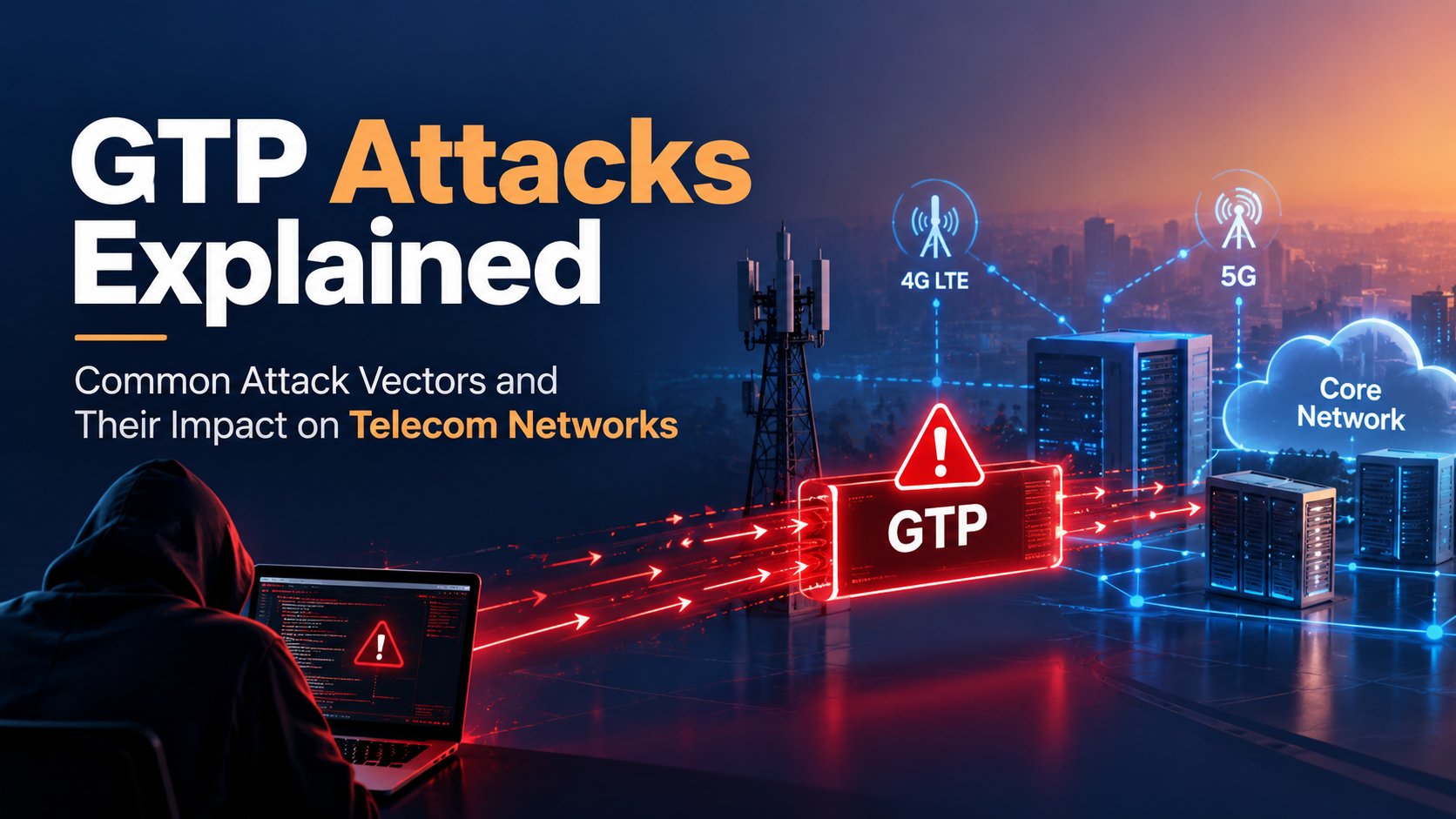

Mobile networks depend on signaling protocols to establish connections, manage subscriber sessions, and deliver data services. The GPRS Tunnelling Protocol (GTP) plays an important role in mobile packet-core networks, including 4G LTE environments. However, weaknesses in network exposure, signaling controls, and protocol implementation can create opportunities for malicious activity.
GTP attacks involve attempts to exploit weaknesses in GTP-enabled network elements, interfaces, or configurations. Depending on the network architecture and security controls, these attacks may contribute to unauthorized signaling, session manipulation, service disruption, or other telecom security incidents.
For telecom operators, understanding GTP attack vectors is essential to protecting network availability, subscriber services, and operational continuity. This guide explains common GTP-based attacks, the conditions that can make them possible, their potential impact, and the defensive controls operators can use to reduce risk.
GTP is used to manage and transport subscriber data sessions across mobile packet-core networks. In LTE, GTP control-plane signaling supports session and tunnel management, while GTP user-plane traffic carries subscriber data.
GTP-based attacks target weaknesses in the systems and security controls that process this traffic. They may involve unauthorized messages, abuse of exposed interfaces, attempts to manipulate session-related information, or excessive signaling intended to disrupt services.
These threats form part of the wider category of telecom signaling attacks. Their feasibility depends on factors such as network exposure, peer authentication and validation controls, message handling, implementation weaknesses, and the attacker's access.
Unauthorized signaling occurs when messages reach a network element from a source that should not be permitted to communicate with it, or when a request is accepted without sufficient authorization checks.
This risk can increase when network interfaces are exposed to untrusted networks or when peer restrictions are incomplete. If controls fail to distinguish legitimate signaling from unauthorized requests, an attacker may attempt operations that affect session management or consume network resources.
Potential impact: Unauthorized signaling activity, suspicious session operations, additional processing load, and increased incident-response requirements.
Defensive controls: Restrict connectivity to approved peers, validate message sources, apply interface-specific policies, and monitor signaling activity for unexpected requests.
GTP session hijacking refers to attempts to interfere with or take control of session-related activity by exploiting weaknesses in session validation, signaling authorization, or the handling of tunnel information.
The feasibility of such activity depends on the implementation, the attacker's position and access, and the controls protecting the relevant interfaces. A weak session-validation process may increase exposure, but the presence of GTP alone does not mean sessions can be hijacked.
Potential impact: Unauthorized session changes, disruption to subscriber connectivity, or misuse of network resources, depending on the weakness exploited.
Defensive controls: Validate session context and message parameters, enforce appropriate peer restrictions, and investigate unexpected changes to session state or tunnel information.
GTP denial-of-service attacks attempt to disrupt network functions by overwhelming resources or exploiting weaknesses in message processing. For example, excessive or malformed signaling traffic may increase processing demand on systems responsible for session establishment and management.
The consequences depend on traffic volume, network capacity, protocol handling, and existing rate controls. Not every unusual signaling burst is malicious, so operators need visibility into legitimate traffic patterns as well.
Potential impact: Increased signaling latency, degraded session establishment, resource exhaustion, and interruptions to subscriber services.
Defensive controls: Apply appropriate rate controls, detect abnormal signaling patterns, validate messages, and establish response procedures for suspected signaling floods. Testing should confirm that these safeguards work without blocking legitimate traffic.
Exposed GTP interfaces can expand the attack surface when they are reachable from networks or sources that do not require access. Poorly controlled routing, permissive firewall policies, and insufficient separation between trusted and untrusted environments can increase this exposure.
The risk is particularly important at network boundaries and operator interconnections, where traffic crosses different administrative domains.
Potential impact: Increased opportunities for reconnaissance, unauthorized signaling attempts, and exploitation of weaknesses in reachable network elements.
Defensive controls: Map all relevant GTP interfaces, restrict unnecessary connectivity, validate source addresses, segment network functions appropriately, and regularly review routing and firewall policies.
Insufficient filtering and inadequate message validation can allow unexpected traffic to reach sensitive network functions. These weaknesses may result from outdated policies, inconsistent configurations, or security controls that do not adequately understand the protocol context.
This attack vector overlaps with broader GTP protocol vulnerabilities, but the focus here is how an attacker might attempt to exploit those weaknesses rather than simply catalogue them.
Potential impact: Unauthorized requests being processed, increased resource consumption, suspicious session activity, or reduced effectiveness of existing security controls.
Defensive controls: Apply protocol-aware filtering, validate messages against expected context, maintain current security policies, and review how network elements handle invalid or unexpected requests.
The consequences of GTP attacks extend beyond individual network components. Depending on the attack and the effectiveness of existing safeguards, operators may face:
These are potential outcomes, not guaranteed consequences. A risk assessment should consider the affected network element, the attack prerequisites, the likely blast radius, and the safeguards already in place.
A layered defense helps operators reduce exposure and respond to suspicious activity.
A structured GTP vulnerability assessment can identify weaknesses in interface exposure, peer restrictions, message validation, configurations, and traffic filtering. Findings should be prioritized according to likelihood, impact, and operational context.
A properly configured GTP firewall can help enforce signaling policies, restrict unauthorized messages, and detect traffic that violates expected rules. Firewall effectiveness depends on suitable protocol inspection, accurate policy configuration, and ongoing maintenance.
Establish a baseline for normal signaling patterns and monitor for unexpected peers, unusual request volumes, abnormal session events, and repeated validation failures. Correlating signaling data with network and security logs can help distinguish legitimate changes from suspicious activity.
A broader telecom network security assessment should examine GTP alongside relevant network architecture, interconnections, access controls, monitoring, and incident-response procedures. Assessments should be authorized, carefully scoped, and designed to avoid disrupting production services.
After remediation, verify that identified weaknesses have been addressed. Repeat assessments when interfaces, network configurations, or interconnection arrangements change significantly, and update controls as the threat environment evolves.
GTP attacks can threaten mobile core network security when exposed interfaces, weak validation, insufficient access controls, or inadequate filtering create exploitable conditions. Attack categories such as unauthorized signaling, session manipulation, and denial of service can have operational and business consequences, depending on the affected systems and existing protections.
Telecom operators can reduce these risks by combining controlled interface exposure, robust message validation, GTP firewall policies, continuous monitoring, and structured security testing.
Matrix Shell Technologies offers Signaling Security Testing to help organizations explore signaling security assessment options. A properly scoped assessment can help identify attack paths, prioritize remediation, and strengthen the resilience of telecom networks.