Blog
.png)
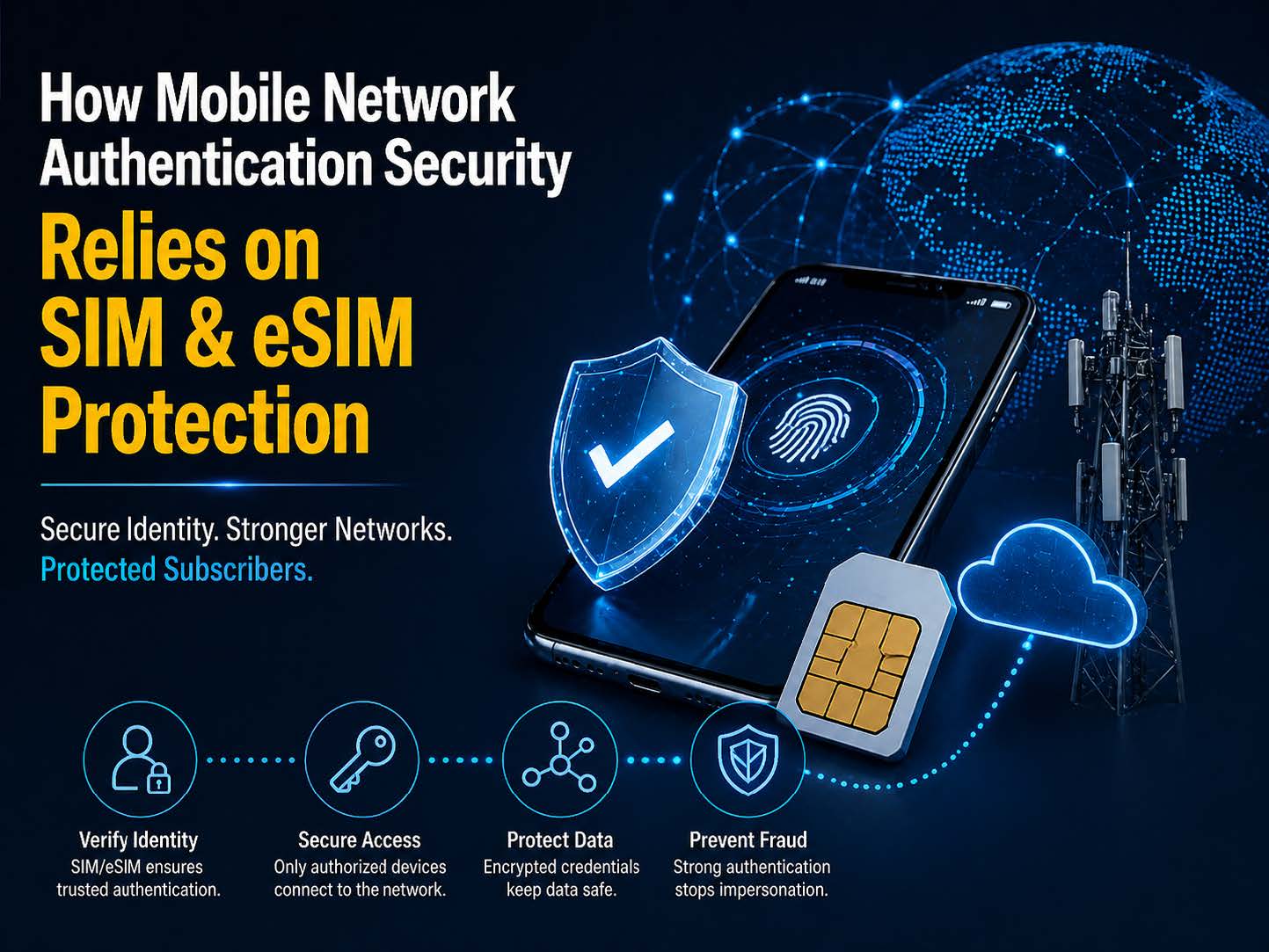
Mobile networks depend on one foundational principle: trusted subscriber identity. Every authentication request—whether voice, data, or IoT—relies on credentials stored within the Subscriber Identity Module (SIM) or embedded SIM (eSIM).
These secure elements act as the root of mobile network authentication security, enabling devices to prove identity and gain network access.
However, as telecom infrastructure evolves toward 5G, remote provisioning, and cloud-native architectures, weaknesses in SIM & eSIM security directly impact authentication integrity, subscriber privacy, and network trust.
SIM cards function as secure elements storing authentication credentials such as IMSI and cryptographic keys. These credentials are used during authentication procedures to validate a subscriber's identity.
SIM technology has historically provided a secure method for authenticating devices onto mobile networks through embedded secure elements. With the evolution to embedded SIM security (eSIM security), authentication now includes:
While this enhances flexibility, it introduces new dependencies in secure mobile authentication systems.
Authentication security depends on three core pillars:
If authentication keys stored in SIM/eSIM are compromised, attackers can:
SIM-based authentication systems rely heavily on secure credential storage, making them a primary target for attackers.
eSIM introduces remote provisioning through GSMA-defined architectures. However, vulnerabilities in provisioning workflows can lead to:
The GSMA Remote SIM Provisioning framework emphasizes secure interoperability and authentication between provisioning entities.
Authentication mechanisms also depend on secure OTA updates. Weak OTA mechanism security can result in:
ENISA identifies OTA and remote provisioning as critical risk vectors in the eSIM ecosystem.
ENISA reports that eSIM ecosystems introduce risks such as profile manipulation, memory exhaustion attacks, and service disruption.
Modern telecom networks combine legacy SIM systems, eSIM environments, and 5G authentication frameworks. This creates hybrid attack paths across authentication layers.
To ensure secure authentication, telecom operators must implement:
GSMA certification ensures strong encryption, secure profile management, and authenticated communication between devices and networks.
Mobile network authentication security is no longer confined to network layers—it is deeply tied to SIM & eSIM protection.
As telecom networks evolve, operators must ensure strong credential protection, secure provisioning systems, and continuous validation of authentication mechanisms.
By prioritizing SIM & eSIM security testing, organizations can safeguard subscriber identity, maintain compliance, and ensure trust in next-generation telecom environments.