
Blog
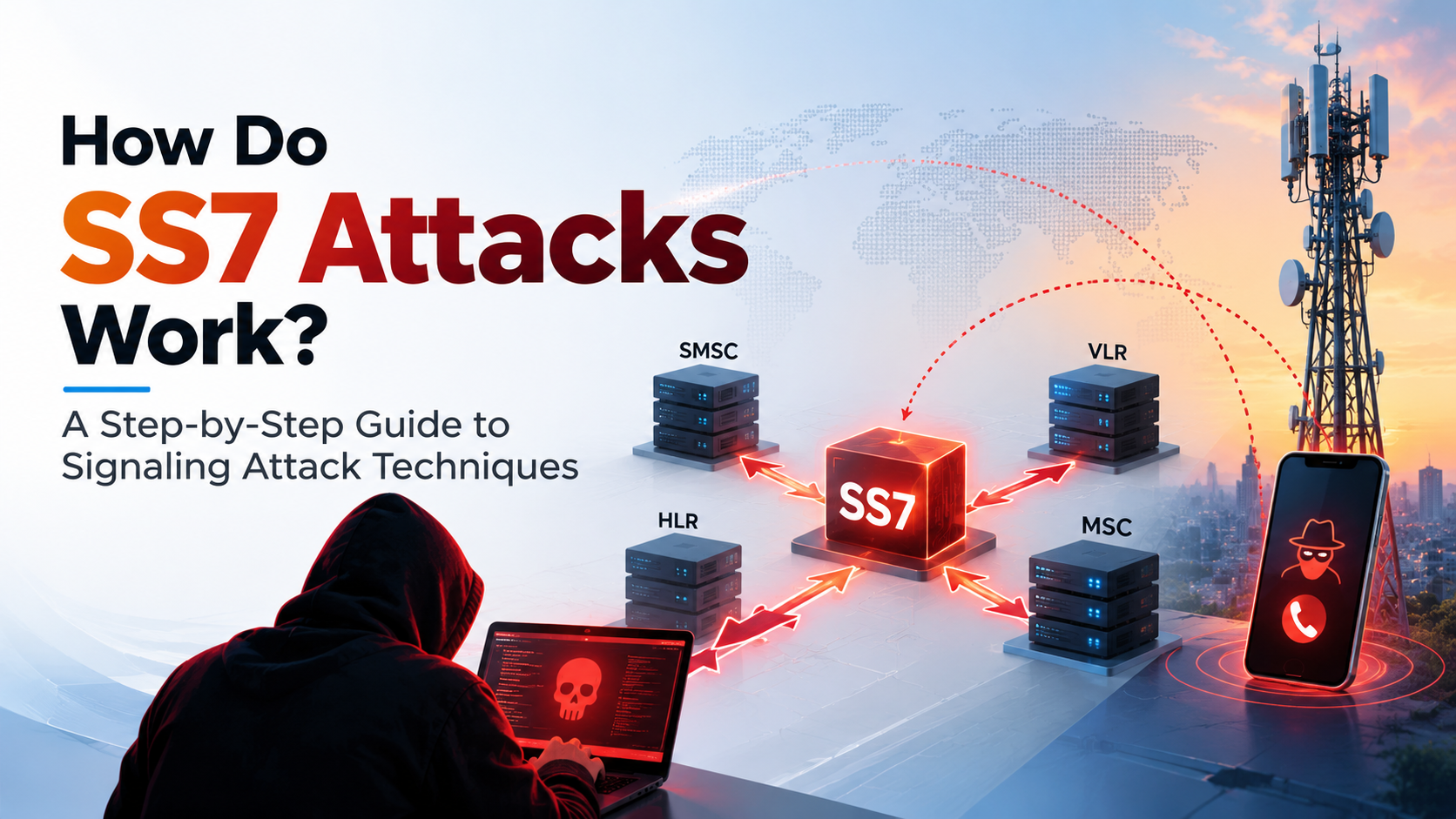

SS7 attacks exploit weaknesses in the signaling systems that help telecom networks authenticate subscribers, route calls and messages, manage mobility, and exchange network information. Because traditional SS7 networks were designed around trusted relationships between network operators, attackers can abuse signaling messages when proper security controls are missing.
Understanding how SS7 attacks work requires looking at the attack process from initial access to exploitation and impact. Attackers may abuse signaling capabilities to obtain subscriber information, track locations, intercept SMS messages, manipulate calls, or disrupt services.
This guide explains the main stages of SS7 attacks, common SS7 attack techniques, and how SS7 exploitation can affect modern telecom networks.
SS7 attacks are attempts to misuse the Signaling System No. 7 protocol and associated telecom signaling infrastructure to perform unauthorized actions.
SS7 handles important network functions such as:
The fundamental problem is that SS7 was developed when participating networks were generally assumed to be trusted. Modern telecom environments are significantly more interconnected, creating opportunities for malicious or compromised signaling entities to send unauthorized requests.
The basic process behind many SS7 attacks can be understood through several stages:
Identify → Access → Send Signaling Requests → Exploit Trust → Obtain Information or Manipulate Services → Maintain or Repeat Access
The exact technique varies depending on the attacker’s objective, network configuration, and available signaling access.
The first stage involves finding a way to interact with the target’s signaling environment.
An attacker may gain access through:
This does not necessarily mean directly connecting to a subscriber’s device. The attack typically targets the signaling infrastructure responsible for managing subscriber and network services.
Once an entry point is available, the attacker attempts to send signaling messages into the SS7 environment.
Historically, many signaling networks relied heavily on network-level trust rather than strong authentication for every signaling request. If security controls do not adequately validate the origin and legitimacy of messages, unauthorized signaling traffic may be accepted.
This trust model is one of the primary reasons SS7 exploitation remains a concern.
The attacker then sends signaling requests designed to retrieve information or influence network behavior.
Depending on the objective, requests may target subscriber data, routing information, mobility information, or SMS-related functions.
For example, an attacker could attempt to determine where a subscriber is currently registered or request information that helps identify the serving network.
The danger is not necessarily the individual signaling message. The problem arises when the network processes a request that should have been rejected.
This is the core of many SS7 attack techniques.
If the receiving network trusts an external signaling entity without sufficient validation, an attacker may be able to abuse legitimate SS7 functionality for unauthorized purposes.
Common weaknesses include:
These weaknesses can allow legitimate SS7 functions to be used maliciously.
Different attack techniques target different signaling functions and produce different outcomes.
One common technique involves abusing signaling requests to determine a subscriber’s location or serving network.
Location-related information can create significant privacy and security risks, particularly when attackers repeatedly query subscriber information.
Attackers may abuse signaling procedures associated with SMS delivery to redirect or intercept messages.
This is particularly serious when SMS is used for authentication or one-time passwords. Successful SS7 exploitation could potentially weaken account security outside the telecom network itself.
Certain signaling weaknesses can be abused to influence call routing or related services.
Depending on the network and attack conditions, this may enable unauthorized call redirection, interception, or manipulation.
SS7 can carry information related to subscribers and network operations. Attackers may attempt to abuse signaling queries to gather information that should not be available to them.
Repeated information requests can turn signaling weaknesses into a broader privacy and intelligence-gathering problem.
Attackers may also generate malicious or excessive signaling traffic to interfere with network services.
This can contribute to:
These risks demonstrate why SS7 security cannot focus only on data confidentiality. Availability and service continuity also need protection.
The underlying issue is usually not a single software vulnerability. Instead, SS7 exploitation often results from architectural assumptions combined with insufficient security controls.
Several factors can increase exposure:
For a broader view of these weaknesses, telecom teams can also review signaling vulnerabilities across modern telecom networks as part of their security planning.
Detecting SS7 attacks requires visibility into signaling traffic and the ability to identify requests that deviate from expected behavior.
Security teams should monitor for:
Behavior-based monitoring can be particularly useful because malicious signaling may appear technically valid while being suspicious in its context.
Preventing SS7 attacks requires multiple layers of protection rather than relying on a single control.
Telecom operators should consider:
Regular testing can identify weaknesses in SS7 filtering, validation, access controls, and signaling behavior before attackers exploit them.
Security assessments can simulate relevant attack scenarios and evaluate whether the network correctly detects and blocks unauthorized signaling activity.
SS7 firewalls can filter signaling messages according to security policies and help prevent unauthorized requests from reaching sensitive network functions.
Networks should validate signaling messages based on source, destination, context, subscriber state, and expected network behavior rather than automatically trusting requests.
Real-time monitoring can help identify abnormal signaling behavior and support faster investigation and response.
Operators should also consider how SS7 interacts with Diameter, GTP, and 5G service-based interfaces. A security strategy that protects only one protocol can leave gaps elsewhere in the signaling environment.
For a broader approach, see the guide on building a signaling security strategy across 2G, 3G, 4G, and 5G networks.
Understanding how SS7 attacks work is valuable, but identifying whether a specific network is vulnerable requires technical assessment.
SS7 security testing can help telecom operators evaluate whether signaling controls can withstand realistic attack scenarios. Testing can uncover weaknesses involving unauthorized signaling, subscriber information exposure, SMS interception risks, location tracking, and service disruption.
A structured assessment can also help operators determine whether signaling firewalls, filtering rules, monitoring systems, and other controls are working as intended.
SS7 attacks work by abusing the trust, functionality, and connectivity built into telecom signaling networks. Attackers may obtain signaling access, send unauthorized requests, exploit weak validation, and use legitimate SS7 functions for malicious purposes.
The most important SS7 attack techniques include subscriber location tracking, SMS interception, call manipulation, information disclosure, and signaling-based disruption.
As telecom networks continue to combine legacy SS7 infrastructure with 4G, 5G, and newer signaling architectures, operators need to treat signaling security as an ongoing security requirement. Regular testing, strong filtering, monitoring, validation, and a unified signaling security strategy can significantly reduce the risk of SS7 exploitation.





