Blog
.png)
When you make a call, send an SMS, or use mobile data, everything feels instant. But behind the scenes, a complex system of telecom signaling protocols is constantly working to connect, authenticate, and route your requests.
This invisible layer—known as signaling—is the backbone of mobile networks. And unfortunately, it's also one of the most vulnerable.
Today, telecom signaling vulnerabilities are actively exploited by attackers to intercept messages, track users, and disrupt services. Understanding these risks—and how to prevent them—is essential for any operator aiming to secure modern networks.
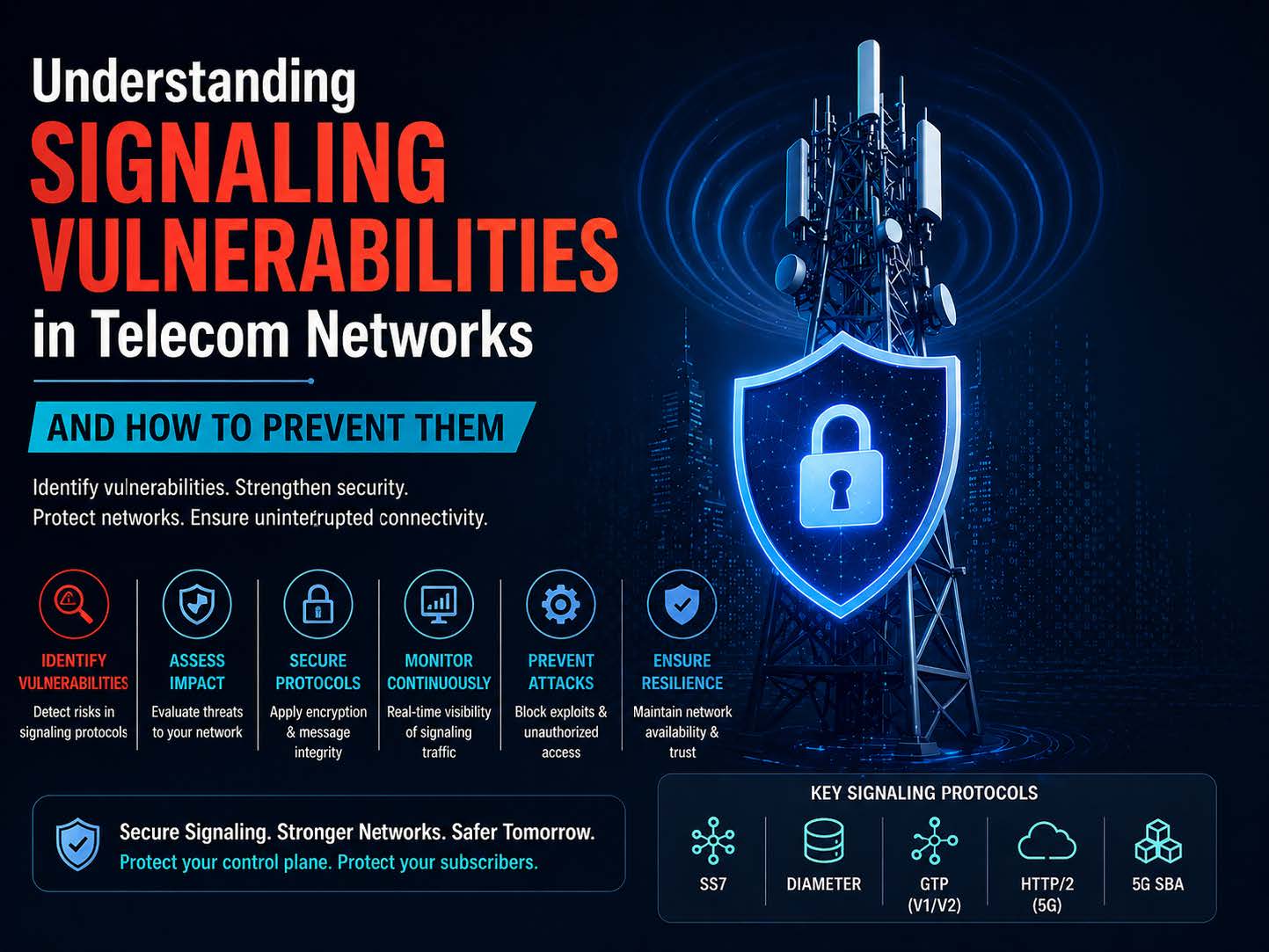
Signaling vulnerabilities refer to weaknesses in the protocols that control communication between network elements. These include:
These protocols were designed in a time when telecom networks operated in a trusted environment. According to ENISA, many signaling systems still rely on outdated trust assumptions, making them vulnerable to external attacks and unauthorized access.
As networks expand across 2G, 3G, 4G, and 5G, signaling layers have become more interconnected—and more exposed. This creates opportunities for attackers to exploit:
Research shows that signaling-based attacks are now one of the most common ways to access telecom networks without detection.
One of the most well-known issues. Attackers exploit SS7 to:
GSMA highlights SS7 weaknesses as a major concern due to the lack of built-in authentication controls.
Signaling requests can be used to track subscriber location and monitor user activity, directly impacting subscriber data protection in telecom networks.
GTP vulnerabilities can allow attackers to:
These risks make GTP security testing critical for telecom operators.
Modern networks rely on Diameter and HTTP/2. However, improper validation can expose systems and APIs can be abused if not secured properly. ENISA notes that 5G's service-based architecture increases reliance on APIs, making API security in 5G networks a top priority.
Attackers don't need physical access. They can:
This makes telecom signaling threats both scalable and difficult to detect.
To secure networks, operators must first identify weak points. This is where signaling security testing comes in. It helps:
Prevention is not about one fix—it's about a structured approach.
Operators must adopt:
Focus on control plane security in telecom:
Ensure secure signaling communication, message integrity checks, and strong encryption mechanisms. This supports telecom encryption and message integrity.
To prevent misuse:
Following GSMA security guidelines and 3GPP signaling security frameworks provides a strong foundation for telecom protocol security.
Telecom environments are constantly evolving. New risks emerge due to network upgrades, interconnections, and new technologies like 5G and APIs. Industry reports show that signaling attacks are increasing year-over-year, making proactive security essential.
Signaling vulnerabilities are no longer hidden risks—they are active threats impacting telecom networks globally.
As networks evolve, operators must move from reactive fixes to proactive strategies focused on signaling security testing, control plane protection, and continuous validation.
By doing so, they can protect subscriber data, ensure network reliability, and build trust in modern telecom ecosystems.