Blog
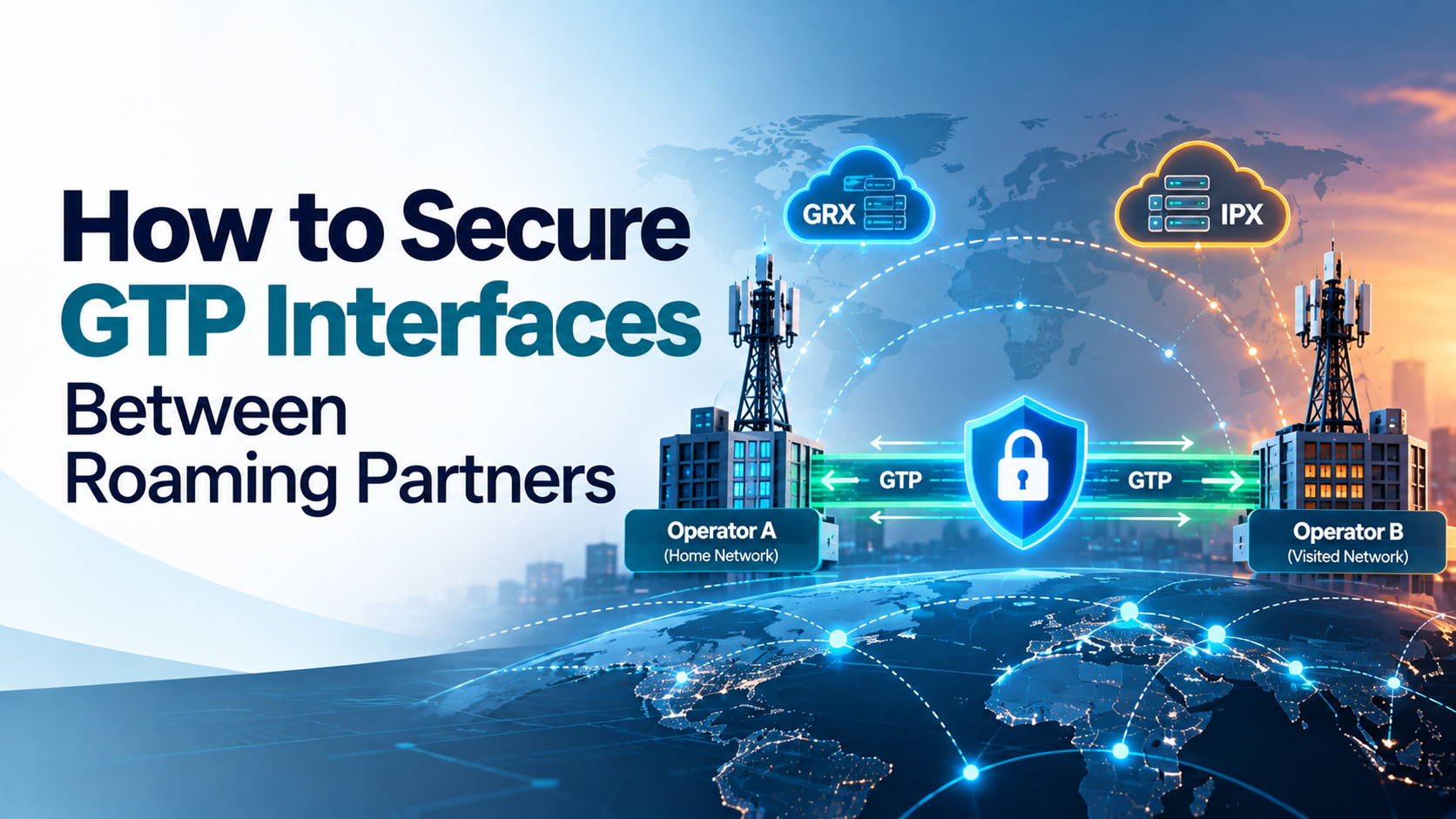

Mobile roaming enables subscribers to access data services when they connect to a visited network outside their home operator's coverage area. To make this possible, telecom operators exchange signaling and data traffic across interconnected networks, often involving roaming partners and managed GRX or IPX connectivity providers.
These connections introduce trust boundaries that must be configured and monitored carefully. If GTP interfaces are exposed unnecessarily, partner access is too permissive or protocol messages are inadequately validated, operators may face security risks affecting network availability, subscriber services and revenue.
GTP roaming interface security focuses on protecting these communication points through partner authorization, traffic filtering, secure configuration, message validation and continuous monitoring.
The GPRS Tunneling Protocol (GTP) supports important functions in mobile core networks. GTP-C handles control-plane procedures, including session creation, modification and deletion, while GTP-U carries user-plane data on applicable interfaces.
During roaming, relevant communications may cross network boundaries outside an operator's direct administrative control. A trusted interconnection provides connectivity, but it does not automatically guarantee that every message is legitimate or that the receiving network is correctly protected.
Weak GTP security in roaming can increase exposure to unauthorized signaling, inappropriate session-related activity and service disruption. Depending on the architecture and the weakness involved, these issues may also contribute to unauthorized data usage or telecom revenue leakage.
Strong interface security helps ensure that communications are permitted, appropriate to the network context and subject to defined security policies.
The first step in roaming interconnect security is to maintain a clear inventory of authorized network peers and their permitted communication paths.
Operators should:
GTP peer validation should use appropriate technical controls to verify that traffic comes from an authorized source. Where supported, this may include approved peer lists, source-network restrictions and additional trust or identity mechanisms.
An approved source address alone does not prove that every message is legitimate. Partner authorization must work alongside protocol validation and traffic filtering.
GRX and IPX providers support connectivity between telecom networks, but operators must understand where provider-managed connectivity ends and their own security responsibilities begin.
GRX security should include appropriate restrictions on roaming-related traffic, clear access policies and visibility into relevant network connections.
Similarly, IPX security requires controls aligned with the services and traffic carried across the interconnect. Operators should confirm which traffic is permitted, how unauthorized communication is handled and which monitoring capabilities are available.
To strengthen these boundaries:
These measures support telecom roaming security without assuming that a managed network eliminates the need for controls at the operator's own boundary.
GTP traffic filtering helps prevent unnecessary or unauthorized communication from reaching protected network elements.
A suitable filtering policy should reflect the network architecture, the purpose of each interface and the traffic expected from each authorized peer.
Operators should validate:
Where supported, GTP protocol filtering should examine protocol-specific message attributes rather than relying solely on basic network-level restrictions.
The objective is to reduce the attack surface while preserving legitimate roaming services. Filtering rules should be reviewed whenever network design, partner connectivity or service requirements change.
Even when traffic originates from an authorized partner, individual messages must still be handled according to applicable protocol requirements and security policies.
Message validation may include checks for malformed structures, invalid fields, unexpected message types or messages that do not fit the permitted signaling context.
Operators should verify that their security controls can identify and appropriately handle invalid or unauthorized messages on the interfaces in scope.
This is particularly important when evaluating GTP vulnerabilities in roaming, because the effectiveness of security controls depends on both who can communicate and how incoming messages are processed.
Validation policies should be tested carefully. Overly restrictive rules may disrupt legitimate signaling, while insufficient checks can allow inappropriate traffic to pass.
Effective interface protection requires visibility into traffic and security events.
GTP security monitoring can help identify unexpected peer activity, repeated filtering violations, unusual signaling volumes and protocol validation failures.
Operators should consider monitoring:
Alerts should include enough information to investigate the affected interface, source, time and observed behavior. Teams should correlate these events with planned maintenance, roaming activity and other operational changes before concluding that an incident has occurred.
Monitoring should support a defined response process, including investigation, escalation, remediation and documentation.
Configuration reviews help identify obvious gaps, but they may not reveal every weakness in the operator's environment.
A GTP security assessment can evaluate interface exposure, peer restrictions, filtering policies, message handling and monitoring coverage. Authorized GTP security testing can validate selected controls and identify weaknesses within an agreed scope.
Assessment activities may include:
Testing should be conducted with appropriate authorization and safeguards to avoid disrupting live roaming services.
Interface weaknesses are not the only cause of telecom fraud, but inadequate signaling controls can increase opportunities for misuse in some environments.
Roaming fraud prevention requires coordination between network security, roaming operations, fraud management and charging teams. Security controls can help restrict unauthorized signaling, while usage analytics and fraud-detection systems help identify suspicious service or charging patterns.
Operators should investigate potential indicators of unauthorized data usage using relevant network, session, usage and charging evidence. They should also review whether technical weaknesses could contribute to telecom revenue leakage.
No single firewall or interface control can prevent every form of fraud. A layered approach provides stronger protection by combining access restrictions, monitoring, testing and operational response.
Securing interfaces between roaming partners requires more than relying on trusted connectivity. Effective GTP roaming interface security combines partner authorization, GRX/IPX boundary protection, traffic filtering, message validation, monitoring and regular security assessment.
By validating these controls and reviewing them as network relationships evolve, telecom operators can reduce unnecessary exposure and strengthen protection for mobile core services.
For a broader evaluation of signaling risks, explore GTP Security Testing Explained or learn about Matrix Shell's Signaling Security Testing services.