Blog
.png)
Subscriber identity is the backbone of mobile network authentication security. Whether through traditional SIM cards or modern eSIM architectures, authentication relies on securely stored credentials such as IMSI and cryptographic keys.
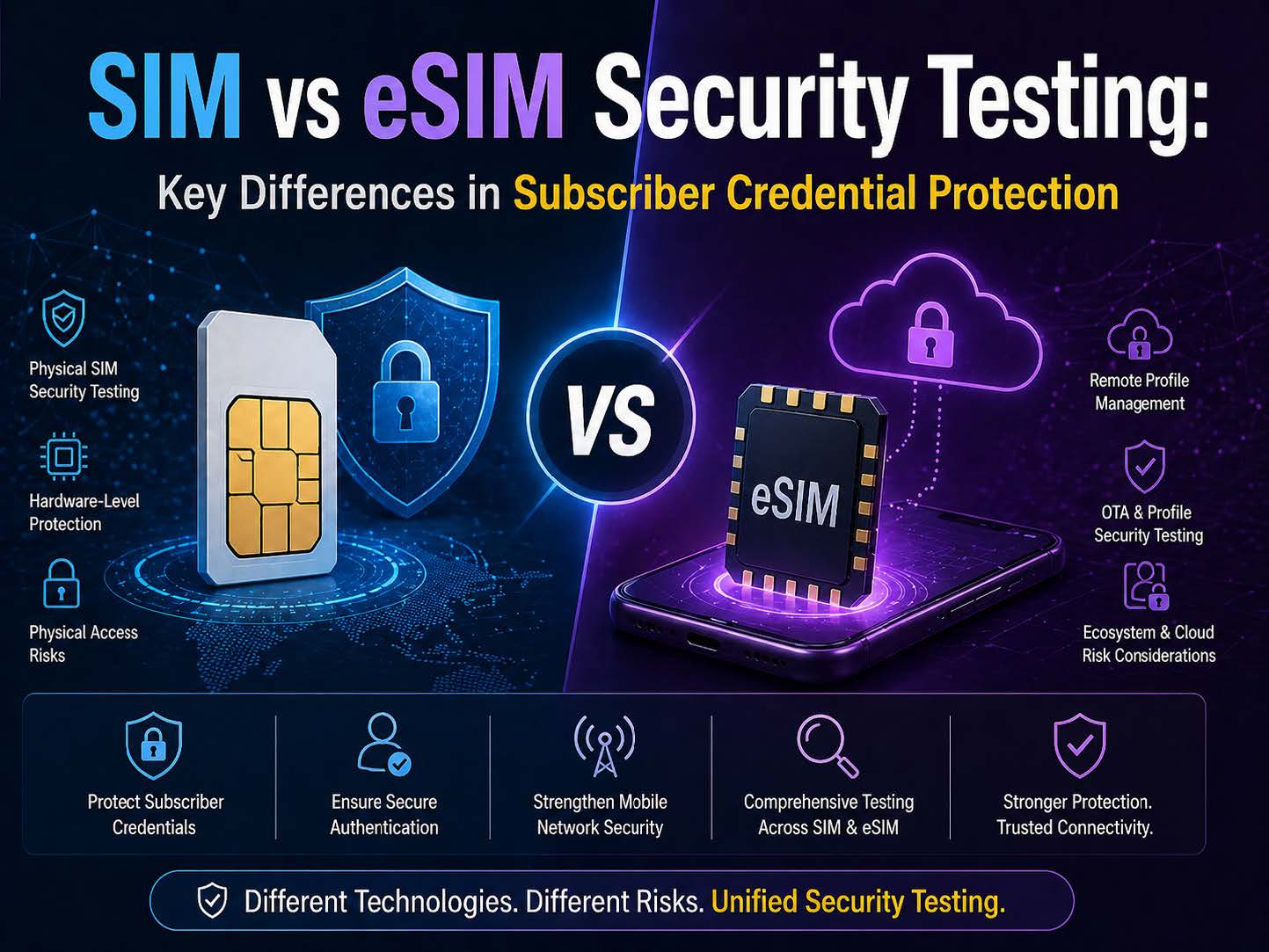
However, as telecom networks evolve, the shift from physical SIM to embedded SIM security (eSIM security) introduces fundamental changes in how subscriber credential protection is implemented and tested.
Understanding the differences between SIM vs eSIM security testing is critical for telecom operators aiming to maintain secure mobile authentication and protect subscriber data across increasingly complex infrastructures.
Traditional Subscriber Identity Module (SIM) cards are removable hardware secure elements that store authentication credentials and enable network access. SIM technology provides a secure mechanism for authenticating devices onto mobile networks using embedded cryptographic identities.
In contrast, eSIM is based on eUICC architecture, where profiles are:
This transformation expands the scope of mobile network credential security beyond physical hardware into cloud-based provisioning systems.
SIM Security Testing:
eSIM Security Testing:
eSIM profiles use multi-layer encryption and secure elements, often comparable to financial-grade security systems.
SIM:
eSIM:
GSMA standards define strict compliance frameworks to secure provisioning workflows and prevent unauthorized access.
Both SIM and eSIM rely on OTA mechanisms—but the risk profile differs.
SIM OTA Risks:
eSIM OTA Risks:
ENISA identifies OTA and provisioning systems as critical attack vectors in eSIM ecosystems.
SIM:
eSIM:
While eSIM reduces physical risks, it introduces new risks in OTA communication security and infrastructure dependencies.
The shift to eSIM does not eliminate risk—it redistributes it. Physical SIM risks center on theft and cloning, while eSIM risks shift toward provisioning compromise and credential exposure.
GSMA certification ensures encryption, secure profile management, and authenticated communication between devices and networks. This makes SIM & eSIM security testing essential for maintaining:
To effectively secure authentication systems, telecom operators must adopt:
Static testing is no longer sufficient. Operators must implement:
The transition from SIM to eSIM represents a shift from device-level security to ecosystem-level security.
Telecom operators must adapt by implementing comprehensive SIM & eSIM security testing strategies that address both legacy vulnerabilities and modern provisioning risks.
By strengthening subscriber credential protection, organizations can ensure trusted authentication, regulatory compliance, and long-term network resilience.