Blog

Telecom operators rely on signaling networks to support critical functions such as subscriber authentication, call and SMS delivery, mobility management, and inter-network communication. Because signaling protocols can expose sensitive network functions, identifying weaknesses before they are exploited is an important part of telecom cybersecurity.
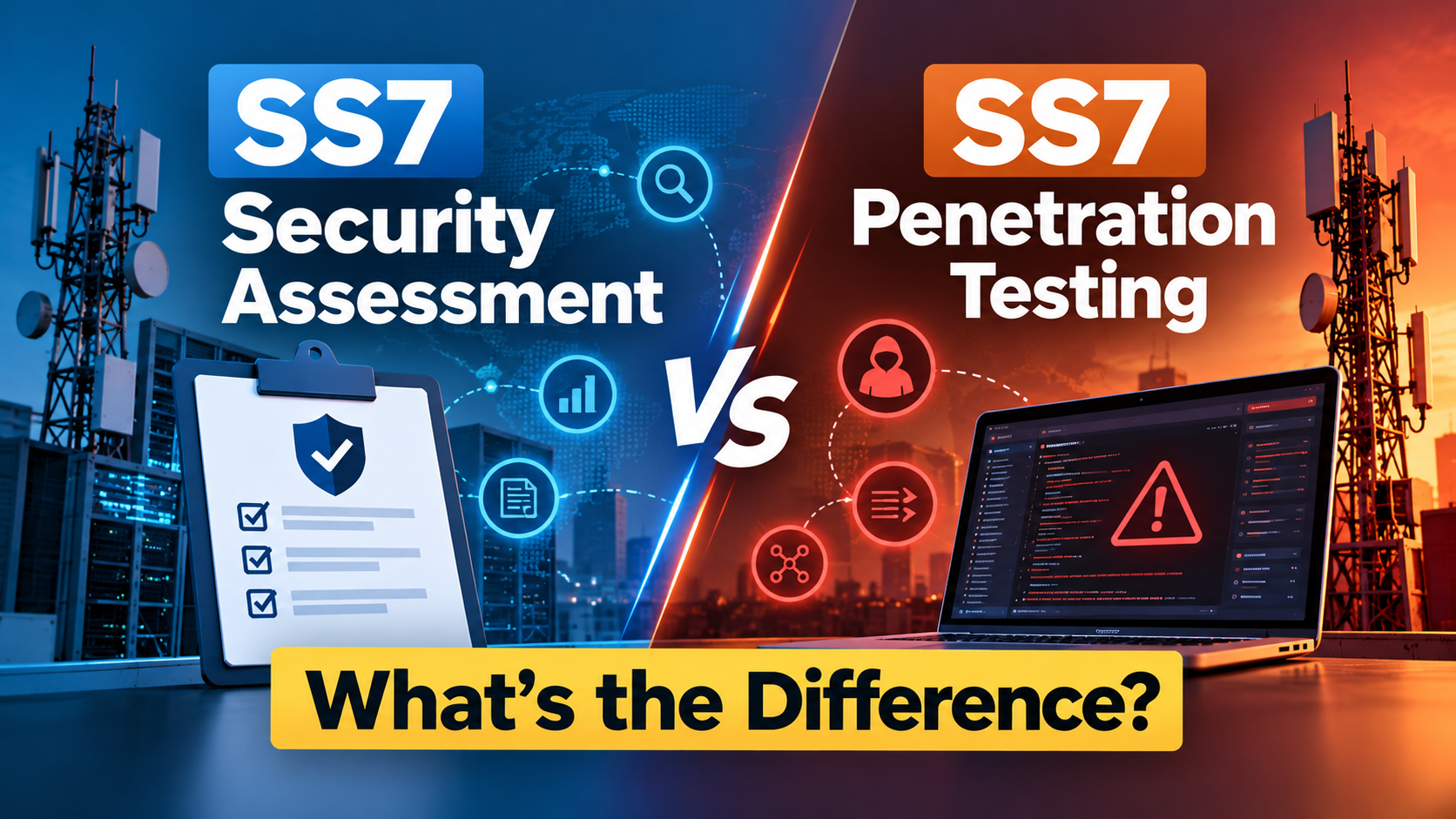
Two approaches are commonly used to evaluate these risks: SS7 security assessment and SS7 penetration testing. Although they are related, they are not the same. An assessment provides a broader evaluation of the security posture, while penetration testing focuses on controlled validation of whether specific weaknesses can be exploited.
Understanding SS7 assessment vs pentesting helps telecom operators select the right security activity based on their objectives, risk exposure, and network environment.
An SS7 security assessment is a structured evaluation of an SS7 signaling environment to identify security weaknesses, configuration gaps, exposure points, and potential risks.
The assessment typically examines how SS7 signaling is implemented, protected, monitored, and controlled across the network. It can evaluate signaling configurations, trust relationships, filtering controls, network exposure, access controls, and potential weaknesses that could affect subscribers or network services.
An SS7 security assessment may identify risks such as:
The primary objective is to establish a clear understanding of the organization’s SS7 security posture and identify areas requiring remediation.
SS7 penetration testing is a more focused security exercise designed to validate whether identified or suspected vulnerabilities can be exploited under controlled and authorized conditions.
Rather than only identifying a potential weakness, penetration testing attempts to demonstrate its practical security impact without disrupting production services.
An SS7 penetration test may simulate scenarios involving:
The purpose is not simply to find vulnerabilities but to determine whether security controls can withstand realistic attack scenarios.
The simplest way to understand SS7 assessment vs pentesting is to look at their primary objectives.
In short, an assessment asks “Where are the security weaknesses?”, while penetration testing asks “Can these weaknesses actually be exploited, and what could happen if they were?”
An SS7 security assessment is generally appropriate when an operator wants a broad understanding of its signaling security posture.
It can be particularly valuable when:
For organizations that have not conducted a comprehensive review recently, an assessment can provide the foundation for prioritizing remediation.
It can also help identify which areas require deeper penetration testing.
SS7 penetration testing is useful when an operator needs stronger evidence that its security controls can resist realistic attack scenarios.
It may be appropriate after:
Because signaling networks are operationally sensitive, testing should be carefully scoped and performed in an authorized, controlled environment to minimize the possibility of service disruption.
Yes. In many cases, combining both approaches provides stronger security assurance.
A practical approach can follow three stages:
1. Assess the environment
First, conduct an SS7 security assessment to map the signaling environment, identify exposure points, review configurations, and uncover security weaknesses.
2. Prioritize critical findings
Not every finding carries the same level of risk. Critical weaknesses affecting subscriber privacy, authentication, signaling integrity, or network availability should receive greater attention.
3. Validate high-risk weaknesses
Penetration testing can then be used to safely validate selected findings through controlled attack simulation.
This creates a security lifecycle where assessment identifies weaknesses and penetration testing validates their real-world security implications.
For a broader view of how signaling security testing can identify risks and prevent operational impact, see [How Signaling Security Testing Helps Prevent Fraud and Network Disruptions].
SS7 does not operate in isolation. Modern telecom environments may include legacy SS7 alongside Diameter, GTP, and 5G service-based interfaces.
Consequently, organizations should consider signaling security as part of a broader telecom security strategy rather than treating SS7 as a standalone technology.
A comprehensive approach can include:
A unified approach becomes increasingly important as networks transition across 2G, 3G, 4G, and 5G environments. For additional guidance, see [How to Build a Signaling Security Strategy for 2G, 3G, 4G, and 5G Networks].
An SS7 security assessment can help telecom operators:
Its broader scope makes it particularly useful as a baseline security activity and as part of a recurring security assurance program.
Penetration testing provides a different layer of assurance by validating security controls against controlled attack scenarios.
Key benefits include:
The combination of assessment findings and penetration testing evidence can give security teams greater confidence in their signaling defenses.
SS7 security assessment and SS7 penetration testing serve different but complementary purposes. An assessment provides a broader view of the signaling security posture, identifies weaknesses, and helps prioritize remediation. Penetration testing goes further by safely validating whether selected weaknesses can be exploited and determining their potential impact.
For telecom operators, the most effective strategy is often not to choose one over the other. Instead, use SS7 security assessment to understand the security landscape and penetration testing to validate the most critical risks.
This layered approach helps organizations strengthen signaling controls, protect subscriber information, improve network resilience, and build a stronger overall telecom cybersecurity program.