Blog
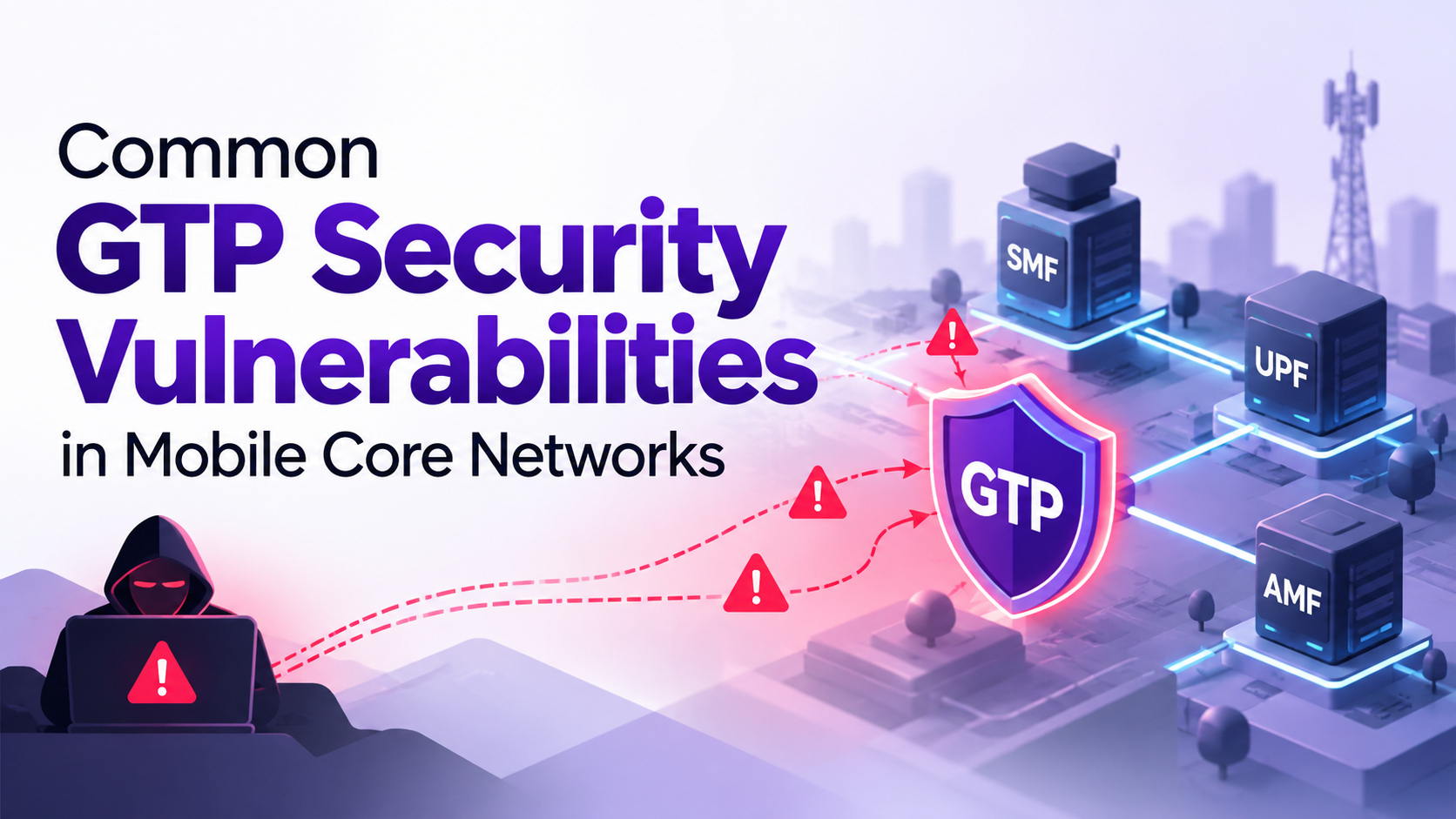

Mobile networks rely on the GPRS Tunnelling Protocol (GTP) to support data sessions and communication between key network elements. In 4G LTE networks, GTP carries control-plane messages used to establish and manage sessions, as well as user-plane traffic carrying subscriber data. However, weaknesses in exposed interfaces, request validation, access controls, and traffic filtering can introduce significant security risks.
GTP vulnerabilities can expose telecom operators to unauthorized session activity, service disruption, subscriber data risks, and revenue loss. These issues may become more serious when network interfaces are reachable from untrusted or insufficiently controlled networks.
Understanding common GTP security vulnerabilities is an important step towards reducing the attack surface and strengthening mobile core network security. This guide explores key GTP protocol vulnerabilities, common attack vectors, and practical ways to identify and address them through a structured GTP vulnerability assessment.
GTP is used in mobile packet-core networks to establish, manage, and transport subscriber data sessions. Its security depends not only on the protocol itself but also on how network interfaces are exposed, how messages are validated, and how communication between network elements is controlled.
GTP protocol vulnerabilities can arise when implementations or deployments fail to enforce appropriate security controls. For example, a network may accept unexpected messages, trust traffic from insufficiently verified sources, or lack filtering rules that restrict communication to legitimate peers.
These weaknesses can contribute to mobile core network vulnerabilities, particularly where signaling interfaces connect operators, roaming partners, and other external networks.
GTP interfaces must communicate with authorized network elements. However, incorrect routing, overly permissive firewall rules, or unintended internet-facing exposure can make these interfaces reachable from untrusted sources.
Exposed GTP interfaces may increase the risk of unauthorized signaling requests, reconnaissance, and attempts to exploit weaknesses in message processing.
This is a key part of the GTP attack surface. Operators should identify where GTP traffic enters and leaves the network, verify that only required peers can communicate with relevant interfaces, and remove unnecessary network exposure.
GTP messages contain information used to establish and manage subscriber sessions. If a network element does not adequately validate incoming messages, it may process unexpected, malformed, inconsistent, or unauthorized requests.
Insufficient validation can increase the likelihood of session-management errors, unauthorized operations, and resource exhaustion. The impact depends on the affected interface, message type, implementation, and surrounding security controls.
A GTP vulnerability assessment should evaluate whether message fields, sender identity, session context, and requested operations are validated appropriately. Testing should also establish how network elements respond to invalid or unexpected messages.
GTP security depends on controlling which network elements are permitted to exchange signaling messages. Weak access controls or incomplete peer verification can allow traffic from sources that should not be trusted.
This risk can be particularly relevant at operator interconnections and roaming boundaries, where traffic may cross organizational and network ownership boundaries.
Operators should implement appropriate peer allowlisting, source-address validation, network segmentation, and interface-specific access policies. These controls should be reviewed regularly to account for network changes and new interconnections.
Misconfigured network elements and insufficient filtering can undermine otherwise sound security practices. Examples include permissive firewall rules, outdated filtering policies, unnecessary enabled services, and inconsistent security configurations across network nodes.
A GTP firewall or suitable signaling security control can help inspect and restrict traffic according to defined policies. However, deploying a firewall alone does not guarantee protection. Its effectiveness depends on rule quality, protocol awareness, accurate peer identification, and ongoing maintenance.
Configuration reviews should confirm that filtering rules align with legitimate business and network requirements. Operators should also examine whether suspicious, malformed, or unauthorized messages are detected and handled consistently.
Weak session validation and inadequate signaling controls may create conditions that attackers could attempt to exploit for unauthorized session manipulation. Depending on the implementation and applicable security weaknesses, this may include attempts associated with GTP session hijacking or unauthorized modification of session-related information.
Another concern is GTP denial-of-service attacks. Excessive, malformed, or otherwise abusive signaling traffic may consume processing capacity, exhaust resources, or disrupt session-management functions.
These outcomes are not inevitable consequences of using GTP. Their feasibility depends on the network architecture, protocol implementation, exposure, and existing protections. Security testing should assess these scenarios in an authorized environment and evaluate whether monitoring, rate controls, validation, and filtering provide effective safeguards.
Understanding GTP attack vectors helps operators prioritize defensive controls. Common areas to examine include:
These categories represent assessment areas rather than proof that a specific network is vulnerable. A structured review is needed to determine whether an attack path is actually feasible.
A structured GTP vulnerability assessment helps telecom operators identify weaknesses and prioritize remediation without disrupting live services.
Identify relevant GTP interfaces, connected network elements, trusted peers, routing paths, and interconnection points. Document where access is required and where exposure can be reduced.
Examine firewall policies, peer allowlists, source-address restrictions, segmentation, and relevant device configurations. Identify excessive permissions and inconsistent controls.
Within an approved scope, assess how network elements handle invalid, unexpected, or unauthorized messages. Verify that session-related requests are checked against the relevant context and policy.
Review the effectiveness of signaling filters, alerting, traffic analysis, and response procedures. Determine whether suspicious activity can be identified and investigated in a timely manner.
Prioritize findings according to exploitability, exposure, operational impact, and business risk. Provide practical remediation recommendations and validate important fixes through controlled retesting.
A professional telecom network security assessment should account for both technical weaknesses and the operational requirements of the mobile core.
Operators can reduce GTP security risks by combining preventive, detective, and corrective controls:
No single control addresses every threat. A layered approach is more effective because it reduces unnecessary exposure while improving the ability to detect and respond to suspicious activity.
GTP vulnerabilities remain an important consideration for operators responsible for securing LTE and other mobile packet-core environments that use the protocol. Exposed interfaces, insufficient request validation, weak access controls, configuration gaps, and inadequate filtering can increase the risk of unauthorized signaling activity and service disruption.
By identifying the GTP attack surface, validating protocol behavior, reviewing access policies, and testing filtering and monitoring controls, operators can make informed decisions about reducing mobile core network vulnerabilities.
Matrix Shell Technologies’ Signaling Security Testing service page provides a relevant starting point for exploring signaling security assessment and testing options. A scoped, authorized assessment can help operators understand their exposure, prioritize remediation, and strengthen telecom network security.