Blog

Telecom operators rely on the GPRS Tunnelling Protocol (GTP) to support subscriber sessions and data communication across mobile packet-core networks. However, weaknesses in network configurations, exposed interfaces, access controls, and message handling can create security risks that affect service availability and network resilience.
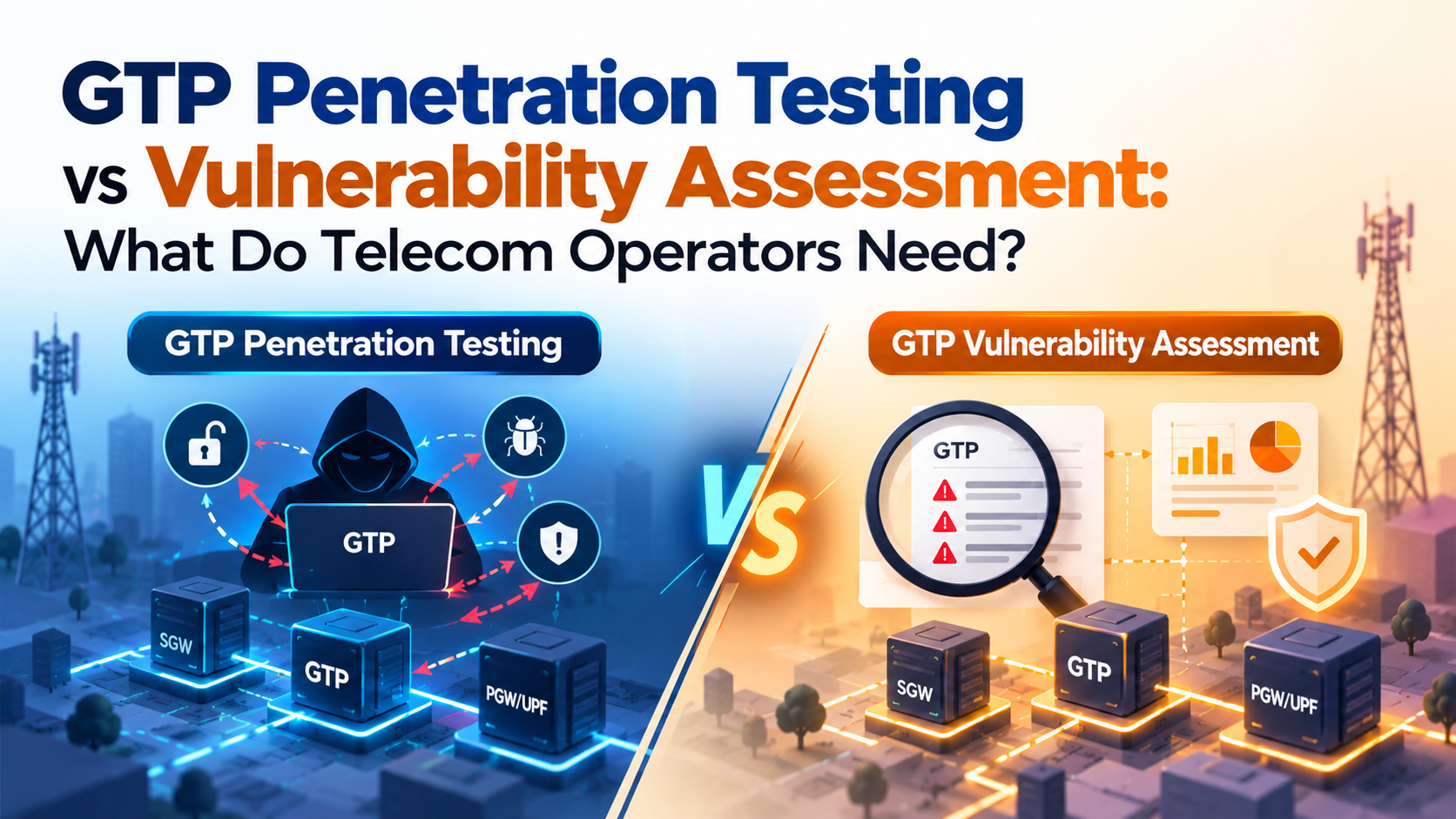
Two approaches can help operators understand these risks: GTP penetration testing and a GTP vulnerability assessment. Although the terms are sometimes used interchangeably, they serve different purposes. A vulnerability assessment focuses on identifying and prioritizing weaknesses, while penetration testing investigates whether selected weaknesses can be exploited under controlled, authorized conditions.
Understanding the difference helps operators select the right approach, define assessment objectives, and prioritize remediation.
A GTP vulnerability assessment systematically reviews GTP-enabled network elements, interfaces, configurations, and security controls to identify potential weaknesses.
The assessment may examine exposed interfaces, peer restrictions, firewall policies, message validation, and configuration gaps. Findings are evaluated according to factors such as severity, exposure, exploitability, and potential operational impact.
A typical GTP vulnerability assessment includes:
This approach is useful when operators need a broad understanding of their security posture or want to establish a baseline before undertaking deeper testing.
GTP penetration testing goes beyond identifying potential weaknesses by investigating whether selected attack paths are practically exploitable within an approved scope.
For example, testers may evaluate whether an exposed interface accepts unauthorized signaling, whether message-validation controls can be bypassed under defined conditions, or whether a suspected weakness could affect session management or network availability.
Testing should be carefully authorized and designed around the operator's operational constraints. Production networks require particular care because active tests can affect signaling performance or subscriber services.
A typical engagement may include interface discovery, targeted testing, controlled validation of suspected weaknesses, risk analysis, and reporting with remediation recommendations.
The two approaches are complementary. A vulnerability assessment can identify where weaknesses may exist, while penetration testing can help determine which of those weaknesses present demonstrable risks.
Whether an operator chooses an assessment, penetration test, or combined engagement, the scope should reflect its network architecture and security objectives.
Review interface exposure, routing, authorized peers, and network boundaries. Determine whether GTP traffic can reach systems from sources that should not have access.
Evaluate how network elements handle unexpected, malformed, or unauthorized messages. Testing should consider the relevant protocol version, interface, and expected session context.
Examine peer restrictions, source-address controls, segmentation, and applicable authorization policies. Identify excessive permissions and communication paths that are not required for legitimate operations.
The assessment should account for the GTP versions and roles actually deployed. GTPv1 is used for relevant user-plane tunneling and certain legacy control-plane applications, while GTPv2-C supports control-plane session management in LTE EPC environments.
Testing should therefore be tailored to the applicable interfaces and network functions rather than assuming every version performs the same role.
Review firewall policies, signaling filters, monitoring, and configuration consistency. Where relevant, evaluate whether a GTP firewall enforces appropriate policies and whether suspicious traffic can be detected and investigated.
The appropriate approach depends on the operator's objectives, existing security maturity, and operational constraints.
Choose a GTP vulnerability assessment when:
Choose GTP penetration testing when:
Consider a combined telecom security assessment when: You need broad coverage and deeper validation of important findings. A combined approach can identify weaknesses first and then investigate the highest-priority issues through controlled testing.
Before testing starts, operators should define the interfaces, network elements, protocol versions, testing windows, permitted methods, and prohibited activities. Written authorization, escalation contacts, and safeguards for production services should be established.
A useful GTP security assessment checklist should cover interface discovery, message validation, access controls, configuration review, traffic filtering, monitoring, and retesting requirements.
Final deliverables should include:
Remediation may involve restricting exposed interfaces, strengthening peer verification, correcting firewall policies, improving message validation, and enhancing monitoring. Findings should be validated before closure.
A GTP security audit may complement these activities by checking configurations and controls against defined requirements. Broader telecom penetration testing or a signaling security assessment may also cover related protocols and interconnections when those areas are included in the agreed scope.
GTP penetration testing and vulnerability assessment address different but complementary security needs. A vulnerability assessment identifies and prioritizes weaknesses, while penetration testing evaluates whether selected weaknesses can be exploited and what impact they may have.
For telecom operators, the strongest approach is the one that matches the network environment, risk priorities, and operational requirements. Combining structured discovery, interface testing, message validation, access-control reviews, and evidence-based reporting can help improve mobile core network security.
Matrix Shell Technologies' Signaling Security Testing service page is a relevant starting point for exploring signaling security assessment options. A clearly scoped engagement can help operators identify gaps, validate important risks, and plan practical remediation.