
Blog
.png)
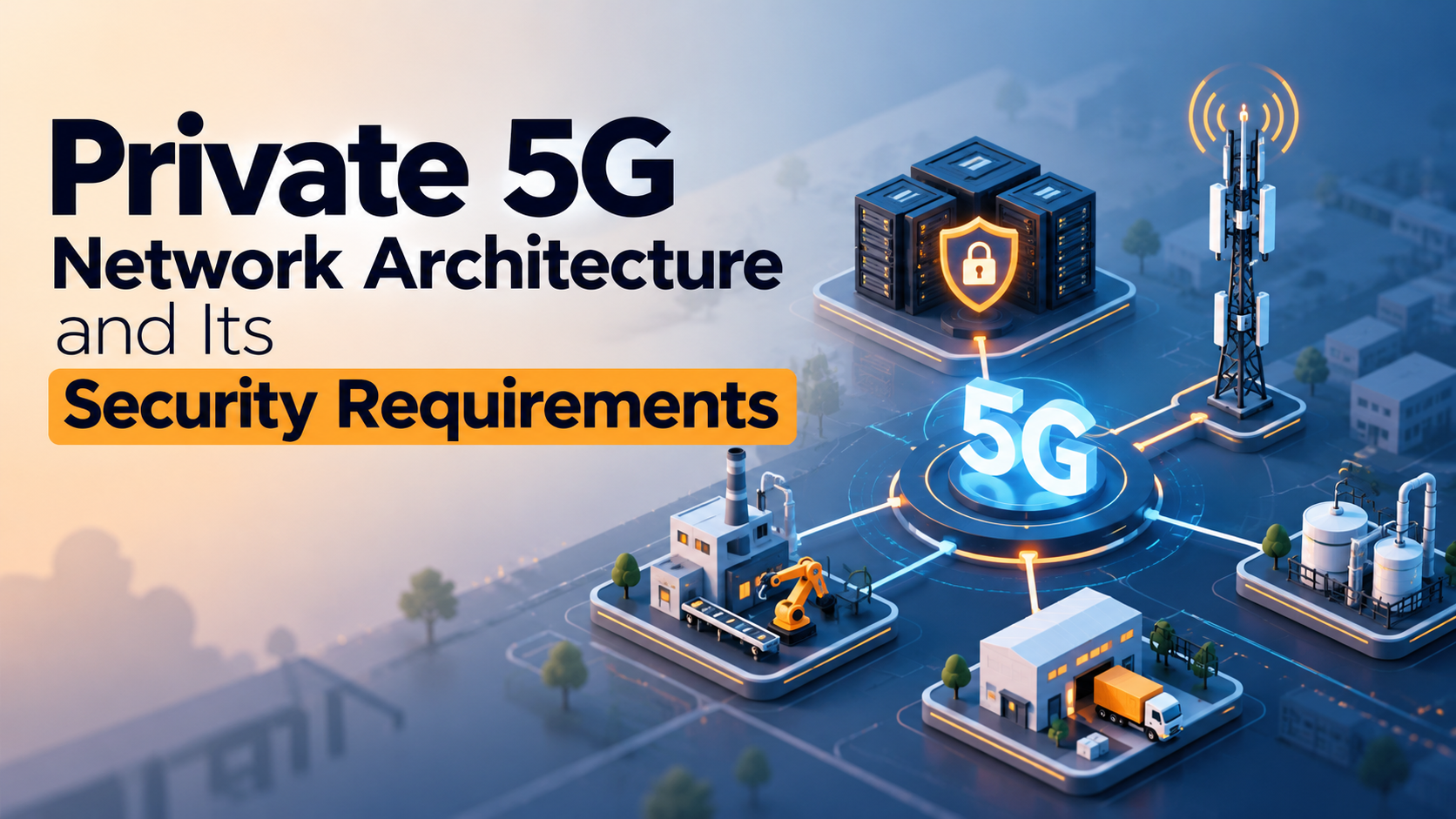
Private 5G networks are becoming an important connectivity foundation for smart factories, logistics, healthcare, energy, ports, mining, and other enterprise environments. Unlike traditional enterprise networks, private 5G combines radio access, cloud-native core functions, APIs, connected devices, edge infrastructure, and enterprise applications.
This distributed architecture creates new opportunities for automation and real-time connectivity, but it also expands the security perimeter. Understanding private 5G security architecture and defining appropriate private 5G security requirements are therefore essential before deploying or scaling a private network.
Private 5G security refers to the technologies, controls, processes, and testing practices used to protect a dedicated 5G network and everything connected to it.
The objective of private 5G network security is not limited to protecting the radio network. It extends across the RAN, 5G Core, network interfaces, APIs, identities, devices, edge infrastructure, enterprise systems, and applications.
For enterprises asking what is private 5G security, the simplest answer is: it is a layered security approach that protects connectivity, network functions, data, identities, devices, and communication interfaces throughout the private 5G environment.
A typical private 5G environment consists of several interconnected layers.
The RAN provides wireless connectivity between devices and the private 5G network. It includes radios, antennas, baseband components, and related network infrastructure.
Because the RAN represents an important access point, private cellular network security must address authentication, encryption, integrity protection, traffic policies, configuration, and unauthorized access.
The 5G Core manages important functions such as authentication, mobility, sessions, subscriber information, and user-plane connectivity.
Cloud-native and distributed core functions can increase flexibility, but they also introduce additional interfaces and dependencies that must be secured.
5G uses Service-Based Architecture (SBA), allowing network functions to communicate through APIs and HTTP/2-based interfaces. This introduces an API-driven attack surface that requires authentication, authorization, secure communication, input validation, and configuration controls.
Matrix Shell's research on HTTP/2 security in 5G SBA APIs explains why API security is an important consideration as 5G networks move toward service-based architectures.
Private 5G environments may connect industrial machines, sensors, robots, cameras, vehicles, employee devices, and IoT systems.
This makes identity and access management a central part of enterprise 5G security. Weak credentials, excessive privileges, compromised devices, or poorly controlled access can create pathways into sensitive systems.
Many private 5G deployments connect directly with MEC or edge infrastructure, enterprise applications, IoT platforms, OT environments, and existing IT networks.
This convergence means security controls must extend beyond the 5G network itself.
A practical private 5G security architecture should protect multiple layers rather than relying on a single security control.
Key security domains include:
The architecture of a private 5G network can create several private 5G security risks.
Common private 5G cybersecurity risks include:
These risks collectively contribute to the private 5G attack surface, which can be significantly broader than the traditional enterprise network perimeter.
A strong security strategy should define clear private 5G security requirements before deployment.
Important requirements include:
Only approved users, devices, applications, and network functions should be allowed to access protected resources.
Critical communication channels should use appropriate encryption and integrity mechanisms to protect data and signaling.
All exposed interfaces should be assessed for authentication, authorization, configuration weaknesses, misuse, and potential abuse.
Critical enterprise workloads should be separated according to business and security requirements. Network slicing should include appropriate isolation and policy enforcement.
Organizations should establish processes for device onboarding, identity management, access control, updates, and retirement.
Security should not end when the network goes live. Testing should be repeated after major architecture, configuration, software, or integration changes.
A private 5G security framework should connect architecture, controls, testing, monitoring, and remediation.
A practical approach can follow this sequence:
Discover → Map → Assess → Test → Remediate → Validate → Monitor
First, map the complete architecture and private 5G attack surface. Next, identify security requirements and assess the RAN, Core, APIs, devices, edge infrastructure, and enterprise connections. Security testing can then validate whether identified controls actually work under realistic conditions.
Matrix Shell provides telecom-focused security services covering 5G security testing, authentication and access control validation, secure communication, and configuration and architectural risk assessment.
Organizations building private networks should consider the following private 5G security best practices:
The most effective private 5G security solutions combine architecture-level controls with continuous assessment and validation rather than relying solely on perimeter defenses.
Security testing should be considered throughout the private 5G lifecycle—not only after deployment.
Testing can help organizations identify weaknesses in architecture, configurations, authentication, interfaces, APIs, RAN components, Core functions, and connected systems.
A controlled telecom security laboratory can also provide a safer environment for validating network functions and protocols before production deployment. Matrix Shell's 5G Security Lab covers 5G Service-Based Architecture, control plane, user plane, data management, and multiple 5G Core functions.
Private 5G introduces a powerful architecture for connecting enterprise systems, devices, applications, and operational environments. However, the same connectivity that creates business value can also expand the security perimeter.
A mature private 5G cybersecurity strategy should therefore protect every important layer—from RAN and 5G Core to APIs, identities, devices, edge infrastructure, network slicing, and enterprise connectivity.
By defining clear private 5G security requirements, understanding private 5G security risks, applying a structured private 5G security framework, and continuously validating controls, enterprises can build security into the network rather than treating it as an afterthought.





