
Blog
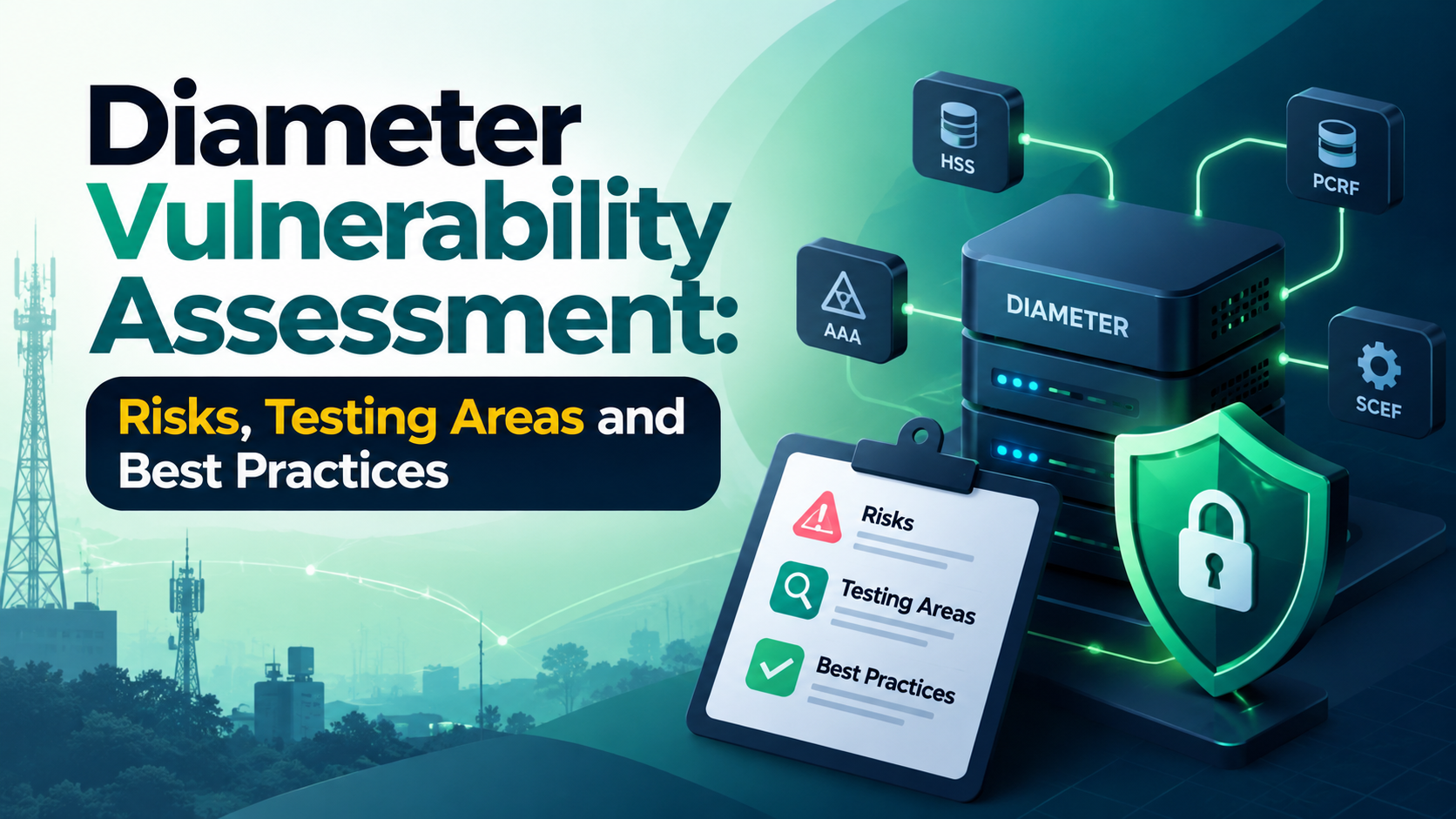

Diameter is a critical signaling protocol used in 4G/LTE networks for authentication, authorization, mobility management, subscriber services, accounting, and roaming. Because Diameter signaling can connect multiple network elements and cross operator boundaries, weaknesses in its implementation or configuration can expose sensitive signaling functions.
This makes a Diameter vulnerability assessment an important part of telecom security.
A vulnerability assessment helps operators identify weaknesses before they can be exploited, while broader Diameter security testing can validate whether security controls effectively defend against realistic attack scenarios.
But what is Diameter security testing, what risks should operators look for, and what should a comprehensive Diameter security assessment cover?
Diameter security testing is the structured evaluation of Diameter signaling infrastructure to identify vulnerabilities, configuration weaknesses, unauthorized access paths, insecure interfaces, and potential attack scenarios.
Depending on the network architecture, testing can include:
The IETF's Diameter specification defines security requirements for Diameter communications and specifies protected transport mechanisms including TLS, DTLS and IPsec.
The objective is to understand whether Diameter infrastructure is properly protected—not simply whether the protocol is functioning.
A Diameter vulnerability assessment focuses on identifying weaknesses that could potentially be exploited by unauthorized users or systems.
Unlike a basic configuration review, an assessment can combine architecture analysis with technical testing.
It may examine:
The findings can then be categorized according to their potential technical and operational impact.
A vulnerability assessment does not necessarily attempt to exploit every identified weakness. Controlled Diameter penetration testing can be performed separately to validate whether specific vulnerabilities are practically exploitable.
Diameter vulnerabilities can affect both signaling infrastructure and subscriber-related services.
Diameter relies on trusted relationships between network elements.
Weak peer authentication or authorization could allow an unauthorized system to attempt communication with Diameter infrastructure.
Testing should determine whether:
Diameter signaling can carry information associated with subscribers and network services.
Weak access controls or improper message validation could create opportunities for unauthorized information access.
A Diameter security assessment should therefore examine whether sensitive information can be requested or accessed outside the intended authorization model.
Diameter signaling supports mobility-related functions within LTE environments.
Security weaknesses may therefore create risks involving subscriber location information.
Testing can examine whether unauthorized signaling requests could obtain or manipulate information associated with subscriber mobility.
Diameter messages can support authentication and subscriber-management functions.
A vulnerability could potentially allow unauthorized requests involving subscriber profiles or authentication-related procedures.
A Diameter vulnerability assessment should verify that only authorized network elements can perform sensitive operations.
Diameter infrastructure may also be exposed to excessive or malformed signaling.
Testing can evaluate whether controls can detect and handle:
These scenarios can help operators evaluate their resilience against signaling-based denial-of-service conditions.
A practical Diameter assessment checklist should cover multiple security layers.
Review:
Assess:
RFC 6733 specifies that Diameter implementations must not be used without TLS, DTLS or IPsec protection.
Check how Diameter nodes handle:
Where applicable, testing should include interfaces such as:
S6a deserves particular attention in LTE environments because of its role in authentication and subscriber-related signaling.
A comprehensive Diameter security audit checklist should include:
GSMA's Diameter Interconnect Security guidance specifically addresses potential Diameter-based attacks and countermeasures for LTE and 5G interconnection environments.
These activities are related but have different objectives.
A mature telecom security program can combine these approaches.
For example, an operator could first perform a Diameter security audit, identify potential weaknesses through a Diameter vulnerability assessment, and then use Diameter penetration testing to validate selected findings.
A vulnerability assessment identifies potential weaknesses. A Diameter pentest goes further by safely simulating approved attack scenarios to determine whether those weaknesses can actually be exploited.
Depending on the approved scope, testing may include:
Testing should be performed within an agreed scope and, where appropriate, against dedicated test subscribers to minimize the possibility of affecting live users.
Telecom operators can strengthen their assessment process by following several practical principles.
1. Start With the Architecture
Understand Diameter nodes, peers, interfaces, routing paths, roaming relationships and trust boundaries before testing.
2. Maintain an Updated Asset Inventory
Keep track of Diameter nodes, interfaces, applications, external peers and interconnects.
3. Test External Trust Boundaries
Pay particular attention to roaming and inter-operator connections.
4. Validate Security Controls
Don't simply document firewall, filtering or authentication controls. Verify that they behave as intended.
5. Use Controlled Testing
Perform penetration testing against approved targets and dedicated test subscribers wherever possible.
6. Prioritize Findings
Classify vulnerabilities according to their potential technical and operational impact.
7. Retest After Remediation
After vulnerabilities are fixed, conduct validation testing to confirm that the security issue has been addressed.
A concise Diameter assessment checklist can include:
Diameter remains an important component of LTE and roaming environments. Security requirements can change as operators introduce new network elements, roaming relationships, interfaces, configurations, and services.
GSMA's roaming security guidance addresses Diameter security requirements and additional protections for inter-operator signaling environments.
Regular Diameter security testing can help operators identify weaknesses before they become exploitable and validate whether existing controls continue to work as the network evolves.
A Diameter vulnerability assessment provides telecom operators with a structured way to identify weaknesses across Diameter peers, interfaces, configurations, message handling, authentication, roaming, and security controls.
However, vulnerability identification is only one part of the process.
Combining a Diameter security assessment, Diameter security audit, Diameter penetration testing, and controlled Diameter pentest can provide a broader view of the security posture.
The strongest approach is to identify vulnerabilities, validate their practical impact, remediate the underlying weakness, and then retest the affected environment.
Recommended internal links
For this article, I recommend these two internal links:
This creates a logical SEO funnel:
Vulnerability Assessment → Diameter Vulnerabilities → Diameter Security Testing Service
I have kept the links as anchor recommendations because the exact Matrix Shell URLs were not provided.





