Blog
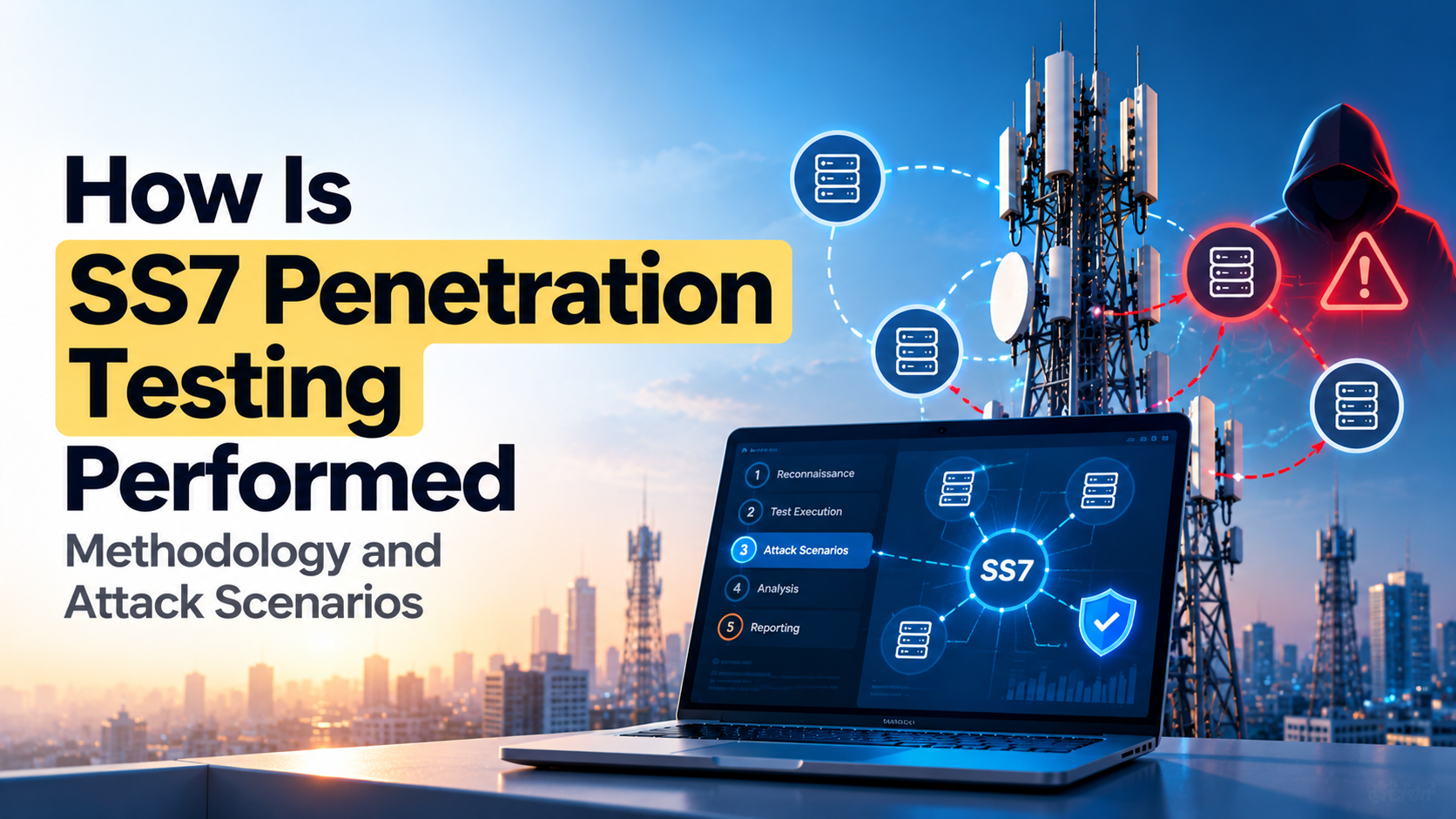

SS7 penetration testing is a specialized security assessment used to evaluate the resilience of telecom signaling infrastructure against unauthorized, abnormal, or potentially malicious signaling activity. Unlike conventional IT penetration testing, it requires an understanding of SS7 architecture, signaling relationships, telecom interconnections, and the security controls protecting the signaling layer.
A structured SS7 pentesting methodology combines architecture review, exposure analysis, controlled security validation, attack simulation, security-control testing, and risk assessment. The objective is to identify weaknesses without disrupting legitimate telecom services.
For telecom operators, understanding how this process works helps establish an effective and controlled approach to signaling security validation.
The SS7 pentesting methodology is a structured process for evaluating SS7 infrastructure and determining whether signaling security controls can withstand realistic but controlled security scenarios.
While the exact methodology varies according to the operator’s architecture and assessment objectives, a professional engagement generally follows these stages:
The methodology should always be performed within an authorized scope and with safeguards designed to protect production telecom services.
The first stage of SS7 penetration testing is defining what can and cannot be tested.
The scope may include selected signaling nodes, interfaces, interconnections, signaling firewalls, monitoring systems, and other relevant components.
The assessment team should establish:
Clear rules of engagement help prevent unintended impact on live subscribers and network operations.
Before performing security validation, testers need to understand how signaling flows through the environment.
This includes reviewing relevant network elements, signaling paths, interconnections, trust relationships, and security controls.
The architecture review helps identify where signaling enters or leaves the operator’s environment and where security controls are expected to enforce restrictions.
It also helps determine which attack scenarios are relevant to the specific telecom architecture rather than applying a generic penetration-testing checklist.
SS7 environments can involve relationships between operators, roaming partners, signaling providers, and other network entities.
During SS7 penetration testing, the assessment evaluates whether these relationships create unnecessary exposure.
The focus can include:
The purpose is to identify areas where excessive trust or insufficient validation could create security risks.
Before conducting controlled attack scenarios, testers assess the security mechanisms designed to protect the signaling environment.
These may include signaling firewalls, filtering policies, access controls, monitoring mechanisms, and alerting systems.
The assessment determines whether controls:
This control-validation stage provides important context for interpreting the results of later attack simulations.
SS7 attack simulation is a central component of penetration testing.
Rather than relying only on configuration reviews, controlled simulations evaluate how the telecom environment responds to realistic security scenarios.
Depending on the authorized scope, simulations may assess categories of risk such as:
Testing can evaluate whether unauthorized signaling activity could potentially expose subscriber-related information or enable inappropriate tracking.
Controlled scenarios can assess whether signaling weaknesses could affect SMS-related functions or other communication services.
Testing may evaluate whether unauthorized signaling requests could influence network functions because of insufficient validation or excessive trust.
Controlled testing can examine whether abnormal signaling activity could place excessive pressure on signaling resources or affect network availability.
The purpose of these simulations is defensive validation, not disruption of live telecom services.
Not every observation discovered during an assessment represents a confirmed vulnerability.
The next stage is therefore validation.
During SS7 penetration testing, security findings are evaluated to determine whether they are genuine, reproducible within the approved scope, and relevant to the operator’s architecture.
Validation can help distinguish between:
This reduces false positives and gives network-security teams clearer remediation priorities.
Technical findings need to be translated into meaningful risk.
For example, a signaling weakness could have implications for subscriber privacy, fraud exposure, service availability, or network operations.
Risk assessment therefore considers factors such as:
This helps operators prioritize vulnerabilities based on both technical severity and business impact.
A strong SS7 pentesting methodology should evaluate not only whether an attack scenario is possible but also whether the operator can detect it.
Security teams should understand whether suspicious signaling activity generates appropriate visibility through monitoring, alerts, or security controls.
Testing can therefore reveal gaps between:
Attack activity → Detection → Alerting → Investigation → Response
A weakness at any stage can reduce the effectiveness of the overall signaling security program.
The final stage is documenting the assessment results.
A professional SS7 penetration-testing report should clearly communicate:
The report should give telecom and security teams actionable information without exposing unnecessary sensitive operational details.
The key difference is authorization and control.
In a professional assessment, SS7 attack simulation is performed within an agreed scope, using controlled scenarios and safety mechanisms.
The objective is to answer questions such as:
This approach allows operators to evaluate defensive capabilities without intentionally causing service disruption.
SS7 penetration testing should be considered part of a broader telecom security program.
Modern telecom environments can contain multiple signaling technologies, including SS7, Diameter, GTP, and 5G service-based interfaces. A comprehensive security strategy should therefore consider risks across network generations and control-plane technologies.
Operators can explore this broader approach in [How to Build a Signaling Security Strategy for 2G, 3G, 4G, and 5G Networks].
Similarly, understanding how signaling testing helps identify fraud and network-disruption risks can provide additional context for designing an ongoing security program.
A structured SS7 penetration testing process helps telecom operators move beyond theoretical vulnerability identification and validate the effectiveness of their actual signaling defenses.
A well-designed SS7 pentesting methodology combines architecture analysis, exposure assessment, security-control validation, controlled SS7 attack simulation, vulnerability verification, impact analysis, and remediation planning.
Because telecom signaling supports critical network functions, testing must always balance realistic security validation with strict operational safeguards. When integrated into a broader telecom security program, SS7 penetration testing can provide valuable visibility into signaling risks and help operators strengthen the security of their networks.