Blog
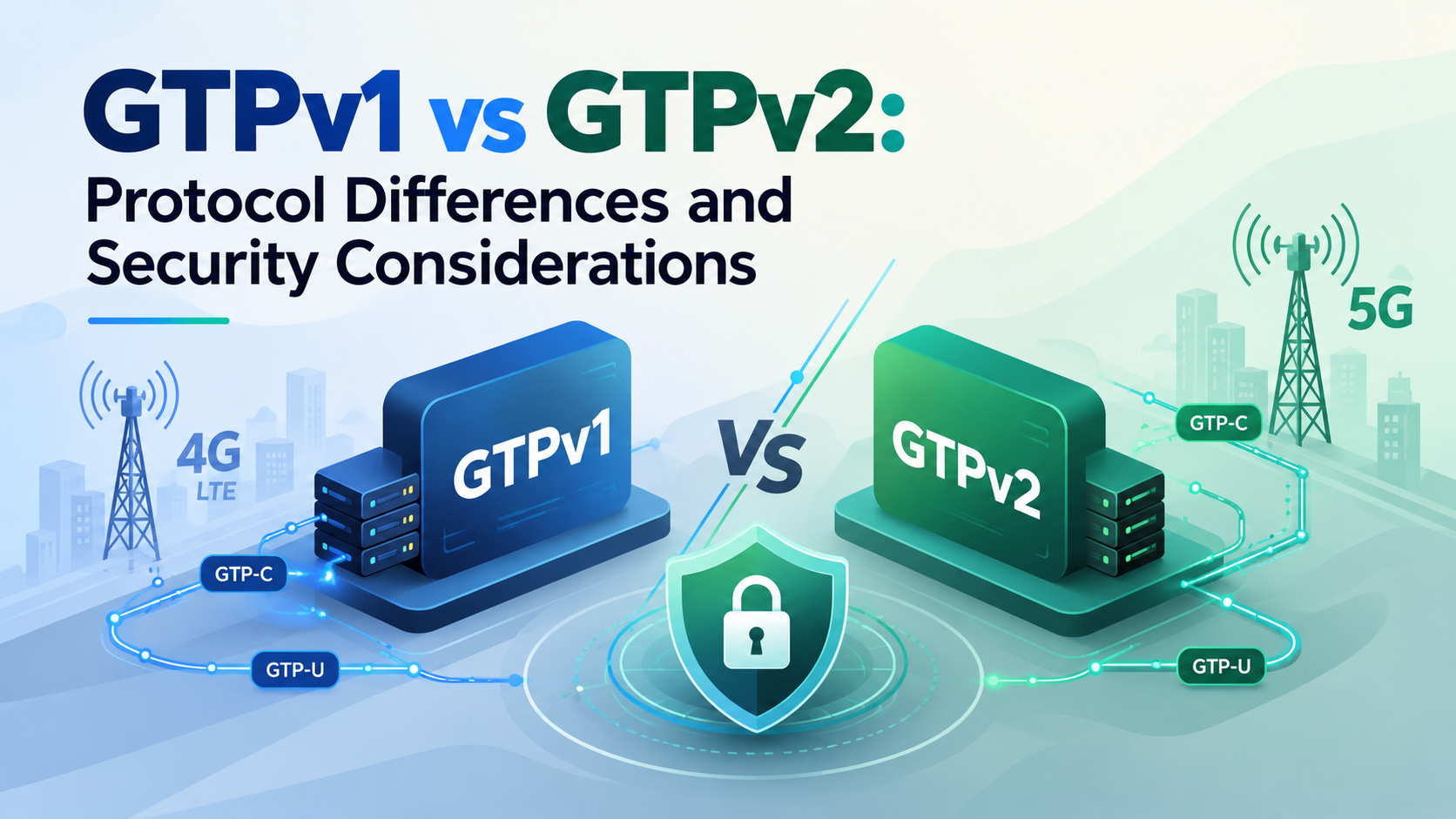

GPRS Tunnelling Protocol (GTP) plays an important role in mobile networks by supporting data sessions, mobility and communication between network elements. Understanding GTPv1 vs GTPv2 helps telecom operators identify which protocol implementations are present in their infrastructure and how to protect them against potential security threats.
Although both versions belong to the GTP protocol family, they serve different purposes depending on the interface and network architecture. Their security considerations also vary according to how control signaling and user data are handled.
This guide explains the differences between GTPv1 and GTPv2, their relationship with GTP-C and GTP-U, and why appropriate GTP security testing is important for LTE and modern mobile networks.
GTP is a group of IP-based protocols used in mobile network architectures to manage tunnel-related signaling and transport encapsulated user traffic. It supports mobile packet-data services across GPRS, UMTS and LTE, and remains relevant to specified interfaces in 5G systems.
The GTP protocol family includes three distinct components:
When evaluating GTP protocol security, operators must consider the component, interface, protocol version and network role involved. A security review focused only on version numbers may overlook important differences between control signaling and user-plane traffic.
GTPv1 and GTPv2 are not simply interchangeable versions of the same implementation. Their use depends on the network architecture and the function being performed.
The key distinction is that GTPv2-C is the control-plane protocol introduced for the Evolved Packet System, while GTPv1-U continues to provide user-plane tunneling on applicable interfaces. Therefore, GTPv1 vs GTPv2 security should be assessed in the context of the specific protocol component rather than by assuming that every network uses one version exclusively.
GTP-C supports session establishment, modification and release between relevant mobile core network elements. In LTE, GTPv2-C is used on interfaces such as S11 and S5/S8, while GTPv1-C remains relevant in applicable legacy environments.
Potential GTP-C vulnerabilities include inadequate validation of incoming messages, insufficient peer restrictions, incorrect handling of session information and permissive interface configurations.
If these weaknesses are present, they may expose network elements to unauthorized signaling, session disruption or information disclosure.
Effective GTP control plane security involves restricting communication to authorized peers, validating messages against expected procedures, applying suitable filtering policies and monitoring suspicious signaling activity.
GTP-U carries encapsulated subscriber data between network nodes. It is used on interfaces such as S1-U and S5/S8 user-plane paths in LTE.
GTP-U vulnerabilities may arise from insufficient tunnel validation, unauthorized traffic sources, inadequate packet filtering or weaknesses in how tunnel endpoints handle incoming traffic.
Potential consequences depend on the deployment and may include unauthorized traffic injection, tunnel misuse or service disruption.
GTP user plane security therefore requires appropriate restrictions on traffic sources, validation of tunnel-related information, filtering of unexpected packets and monitoring for anomalous behavior.
Although GTP-C and GTP-U work together, their security requirements are not identical. An assessment should cover both where applicable to the operator's architecture.
The protocol version alone does not determine whether a network is secure. Several common weaknesses can affect GTP deployments:
1. Unauthorized interface access: GTP interfaces exposed to untrusted networks or unnecessary communication paths increase the attack surface.
2. Insufficient message validation: Incorrectly handled message fields, unexpected requests or inconsistent session information may create opportunities for protocol misuse.
3. Weak filtering controls: Network elements may accept traffic that does not belong to the expected interface or communication relationship.
4. Session and tunnel handling weaknesses: Inadequate validation of session context or tunnel information may expose subscribers and network services to risk.
5. Limited monitoring: Without suitable logging and anomaly detection, suspicious signaling patterns may remain unnoticed.
These are assessment areas, not proof that a particular implementation is vulnerable. Their actual significance must be established through authorized testing and technical analysis.
GTP security in LTE depends on the interfaces and protocol components deployed within the Evolved Packet Core. GTPv2-C supports control-plane procedures on interfaces such as S11 and S5/S8, while GTPv1-U transports user traffic on relevant LTE interfaces.
GTP in 5G networks requires a similarly architecture-specific approach. GTP-U is specified for interfaces including N3 and N9 in the 5G System. This does not mean that GTPv2-C is used universally across the 5G core.
For operators managing legacy, LTE and 5G environments, the assessment should identify:
This approach supports a more accurate understanding of mobile core network security than treating GTPv1 or GTPv2 as a standalone measure of risk.
A structured GTP security assessment helps determine whether protocol handling and network controls are appropriate for the deployed architecture.
A typical assessment may include four stages:
The scope should explicitly distinguish GTP-C from GTP-U and identify the applicable protocol versions. Testing should be authorized, controlled and planned to minimize the risk of disrupting live subscriber services.
Matrix Shell's Signaling Security Testing service is a relevant starting point for telecom operators seeking to evaluate their signaling infrastructure.
Understanding GTPv1 vs GTPv2 is essential for assessing security across mobile core networks. GTPv1-C and GTPv2-C serve control-plane functions in their respective environments, while GTPv1-U carries encapsulated user data on applicable interfaces.
Strong GTP protocol security depends on more than identifying the protocol version. Operators must also evaluate interface exposure, peer authorization, message validation, tunnel handling, filtering and monitoring.
A structured GTP security testing programme helps identify weaknesses in the components actually deployed and supports practical improvements to subscriber protection, service reliability and network resilience.
Strengthen your mobile core network security: Explore Matrix Shell's Signaling Security Testing services to learn more about evaluating GTP-related risks.