Blog
.png)
When telecom fraud happens — whether it's SMS interception, call redirection, or unauthorized access — the root cause is rarely visible to end users. It almost always starts within the signaling layer.
This hidden layer controls how networks communicate, authenticate users, and route traffic. And when it's vulnerable, attackers don't need to hack devices — they simply exploit the network itself. That's why signaling security testing has become one of the most effective ways to prevent both fraud and large-scale network disruptions.
Telecom signaling protocols (SS7, Diameter, GTP, and 5G APIs) were built on trust-based communication models. This creates a major problem: if an attacker gains access, the network may treat malicious requests as legitimate.
According to ENISA, telecom signaling systems carry medium to high risk, especially due to weak validation and interconnect exposure. Industry research further shows attackers actively exploit signaling to perform impersonation, data theft, and service disruption.
Key Insight: Most telecom fraud doesn't break the system — it uses the system exactly as designed, exploiting its trust assumptions.
Attackers exploit SS7 vulnerabilities to intercept OTP messages, bypass two-factor authentication, and access banking and enterprise systems. Research confirms SS7 attacks can intercept messages and redirect communications for fraud.
By manipulating signaling messages, attackers can impersonate legitimate users, access network services, and generate fraudulent activity — directly impacting mobile network authentication security.
Attackers can request location data using signaling queries, leading to privacy violations, regulatory risks, and targeted fraud. SS7 vulnerabilities allow real-time tracking of users without consent.
Signaling manipulation enables call rerouting, voice interception, and caller ID spoofing. These attacks are frequently used in fraud campaigns targeting both consumers and enterprises.
Fraud is only part of the problem — signaling weaknesses also impact network stability.
Attackers flood signaling systems with requests, overloading network elements, causing service outages, and disrupting communication. GTP and Diameter vulnerabilities can expose networks to significant DoS risks.
The control plane manages core network operations. If overloaded, network performance drops, services become unstable, and large-scale outages can occur.
Because telecom networks are interconnected, one vulnerable operator can impact others — with attacks spreading across roaming networks. This makes telecom network disruption prevention a shared industry responsibility.
Signaling security testing is the process of identifying vulnerabilities across telecom signaling protocols before attackers can exploit them. It includes:
Testing identifies missing validation checks, unauthorized access paths, and identity spoofing risks before they can be exploited.
By simulating attacks, operators can block malicious signaling messages and restrict access to network functions.
Testing ensures sensitive data is not exposed and privacy risks are minimized — strengthening subscriber data protection in telecom.
Operators can detect SMS interception paths, call manipulation risks, and billing fraud vulnerabilities before they are exploited in the wild.
Testing ensures stable signaling communication, proper request validation, and reduced overload risk across the network.
It enables detection of abnormal signaling behavior and early identification of attacks before they escalate.
By simulating overload scenarios, operators can strengthen defenses and improve overall network stability.
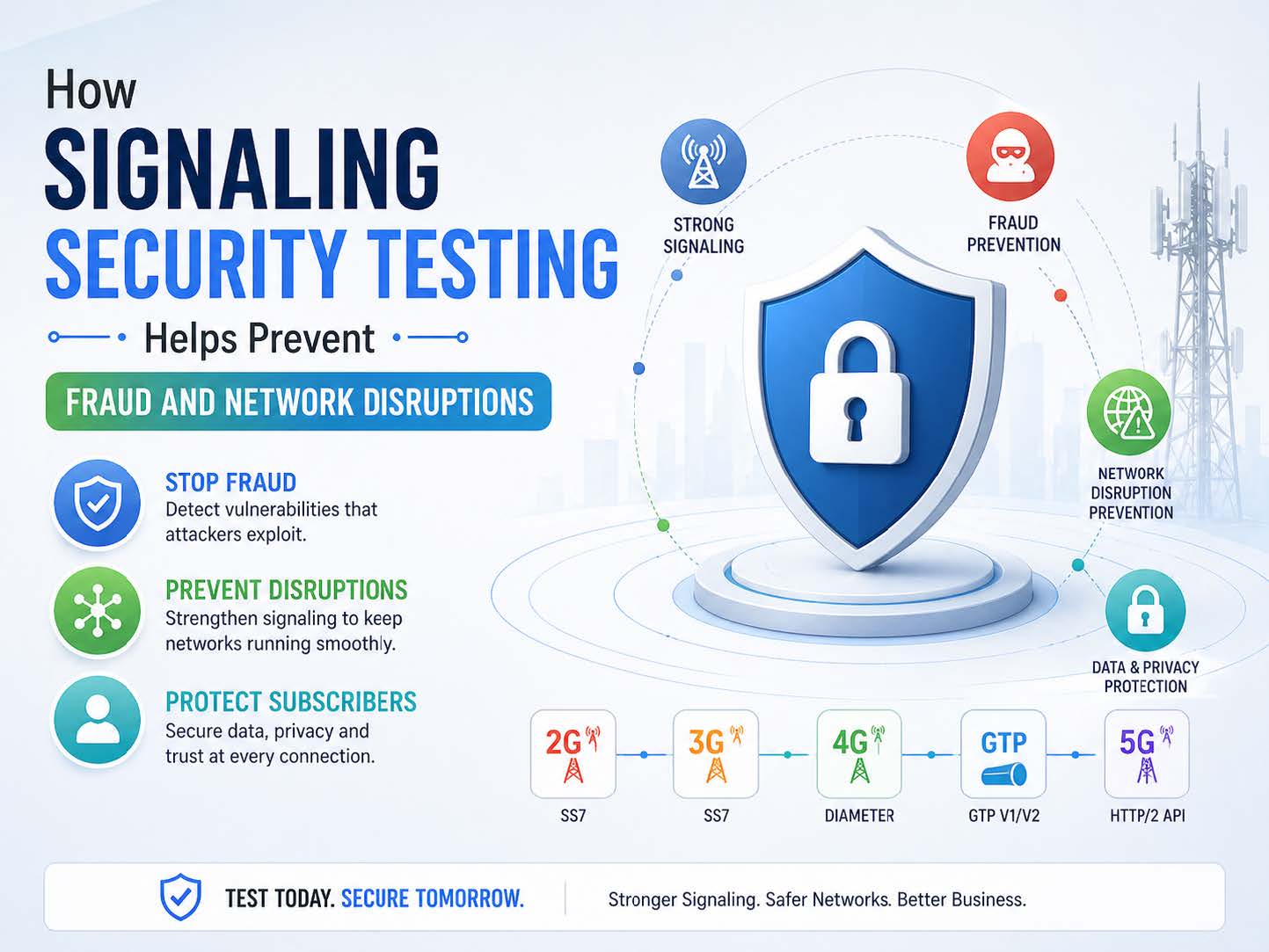
Modern networks rely on SS7 (2G/3G), Diameter (4G), GTP (data layer), and HTTP/2 APIs (5G). Testing ensures telecom network security across all generations simultaneously.
Signaling threats are not static — they evolve due to new interconnections, API-driven architectures, and increasing attack sophistication. Reports show signaling-based attacks include impersonation, message tampering, and resource exhaustion across networks. This makes continuous mobile network security testing essential, not optional.
Fraud and network disruptions in telecom don't happen randomly — they exploit weaknesses in signaling systems. By adopting continuous signaling security testing, telecom operators can detect vulnerabilities early, prevent attacks, and ensure stable, secure network operations.
In today's interconnected telecom environment, this is not just a security measure — it's a business necessity.