Blog
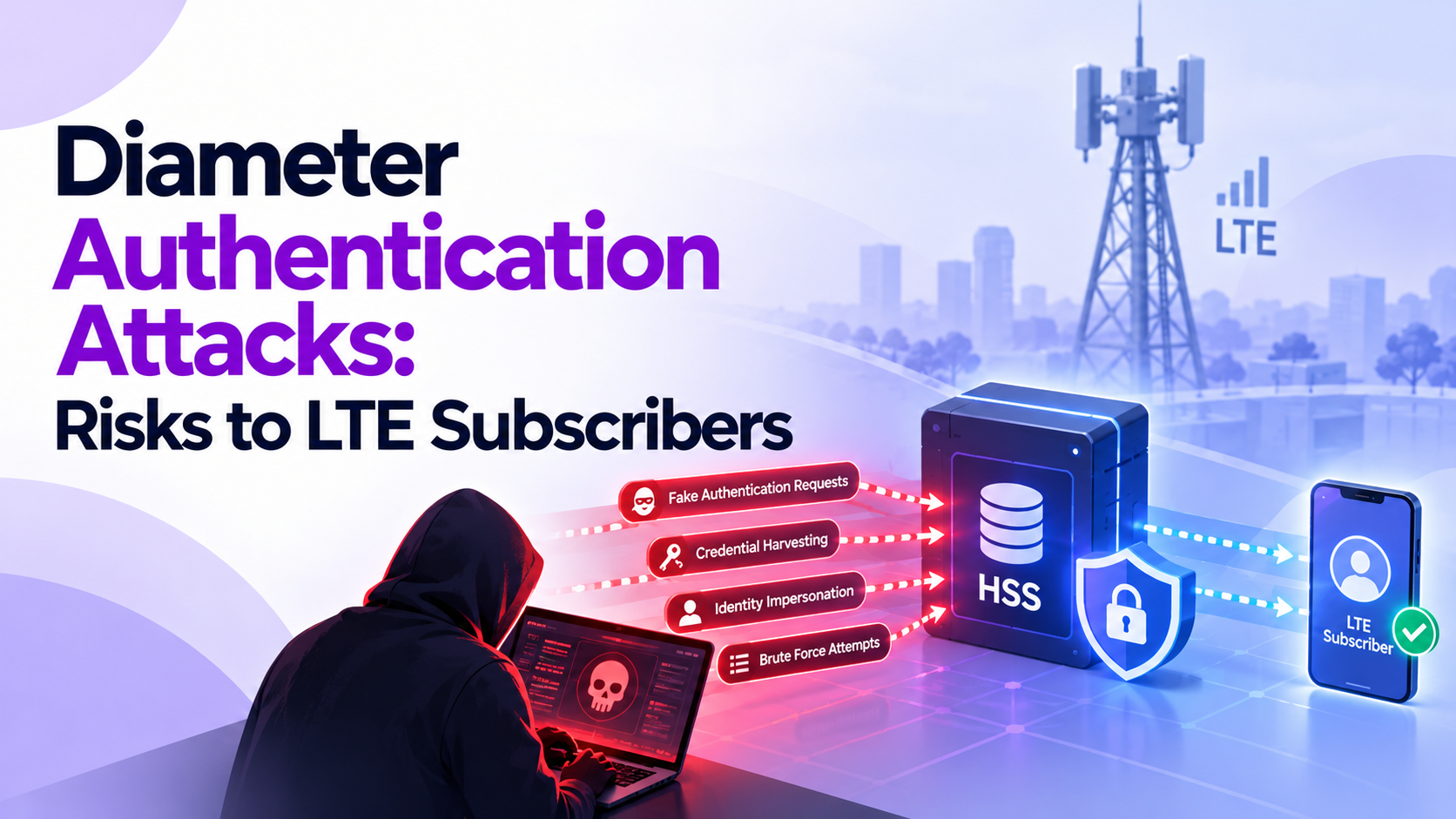

Diameter plays a central role in 4G/LTE networks, supporting authentication, authorization, mobility management, subscriber information exchange, and other critical signaling functions.
These capabilities make Diameter essential to network operations, but they also mean that weaknesses in Diameter signaling can have consequences beyond the network itself. If authentication-related Diameter traffic is abused or improperly protected, attackers may potentially target subscriber information, authentication processes, location-related data, or subscriber profiles.
Understanding Diameter authentication attacks is therefore important for telecom operators and security teams responsible for protecting LTE core networks.
This article explains how authentication-related attacks can affect subscribers, why Diameter subscriber data security matters, how Diameter location tracking and location privacy can become security concerns, and how subscriber profile manipulation can create additional risks.
Diameter authentication attacks are attacks that target the authentication-related signaling exchanged between Diameter-enabled network elements.
In LTE, authentication involves communication between core network functions such as the MME and HSS. Diameter signaling carries information needed to authenticate subscribers and support secure access to network services.
An attacker who gains unauthorized access to Diameter signaling or compromises a trusted signaling environment may attempt to abuse this communication.
Potential objectives can include:
The exact impact depends on the attack, network architecture, security controls, and level of access available to the attacker.
Authentication is one of the foundational functions of a mobile network.
Before a subscriber can access network services, the network needs to establish that the subscriber is authorized to use those services.
Diameter signaling supports several processes around this authentication environment.
If an attacker can interfere with these processes, the consequences may include:
For this reason, protecting authentication-related Diameter signaling is also an important part of broader Diameter subscriber data security.
LTE networks process significant amounts of subscriber-related information.
Depending on the Diameter application and network function, signaling may involve information related to:
Unauthorized access to this information could create privacy and security concerns.
Diameter subscriber data security therefore requires controls that restrict who can access subscriber-related signaling and ensure that messages are appropriately validated.
Operators should consider:
The impact of an authentication attack is not limited to a signaling system.
Depending on the scenario, subscribers could experience:
Authentication Disruption
An attacker may generate or manipulate signaling in a way that interferes with legitimate authentication procedures.
This could result in subscribers being unable to connect to network services.
Subscriber Information Exposure
If unauthorized parties gain access to signaling traffic, sensitive subscriber-related information could potentially be exposed.
Privacy Risks
Location-related signaling can create additional privacy concerns if it is improperly accessed or abused.
Profile Abuse
If subscriber profile information is manipulated, the network could potentially apply incorrect permissions or service information to a subscriber.
Service Availability Issues
Large volumes of authentication-related signaling can contribute to resource exhaustion or denial-of-service conditions.
One of the significant privacy concerns associated with signaling security is Diameter location tracking.
Mobile networks need location-related information to support legitimate functions such as mobility management and service delivery.
However, location information can become sensitive when accessed by unauthorized parties.
An attacker who gains inappropriate access to signaling information may attempt to infer or obtain information about a subscriber's network location.
This creates a location privacy concern.
Location information can potentially reveal:
The sensitivity of such information means that operators need appropriate access controls and monitoring around Diameter signaling.
Location information can be highly sensitive because it can reveal patterns about an individual's movements or activities.
Strong location privacy requires operators to ensure that only authorized network functions and trusted relationships can access relevant information.
Security controls should include:
Operators should also minimize unnecessary exposure of subscriber information across network boundaries.
Another potential risk is subscriber profile manipulation.
Subscriber profiles contain information that influences how network services are provided.
Depending on the network architecture, subscriber-related information may influence:
If an attacker can manipulate relevant signaling or gain unauthorized access to subscriber information, the integrity of these profiles could potentially be affected.
Possible consequences include:
Protecting profile integrity is therefore an important component of Diameter subscriber data security.
Operators should monitor for unusual patterns that could indicate authentication-related attacks.
Potential indicators include:
No single indicator automatically confirms an attack. However, several anomalies occurring together should trigger investigation.
A layered approach is important.
1. Restrict Diameter Peers
Only authorized systems should be permitted to communicate with protected Diameter infrastructure.
2. Apply Message Filtering
Filter signaling based on approved applications, commands, routing information, and security policies.
3. Validate Diameter Messages
Messages and relevant AVPs should be validated according to applicable network and application requirements.
4. Protect Subscriber Information
Access to subscriber-related signaling should follow least-privilege principles.
5. Monitor Authentication Traffic
Establish normal authentication traffic baselines and investigate significant deviations.
6. Protect External Connections
Roaming and interconnect-facing Diameter relationships should receive appropriate security controls.
7. Test Security Controls
Regular Diameter security testing can help identify weaknesses in authentication-related signaling and associated controls.
Security testing can help operators evaluate whether their controls can withstand realistic attack scenarios.
A controlled assessment may examine:
Testing should be performed under controlled conditions, using approved test subscribers and systems where appropriate.
Diameter authentication attacks can create risks that extend beyond the signaling layer and potentially affect LTE subscribers.
Because Diameter supports authentication, subscriber information exchange, mobility, and other core functions, weaknesses can contribute to information exposure, service disruption, privacy concerns, and subscriber profile manipulation.
Strong Diameter subscriber data security requires a layered approach combining peer controls, message validation, filtering, monitoring, secure transport, and security testing.
Particular attention should also be given to Diameter location tracking and location privacy, especially where signaling crosses roaming or interconnect boundaries.
For telecom operators, continuously monitoring authentication activity and testing Diameter security controls can help identify weaknesses before they develop into larger subscriber-facing risks.