Blog
.png)
Subscriber identity is the root of trust in mobile networks. Every device authentication, session establishment, and service access depends on the integrity of the Subscriber Identity Module (SIM) or embedded SIM (eSIM).
However, with the rise of remote provisioning, OTA updates, and cloud-integrated telecom infrastructure, traditional assumptions around mobile network authentication security are no longer sufficient.
This is where SIM & eSIM security testing becomes critical—not just to identify vulnerabilities, but to ensure secure subscriber identity management across evolving telecom ecosystems.
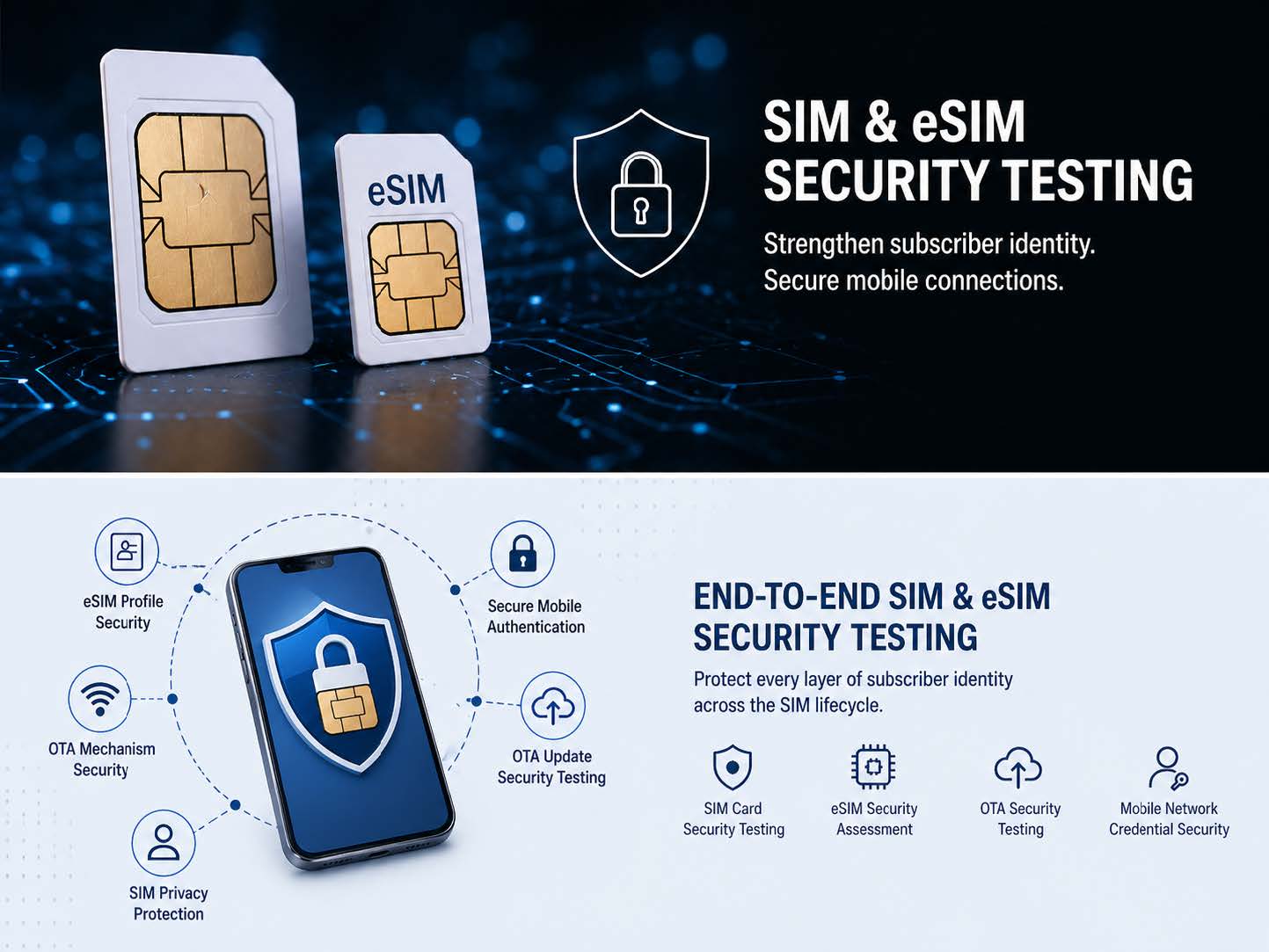
SIM and eSIM security testing is the process of evaluating vulnerabilities across:
Unlike general cybersecurity testing, SIM card security testing focuses on telecom-specific risks tied to identity, encryption keys, and lifecycle management.
According to GSMA, SIM and eSIM technologies provide a secure element for authenticating devices onto mobile networks, but require strict compliance frameworks and continuous validation to maintain security integrity.
Traditional SIM cards are hardware-based and physically replaceable. In contrast, embedded SIM security (eSIM security) introduces:
While this improves scalability and flexibility, it also introduces new eSIM security risks. ENISA highlights that eSIM ecosystems can be exposed to threats such as profile manipulation, remote takeover attempts, and service disruption if provisioning systems are not secured properly.
Weak protection of authentication keys can compromise subscriber credential protection, allowing attackers to impersonate users or intercept communications.
eSIM relies on remote provisioning via secure servers. However, research shows that compromised provisioning workflows or servers can introduce attack paths if trust relationships are broken.
OTA security testing is critical because OTA mechanisms control SIM updates. If improperly secured, attackers can:
Modern telecom networks rely on secure mobile authentication to maintain trust between devices and operators.
Without continuous SIM vulnerability assessment and eSIM security testing, operators risk:
GSMA security frameworks emphasize that strong encryption, secure profile management, and compliance testing are essential to ensure mobile communication security and protect sensitive subscriber data.
To manage evolving risks, telecom operators must move beyond static controls. They require:
As telecom networks evolve toward cloud-native and remotely managed architectures, SIM & eSIM security has become central to infrastructure protection.
Securing subscriber identity requires continuous validation across authentication systems, OTA channels, and provisioning frameworks.
Operators that invest in proactive SIM security testing and eSIM security assessment will be better positioned to protect subscriber data, maintain compliance, and ensure long-term network trust.