
Blog
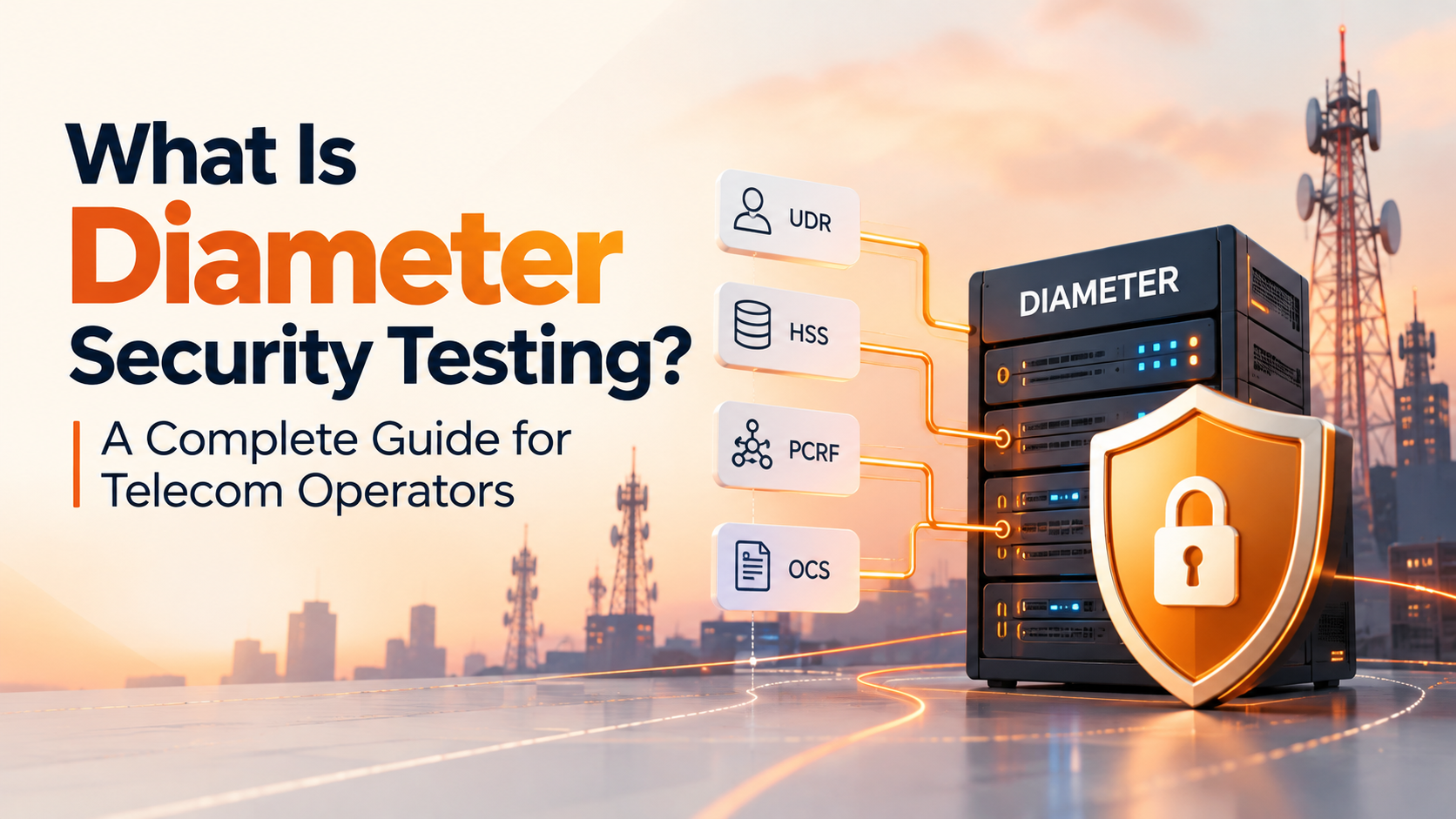

Diameter is a critical signaling protocol used across 4G/LTE mobile networks to support authentication, authorization, subscriber management, policy control, charging, and roaming. Because Diameter messages can carry sensitive subscriber and network information, weaknesses in Diameter deployments can create significant security risks.
What is Diameter security testing? It is a structured process for evaluating the security of Diameter-based signaling infrastructure, identifying vulnerabilities, validating security controls, and determining whether unauthorized or malicious signaling activity can affect network services or subscribers.
For telecom operators, Diameter security testing provides a way to validate whether signaling interfaces, trusted peers, roaming connections, and security controls are adequately protected against real-world threats.
Diameter was designed with security mechanisms for protecting communications between peers. The Diameter base protocol requires secure transport mechanisms such as TLS, DTLS, or IPsec for protected communications. However, secure transport alone does not eliminate every risk associated with signaling, peer authorization, configuration, application exposure, or message handling.
The risk becomes more significant when Diameter is used across roaming and inter-operator environments, where signaling traffic may cross network boundaries and involve multiple trusted entities.
A properly designed Diameter security assessment therefore needs to look beyond encryption and evaluate how the protocol is actually deployed.
For example, security testing can help identify whether an operator’s infrastructure is vulnerable to:
A comprehensive Diameter security testing program should examine the protocol, network architecture, interfaces, trusted relationships, and security controls surrounding Diameter traffic.
Diameter networks rely on trusted relationships between communicating peers. Testing should verify whether only authorized systems can establish Diameter relationships and whether peer identities are properly validated.
This can include reviewing:
Weak peer validation can increase the risk of unauthorized signaling entering the network.
Diameter uses Attribute-Value Pairs (AVPs) to carry information within messages. Security testing should evaluate how systems handle unexpected, malformed, unauthorized, or inappropriate AVPs.
Testing can assess whether network elements properly validate:
This is an important part of a Diameter vulnerability assessment because weaknesses in message validation can expose signaling interfaces to manipulation or abuse.
The S6a interface is particularly important in LTE environments because it supports signaling between the Mobility Management Entity (MME) and Home Subscriber Server (HSS).
A Diameter security assessment can evaluate whether S6a-related signaling is adequately protected against unauthorized requests and inappropriate access to subscriber-related information.
Testing may examine authentication-related signaling, subscriber information requests, location-related procedures, and the controls governing communication between network elements.
This makes S6a security testing an important component of a broader LTE Diameter security testing program.
Diameter is heavily used for inter-operator signaling and roaming. These environments introduce additional trust boundaries and security considerations.
Diameter interconnect security testing should assess whether external or roaming peers can access only the Diameter applications and resources they are authorized to use.
Areas of assessment may include:
This is particularly relevant to operators that exchange Diameter traffic through roaming and interconnect environments.
The objective of a Diameter security audit is not simply to confirm that security controls exist. It is to determine whether those controls work effectively against realistic scenarios.
Potential findings can include:
Improperly controlled Diameter requests could potentially be used to interact with authentication-related functions or obtain information that should not be accessible.
Diameter signaling can involve sensitive subscriber information. Weak access controls or insufficient filtering can increase the risk of unauthorized information disclosure.
Certain Diameter procedures can provide information associated with subscriber mobility and network location. Testing can identify whether these functions can be abused by unauthorized parties.
Security weaknesses affecting subscriber-related signaling may create opportunities for unauthorized manipulation or misuse of subscriber profiles.
Diameter infrastructure can also be assessed for resilience against excessive or abnormal signaling activity. Testing helps determine whether rate controls, filtering, and other protections can prevent signaling abuse from affecting legitimate users.
A typical Diameter security testing methodology can include several stages.
First, the testing team maps the Diameter architecture and identifies relevant interfaces, peers, applications, and trust boundaries.
Next, security controls and configurations are reviewed to understand how Diameter traffic is authenticated, authorized, filtered, routed, and monitored.
Controlled testing is then performed against the agreed test environment. This can include validation of peer security, message handling, application exposure, access controls, abnormal signaling behavior, and selected attack scenarios.
Finally, findings are documented according to severity and business impact. Recommendations are provided to address weaknesses, followed by remediation validation where required.
For production-sensitive environments, testing should be carefully controlled. Dedicated test subscribers and agreed testing windows help ensure that assessment activities do not affect live subscribers or network operations.
Diameter remains an important component of 4G/LTE core-network signaling and continues to matter in environments where operators operate hybrid or evolving networks.
A Diameter security assessment helps operators move from assumed security to validated security. Instead of relying only on network architecture, firewalls, or protocol-level protections, operators can verify whether their Diameter deployment withstands realistic security scenarios.
A comprehensive assessment can help organizations:
What is Diameter security testing? In simple terms, it is the process of testing Diameter-based signaling infrastructure to identify vulnerabilities, validate security controls, and determine whether unauthorized or malicious signaling can compromise network operations or subscriber security.
For telecom operators, Diameter security testing should cover more than the protocol itself. It should consider peer trust, signaling interfaces, S6a security, roaming, interconnects, message validation, subscriber-related procedures, and denial-of-service resilience.
A structured Diameter security assessment can therefore provide operators with practical visibility into their signaling security posture and help identify weaknesses before they can be exploited against critical telecom infrastructure.





