Blog
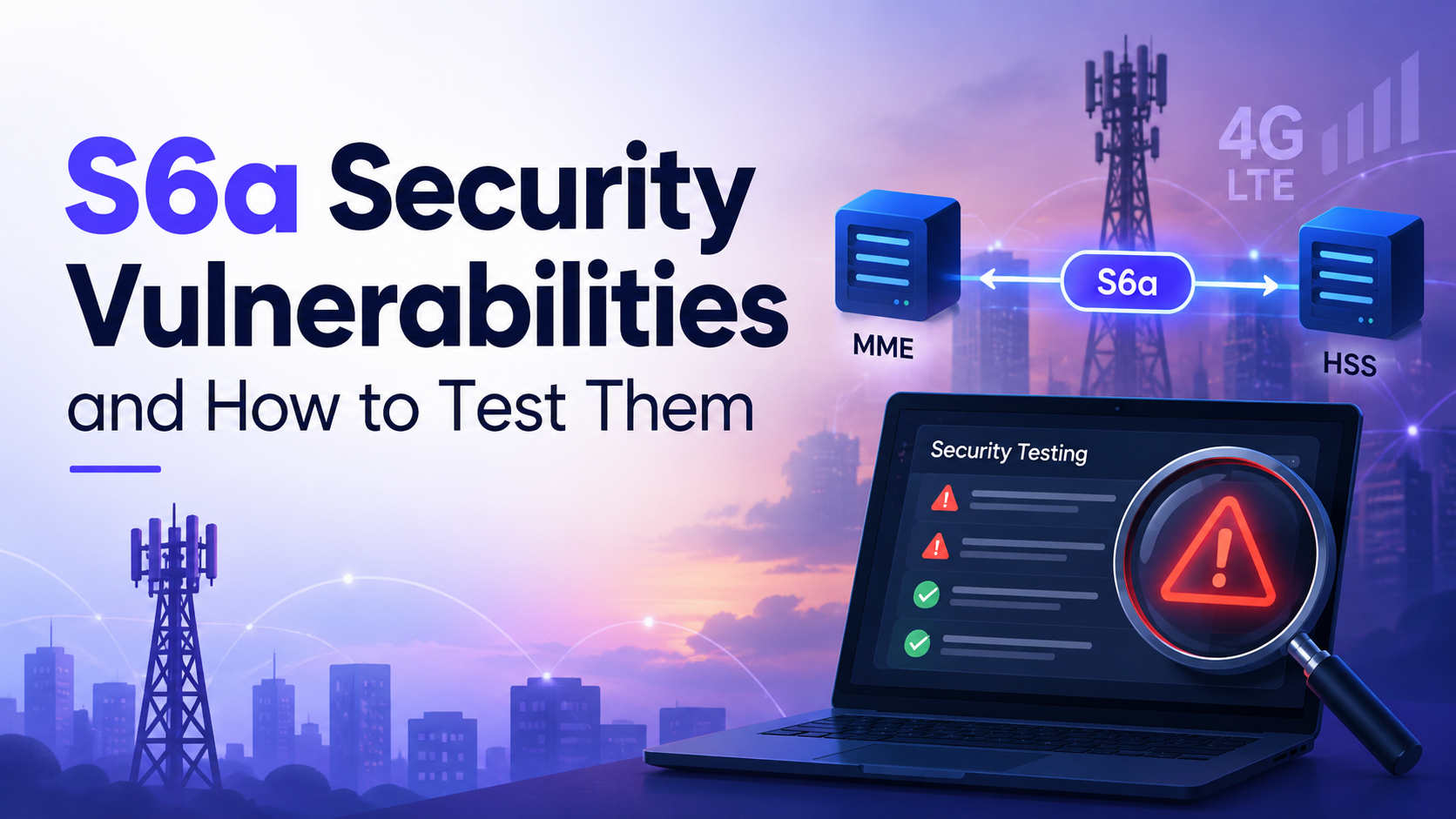

The S6a interface is a critical part of 4G/LTE networks, enabling communication between the Mobility Management Entity (MME) and Home Subscriber Server (HSS). It carries information required for subscriber authentication, authorization, mobility management, and access to subscriber profiles.
Because S6a uses the Diameter protocol, weaknesses in its implementation, configuration, peer relationships, or security controls can create risks across the LTE core network.
This makes S6a security an important part of broader telecom signaling security.
An effective security program should therefore address S6a vulnerabilities, understand potential S6a risks, and regularly perform S6a security testing and S6a security assessment.
S6a security refers to the security controls and testing practices used to protect the S6a interface between the MME and HSS.
The interface exchanges sensitive signaling and subscriber-related information, making appropriate authentication, authorization, transport protection, message validation, access control, and monitoring important.
S6a Diameter security is therefore closely connected to overall Diameter security.
A security assessment typically examines whether:
S6a should not be treated as an isolated interface. Its security should be considered as part of the wider LTE core and Diameter security testing strategy.
S6a sits between two important LTE core components: the MME and HSS.
The MME manages mobility and access-related functions, while the HSS maintains subscriber information and authentication-related data. Communication between these systems therefore needs to be protected against unauthorized access and manipulation.
Weak S6a Diameter security can potentially contribute to risks involving:
The exact impact depends on the network architecture, implementation, configuration, and security controls in place.
For this reason, MME HSS security should include dedicated consideration of the S6a interface.
Understanding common S6a vulnerabilities is the first step toward building an effective testing strategy.
S6a communication depends on trusted Diameter peers.
If peer authentication is weak or improperly configured, an unauthorized system could potentially attempt to establish a Diameter relationship with an MME or HSS.
During S6a testing, security teams should verify:
Authentication establishes who a peer is, but authorization determines what that peer is allowed to do.
A network may therefore have authentication controls while still having overly broad trust relationships.
An S6a security assessment should examine whether:
This is particularly important when S6a-related signaling crosses organizational or network boundaries.
Diameter messages contain Attribute-Value Pairs (AVPs) that carry information required for signaling procedures.
Improper validation can increase the risk associated with malformed, unexpected, or unauthorized messages.
S6a security testing should therefore evaluate whether the network:
The goal is not simply to check whether messages are transmitted successfully, but whether they are handled securely.
Protecting Diameter traffic during transmission is an important component of S6a Diameter security.
Security teams should verify how signaling traffic is protected between trusted systems and whether appropriate transport security mechanisms are implemented.
An assessment can examine:
Transport security should be evaluated alongside peer authentication and authorization rather than treated as a standalone control.
A common security concern is excessive trust.
If the network assumes that a connected Diameter peer is automatically trustworthy, an attacker who gains access to an approved signaling path could potentially have more opportunity to abuse legitimate signaling capabilities.
Testing should therefore determine whether trust is:
This becomes particularly important in roaming environments.
The S6a interface can carry information associated with subscriber authentication, subscription, and mobility procedures.
Poor access controls or insufficient filtering can increase the possibility of unauthorized access to sensitive information.
An S6a security assessment should therefore determine whether:
S6a supports procedures associated with subscriber authentication.
Weak controls around authentication-related signaling can therefore create security concerns.
Testing should evaluate whether authentication-related requests:
This forms an important part of MME HSS security.
LTE signaling can involve information related to subscriber mobility and network location.
If signaling controls are weak, unauthorized access to such information could create privacy and security concerns.
S6a risks should therefore include consideration of:
The assessment should focus on validating whether such requests are authorized within the intended network context.
Spoofing occurs when an unauthorized party attempts to present itself as a legitimate signaling entity or manipulate signaling identity information.
For S6a security testing, this means evaluating whether:
Spoofing should be assessed together with peer authentication and authorization.
S6a signaling can also be exposed to availability-related threats.
Excessive or malformed signaling could potentially consume resources or interfere with normal signaling operations.
An assessment can evaluate controls for:
Testing should be performed in a controlled environment or against dedicated test subscribers to avoid disruption to live customers.
A structured S6a testing process should combine configuration assessment, vulnerability assessment, security-control validation, and controlled security testing.
Begin by identifying:
The objective is to understand the actual S6a communication path before testing begins.
The assessment should map:
MME → S6a → HSS
The security team should identify where authentication, authorization, filtering, monitoring, and transport protection are applied.
This helps identify trust boundaries and potentially exposed signaling paths.
The next stage evaluates the trust relationship between Diameter peers.
Testing should verify:
This is one of the most important areas of S6a security testing.
Security testers can evaluate how the environment handles expected and unexpected Diameter messages.
This may include controlled validation of:
The purpose is to determine whether the S6a implementation securely handles signaling input.
Testing should verify whether appropriate security controls protect S6a communication in transit.
The assessment should consider:
Access controls should be tested to determine whether only legitimate systems and signaling relationships can perform relevant operations.
The assessment should look for:
A secure S6a environment should not only prevent unauthorized activity; it should also provide visibility into suspicious signaling.
Monitoring should be reviewed for indicators such as:
This allows operators to identify potential attacks and investigate suspicious activity.
The two terms are related but can describe different activities.
A broader S6a security assessment can establish the security posture of the interface, while deeper S6a security testing can validate whether identified weaknesses can actually affect the environment under controlled conditions.
Organizations can use the following checklist when reviewing their S6a security posture:
A strong S6a security program should combine multiple layers of protection.
1. Restrict Trusted Peers
Only legitimate Diameter peers should be able to communicate with S6a endpoints.
2. Strengthen Authentication and Authorization
Authentication and authorization should work together to ensure that connected systems are both known and permitted.
3. Validate Diameter Messages
Implement appropriate validation for messages and AVPs to reduce the risk of malformed or unauthorized signaling.
4. Protect Signaling Transport
Use appropriate transport-level security and network controls to protect signaling communication.
5. Apply Filtering
Filtering can help prevent unnecessary or unauthorized signaling from reaching critical S6a systems.
6. Monitor Signaling
Continuous monitoring helps operators identify abnormal signaling patterns and investigate potential threats.
7. Test Regularly
S6a security testing should be repeated after major architecture, configuration, roaming, or security-control changes.
8. Use Controlled Test Subscribers
Where security testing involves authentication, subscriber data, or signaling behavior, dedicated test subscribers can help reduce the risk of affecting live customers.
S6a is one component of the broader Diameter ecosystem.
Consequently, an operator should not assess S6a security in isolation.
A broader Diameter security testing program can evaluate additional areas such as:
This creates a more complete view of the operator's Diameter security posture.

Case Study