Blog
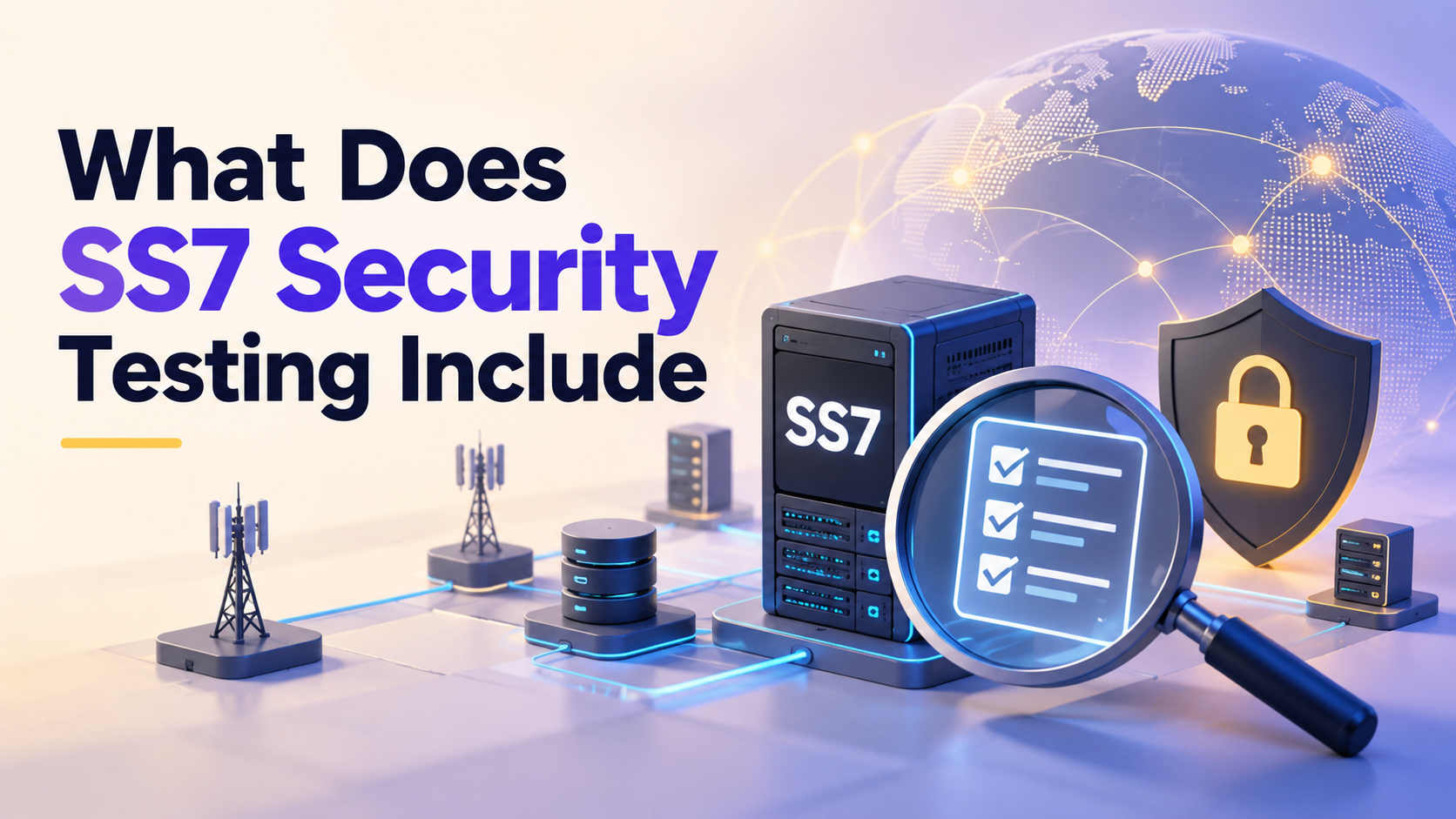

SS7 security testing is a specialized assessment that examines the security of telecom signaling infrastructure and identifies weaknesses that could be exploited to access subscriber information, track users, intercept SMS messages, manipulate services, commit fraud, or disrupt network operations.
But what exactly does an SS7 security assessment cover?
The SS7 security testing scope can vary depending on an operator’s architecture, signaling connections, network elements, and security requirements. A comprehensive assessment typically examines signaling exposure, message validation, access controls, filtering, subscriber privacy, SMS security, location related signaling, firewall effectiveness, monitoring, and network resilience.
Understanding what testing includes helps telecom operators determine whether their signaling defenses provide adequate protection.
A comprehensive SS7 security testing program generally covers several security domains rather than focusing on a single vulnerability.
The key areas include:
The exact SS7 security testing scope should be adapted to the operator’s network and risk profile.
Testing begins by understanding how SS7 signaling is deployed and where signaling traffic enters and leaves the network.
Security teams assess elements such as:
The objective is to identify potential exposure points and determine which external entities can interact with the signaling environment.
Architecture visibility is essential because an operator cannot adequately protect signaling paths it has not identified.
SS7 environments often involve relationships between multiple telecom operators and signaling providers.
These relationships need to be assessed to determine whether external signaling sources have appropriate access.
The assessment may examine:
Weak or overly broad trust relationships can increase the attack surface.
One of the most important areas within the SS7 security testing scope is message validation.
A signaling message can be technically valid while still being inappropriate for the context in which it is received.
Testing can evaluate whether the network validates requests based on:
The objective is to determine whether unauthorized signaling requests are correctly rejected or restricted.
SS7 signaling can involve sensitive subscriber and network information.
SS7 test cases can therefore assess whether unauthorized signaling requests can obtain information that should be protected.
Testing may examine exposure involving:
The findings can help operators strengthen controls around sensitive subscriber operations.
Location-related signaling is another important area of SS7 security assessment.
Attackers may attempt to abuse signaling functions to determine a subscriber’s serving network or obtain location-related information.
Relevant SS7 test cases can evaluate whether:
Protecting location information is important for both subscriber privacy and telecom security.
SMS-related signaling deserves specific attention because SMS continues to support communication, notifications, and authentication workflows.
Testing can assess whether signaling weaknesses could potentially enable:
The assessment should also determine whether signaling firewalls and other security controls correctly identify and restrict unauthorized SMS activity.
Another component of the SS7 security testing scope is the assessment of signaling functions associated with voice and subscriber services.
Security teams can evaluate whether unauthorized signaling requests could potentially influence call routing or related network services.
This helps identify weaknesses that may enable service manipulation or contribute to telecom fraud.
Where an operator has an SS7 firewall, testing should determine whether the firewall provides the protection expected from its configured policies.
Relevant SS7 test cases may evaluate whether:
Testing is especially valuable because the presence of an SS7 firewall does not guarantee that its configuration is effective.
Access control determines which entities can interact with signaling functions and what they are permitted to do.
Testing can evaluate whether signaling permissions follow appropriate security principles.
Security teams should look for:
Reducing unnecessary access can significantly reduce potential attack paths.
Effective SS7 security testing should also assess the operator’s ability to identify suspicious signaling behavior.
Testing can evaluate whether monitoring systems detect:
This is important because some malicious requests may appear legitimate when examined individually but become suspicious when analyzed as a pattern.
SS7 can potentially be abused as part of telecom fraud schemes.
Testing can examine whether signaling controls prevent unauthorized operations that could facilitate fraud or service abuse.
This may include evaluating signaling access, message filtering, subscriber service controls, and monitoring capabilities.
For a broader discussion of how signaling security testing helps address fraud and network disruption, see [How Signaling Security Testing Helps Prevent Fraud and Network Disruptions].
SS7 security is not only about protecting confidentiality.
Operators should also consider the potential impact of excessive or malicious signaling activity on network availability.
Relevant SS7 test cases can evaluate how the environment responds to controlled volumes of unusual signaling traffic and whether security controls can reduce the potential impact without affecting legitimate services.
Testing should be carefully controlled, particularly when conducted in production environments.
The exact test plan depends on the operator’s environment, but common SS7 test cases may include:
These cases should be adapted to the operator’s architecture rather than applied as a generic checklist.
Defining what is not included is equally important.
Depending on the engagement, an SS7 assessment may not automatically include:
If broader telecom security coverage is required, these areas should be explicitly added to the assessment scope.
A practical SS7 security testing scope should be based on the operator’s architecture and risk exposure.
Before testing, teams should document:
This creates a clear testing boundary and helps ensure important signaling functions are not overlooked.
A narrow vulnerability check may identify individual weaknesses but fail to reveal how different weaknesses interact.
For example, a network may have an SS7 firewall but still contain overly permissive rules. Similarly, monitoring may exist but fail to detect abnormal signaling patterns.
A comprehensive SS7 security testing program evaluates the complete security chain:
Exposure → Access → Signaling Request → Validation → Filtering → Monitoring → Response
This approach provides operators with a clearer understanding of their actual signaling security posture.
Many operators continue to run SS7 alongside newer technologies.
A multi-generation environment may include:
Therefore, SS7 should be considered as one component of a broader telecom signaling security program.
Operators looking to extend security coverage across network generations can refer to [How to Build a Signaling Security Strategy for 2G, 3G, 4G, and 5G Networks].
SS7 security testing should provide a comprehensive view of how securely an operator’s signaling environment handles potentially unauthorized or malicious activity.
The SS7 security testing scope can include signaling exposure, trust relationships, message validation, subscriber information, location tracking, SMS security, call-related signaling, firewall controls, access management, monitoring, fraud risks, and network resilience.
Meanwhile, carefully designed SS7 test cases help validate whether these controls work as intended.
For telecom operators, the goal should not simply be to identify individual vulnerabilities. A comprehensive assessment should determine whether the complete signaling security chain from external access through message validation, filtering, monitoring, and response can effectively protect critical telecom services and subscribers.