Blog

Mobile networks depend on signaling protocols to establish connections, manage subscriber sessions, support roaming, and deliver data services. However, when signaling traffic is not properly validated, weaknesses can expose mobile core networks to unauthorized requests, subscriber information disclosure, and service disruption.
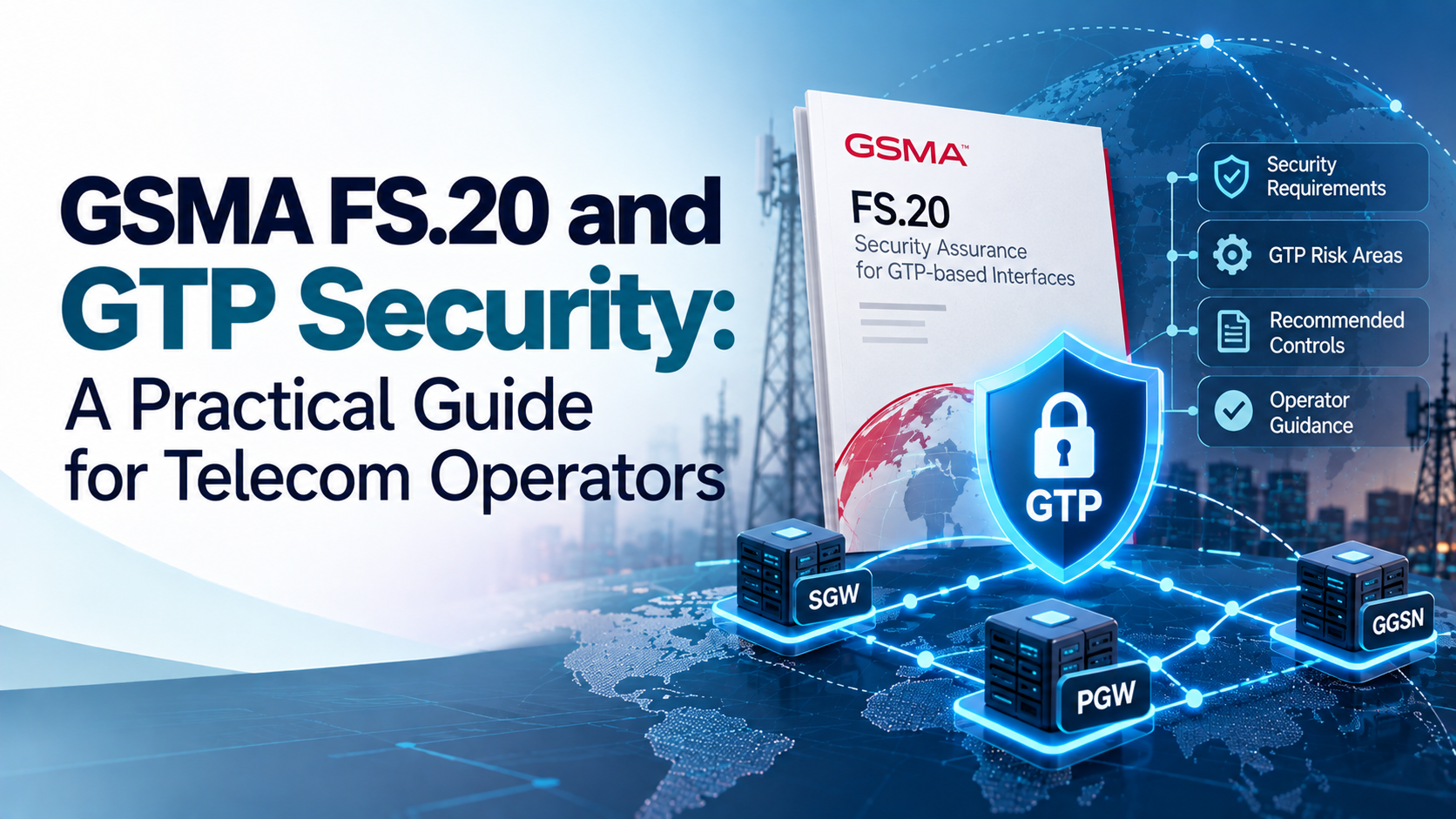
GSMA FS.20 GTP security guidance helps mobile network operators understand these risks and implement controls to protect GPRS Tunnelling Protocol (GTP) traffic. For operators managing LTE, roaming interconnections, and evolving 5G environments, understanding these recommendations is an important part of a broader telecom signaling security strategy.
GSMA FS.20 is a security guidance document focused on attacks involving GTP and the countermeasures operators can implement to reduce exposure. It discusses threats associated with GTP interfaces, including those used across GPRS Roaming Exchange (GRX) and IP Exchange (IPX) interconnections.
The guidance covers network architecture, secure configuration, GTP firewall rules, traffic filtering, and ongoing monitoring. Its purpose is to help operators identify weaknesses and strengthen the protection of their mobile core networks.
FS.20 should be treated as a technical security reference rather than a guarantee of telecom security compliance. Operators should assess its recommendations alongside their architecture, applicable regulatory obligations, vendor guidance, and other relevant security standards.
GTP enables data sessions and related signaling in mobile networks. Its control-plane and user-plane functions serve different purposes:
GTP interfaces can be exposed to traffic from roaming partners and other connected network environments. If trust boundaries, message validation, or access controls are weak, an attacker with the necessary network access may attempt to exploit GTP vulnerabilities.
Potential consequences include unauthorized signaling activity, disclosure of subscriber or session information, tunnel manipulation, and service disruption. The actual risk depends on network design, implementation, exposed interfaces, and existing security controls.
For this reason, GTP security best practices should combine network-layer protections with protocol-aware inspection and continuous validation.
Operators should identify which network elements and roaming partners need to exchange GTP messages. Configure access controls to permit only authorized sources and required traffic.
Review IP address allowlists, interconnection routes, interface exposure, and firewall policies regularly. Changes to partner infrastructure should trigger a review of the relevant rules.
A conventional IP firewall can restrict network access, but it may not fully identify malicious or invalid GTP messages. A GTP-aware firewall can inspect protocol-specific fields and apply filtering policies based on message types, interface context, and configured security rules.
Relevant controls include:
The exact rules should reflect the interfaces and GTP versions deployed. Overly restrictive rules can disrupt legitimate roaming and data services, so testing is essential before and after implementation.
Telecom signaling security requires more than a firewall. Operators should harden network elements, remove unnecessary services, restrict administrative access, patch supported software, and segment sensitive network functions.
Network-layer filtering and protocol-aware inspection serve complementary purposes. Traffic from an authorized interconnection can still contain unexpected or invalid messages, which is why GTP-specific controls remain important.
Security controls can become less effective when network configurations change or new attack patterns emerge. Operators should monitor GTP traffic for unusual message rates, unexpected peers, invalid message sequences, and other deviations from established network behavior.
Monitoring should generate actionable alerts and preserve sufficient context for investigation. Correlating signaling observations with network events and relevant operational records can help teams determine whether an anomaly indicates a genuine security incident.
GTP remains relevant in LTE and in certain 5G network architectures. In particular, 5G Non-Standalone (5G NSA) deployments can rely on the LTE Evolved Packet Core and associated GTP-based interfaces. GTP is also used on applicable interfaces in some 5G architectures.
However, 5G mobile core security is broader than GTP security alone. Not every 5G interface uses GTP, and security requirements vary by deployment model.
Operators should map the protocols and interfaces present in their own environments before applying controls. They should also consider the specific recommendations applicable to GTP-U and other relevant 5G interconnection security guidance.
A GTP security assessment should therefore verify which interfaces are deployed, how traffic flows between network elements, and whether controls match the architecture in use.
SS7, Diameter, and GTP are different telecom signaling protocols. They support different network functions and require protocol-specific security controls.
The comparison of SS7 vs GTP security and Diameter vs GTP should not be treated as a choice between competing controls. Each protocol has different attack surfaces, and weaknesses in one do not automatically establish a vulnerability in another.
For operators, a coordinated telecom signaling security strategy should assess the protocols actually deployed, their interconnections, and how risks can cross network boundaries.
A structured GTP security assessment can help operators identify gaps between documented security guidance and actual network configurations.
A practical assessment should include:
This process helps translate GSMA GTP security guidelines into practical security improvements. It should be conducted with appropriate authorization, safeguards, and coordination with network operations teams.
To learn more about identifying weaknesses in signaling environments, explore Matrix Shell’s Signaling Security Testing service and its guide to GTP security testing.
GSMA FS.20 provides useful guidance for understanding GTP-based threats and selecting appropriate countermeasures. For telecom operators, effective protection requires trusted-peer restrictions, protocol-aware firewall controls, secure network configurations, and continuous signaling monitoring.
As networks evolve, operators should review their LTE, roaming, and applicable 5G interfaces regularly rather than assuming that existing controls remain sufficient. A documented GTP security assessment can help identify gaps, prioritize remediation, and strengthen the wider telecom signaling security program.