Blog

The Diameter protocol is a critical signaling framework used across 4G/LTE networks for authentication, authorization, mobility management, policy control, charging, and subscriber-related communication.
At the heart of Diameter messages are Attribute-Value Pairs (AVPs). These structured fields carry the information that allows Diameter nodes to understand what a request or response contains and how it should be processed.
For anyone trying to understand what is Diameter protocol, learning how Diameter AVPs work is essential. AVPs connect the protocol's message structure with practical functions across Diameter in LTE, roaming, authentication, policy, and charging.
This guide explains Diameter AVP, its structure, common types, how AVPs fit into Diameter protocol architecture, and why AVP security matters in Diameter 4G networks.
The Diameter protocol is an IP-based signaling protocol designed primarily for authentication, authorization, and accounting (AAA). It evolved from RADIUS and provides a more flexible framework for communication between network elements.
In LTE networks, Diameter supports several important interfaces and functions, including:
Diameter uses request and answer messages to exchange information. These messages contain multiple AVPs that describe the identities, routing information, session details, authentication data, and other parameters required for a particular transaction.
A Diameter AVP (Attribute-Value Pair) is a structured data element contained within a Diameter message.
At a simplified level:
AVP = Attribute + Value
The attribute identifies what type of information is being carried, while the value contains the actual information.
For example, a Diameter message may contain AVPs representing:
A single Diameter message can contain many AVPs, allowing network elements to exchange detailed information in a structured format.
AVPs are fundamental to how Diameter works because they make Diameter messages flexible and extensible.
Instead of defining a separate message format for every piece of information, Diameter uses a common message structure with AVPs that can carry different types of data.
This allows different Diameter applications to support different network functions while using the same underlying protocol framework.
For example, authentication-related Diameter messages may contain subscriber and authentication information, while policy-related messages can contain policy rules or charging-related information.
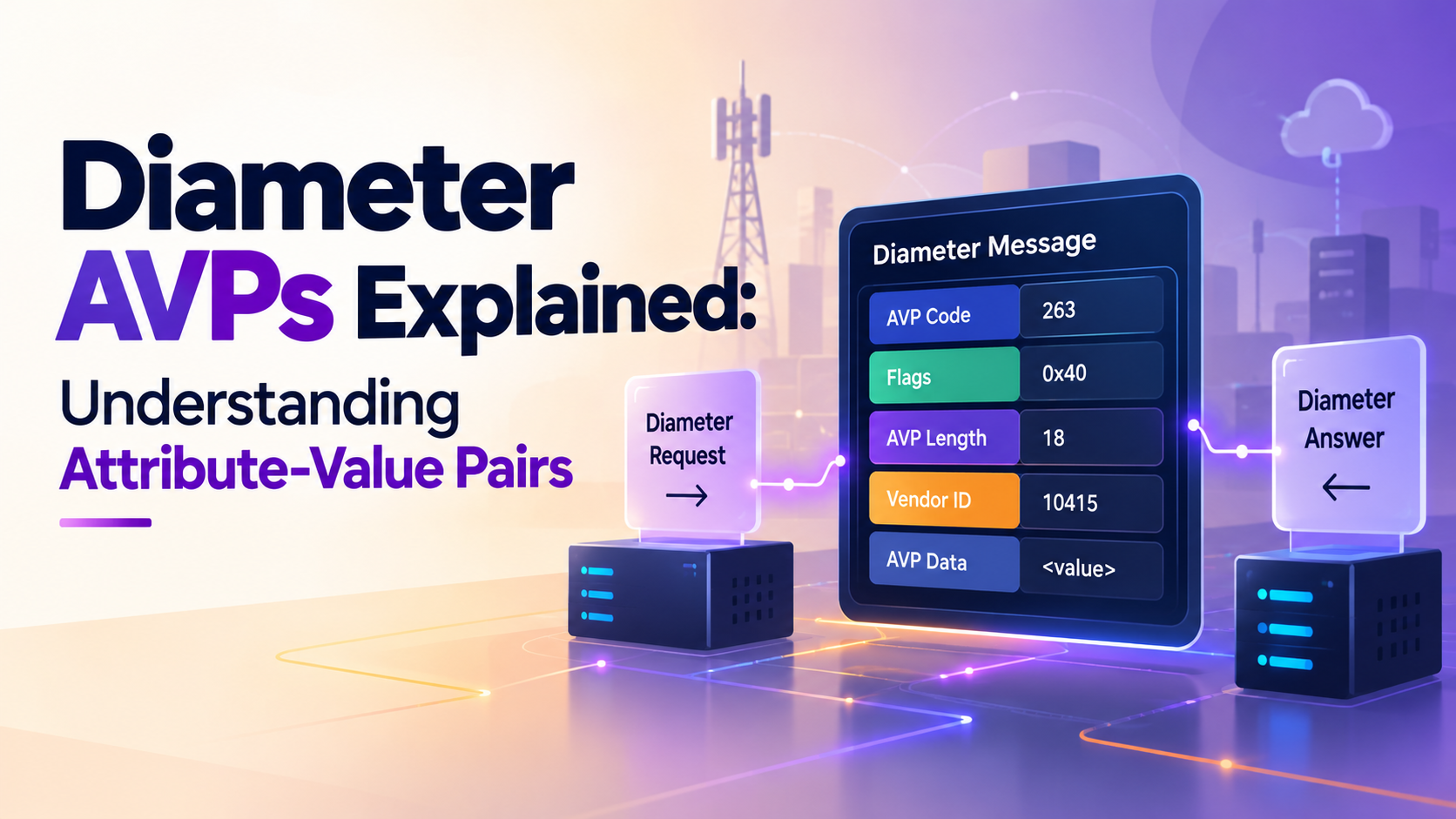
A Diameter AVP contains several fields that help a receiving node identify and process the information.
A simplified AVP structure includes:
The AVP Code is particularly important because it identifies the type of attribute being carried.
The Flags provide additional information about how the AVP should be handled.
The Data field contains the actual value, which can vary depending on the AVP.
Several AVPs appear frequently in Diameter signaling.
The Origin-Host AVP identifies the Diameter node that generated a message.
It helps the receiving system understand which Diameter host originated the request or answer.
The Origin-Realm AVP identifies the administrative realm associated with the originating Diameter node.
It is also relevant to Diameter routing.
The Destination-Host AVP identifies the intended Diameter destination when a specific host is required.
The Destination-Realm AVP identifies the destination realm for routing a Diameter message.
The Session-Id AVP identifies a Diameter session and helps correlate messages belonging to the same transaction or session.
The Result-Code AVP communicates the result of processing a Diameter request.
It helps the requesting node determine whether an operation succeeded or failed.
Understanding Diameter in LTE requires understanding how AVPs carry information between LTE core network elements.
Consider the S6a interface between the MME and HSS.
A simplified flow is:
MME → Diameter Request → HSS
HSS → Diameter Answer → MME
The Diameter messages exchanged during this process contain AVPs carrying the information needed for subscriber authentication, identification, routing, and related procedures.
This means AVPs are not simply technical fields. They directly support important LTE network operations.
Diameter 4G deployments use different Diameter applications for different functions.
For example:
The exact AVPs used depend on the Diameter application and transaction being performed.
This application-based approach makes Diameter adaptable across multiple functions within the LTE core.
AVPs are one layer within the broader Diameter protocol architecture.
A simplified relationship is:
Diameter Application
↓
Diameter Command / Message
↓
Diameter AVPs
↓
AVP Data / Values
The Diameter application determines what operation is being performed.
The Diameter message carries the request or response.
The AVPs provide the detailed information required to execute that operation.
This separation allows Diameter to support multiple applications while maintaining a common protocol foundation.
Not every AVP has the same processing requirements.
Some AVPs are mandatory for a particular Diameter message or application, while others may be optional depending on the transaction.
The AVP flags help communicate handling requirements.
This distinction is important because a receiving node needs to know whether an AVP can be ignored, must be processed, or requires specific handling.
Incorrect handling of mandatory or unexpected AVPs can result in failed transactions or potentially expose implementation weaknesses.
Diameter can also support vendor-specific AVPs.
A vendor can define additional AVPs for proprietary or specialized functionality while still operating within the Diameter framework.
Vendor-specific AVPs are useful when standard Diameter applications do not provide all the information required by a particular implementation.
However, operators should carefully manage such extensions because differences between implementations can create interoperability and security challenges.
AVPs can contain sensitive network and subscriber information, making AVP security an important consideration.
Potential risks include:
For example, if a network fails to properly validate incoming Diameter messages, an attacker may attempt to manipulate specific fields or introduce unexpected values.
Security testing should therefore evaluate how Diameter implementations validate messages and AVPs.
A Diameter security assessment can examine peer authorization, message validation, routing controls, filtering, transport protection, and other security mechanisms.
Operators can strengthen AVP security through several measures:
1. Validate Incoming Messages
Diameter nodes should validate messages and their AVPs according to the applicable Diameter application and network policy.
2. Control Diameter Peers
Only authorized Diameter peers should be permitted to establish communication.
3. Apply Message Filtering
Filtering can help prevent unexpected or unauthorized Diameter traffic from reaching sensitive network elements.
4. Protect Signaling Transport
Appropriate transport-level security mechanisms should be implemented based on the network architecture and security requirements.
5. Monitor Diameter Traffic
Monitoring helps identify unusual signaling patterns, unexpected requests, malformed messages, and potential attacks.
6. Test Critical Interfaces
Interfaces such as S6a and interconnect-facing Diameter paths should be included in security assessments and penetration testing.
Diameter AVP is one of the fundamental building blocks of the Diameter protocol. AVPs provide the structured information that enables Diameter messages to perform authentication, mobility, policy, charging, and subscriber-related functions.
For organizations working with Diameter in LTE and Diameter 4G networks, understanding AVPs is essential not only for protocol architecture and interoperability but also for security.
Because AVPs can carry sensitive information and influence how network elements process signaling requests, they should be properly validated, controlled, monitored, and tested.
Understanding the relationship between what is Diameter protocol, Diameter protocol architecture, Diameter messages, and AVPs provides a stronger foundation for evaluating the security of LTE signaling environments.