Blog
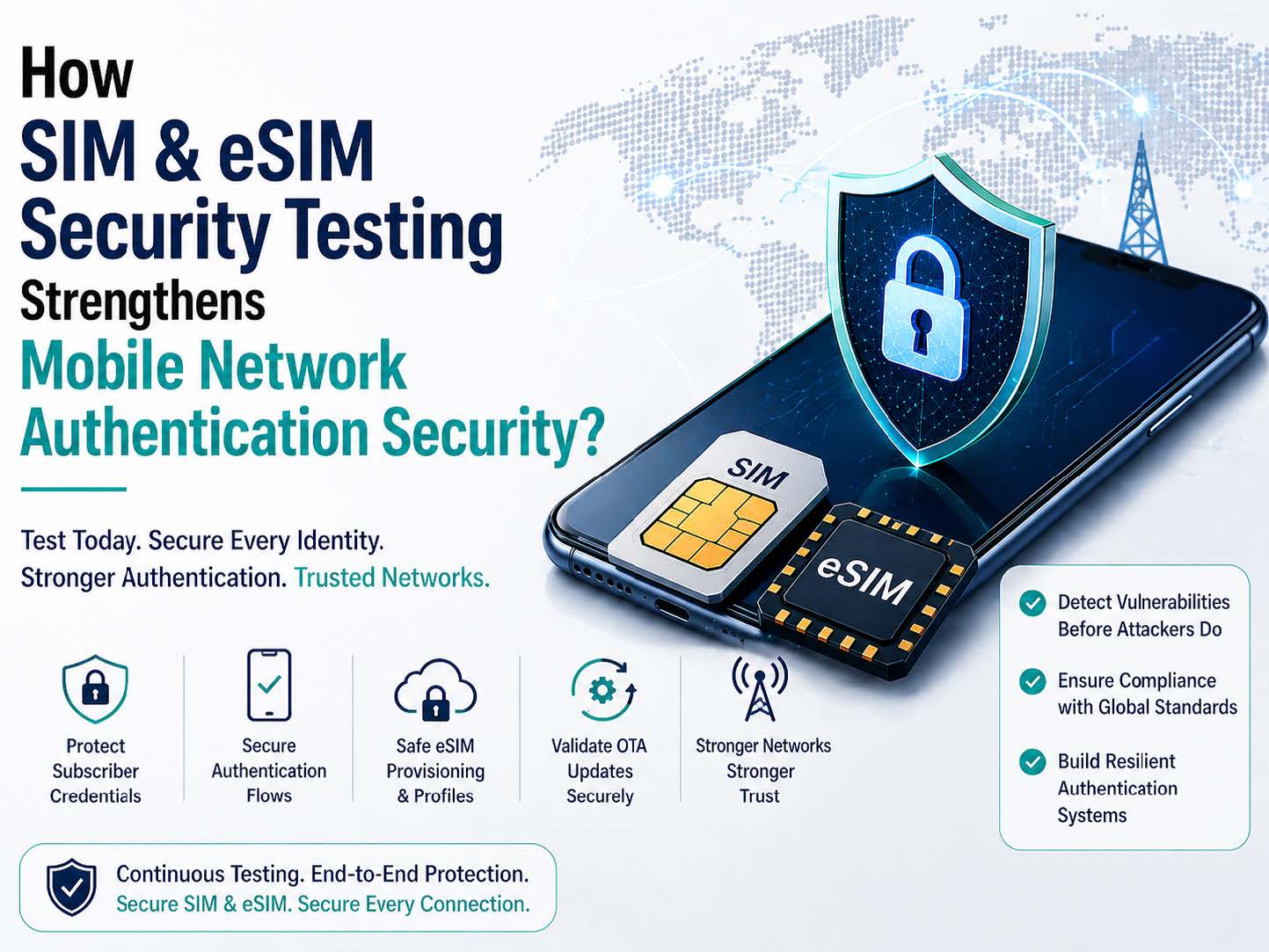
.png)
Every time a mobile device connects to a network, there is a silent verification happening in the background. That trust is built on one critical element—SIM or eSIM-based authentication.
These tiny components are responsible for validating identities, securing communication, and ensuring only legitimate users access telecom services. But as networks evolve toward 5G, IoT, and cloud-driven architectures, mobile network authentication security is increasingly dependent on how well SIM and eSIM environments are tested and secured.
This is where SIM & eSIM security testing plays a crucial role—not just in identifying vulnerabilities, but in actively strengthening the authentication layer itself.
SIM and eSIM technologies act as a root of trust for telecom networks. They store subscriber credentials and enable secure authentication between devices and operators.
According to GSMA, SIM-based systems are designed to securely authenticate devices and protect communication through embedded cryptographic identities. However, the effectiveness of this system depends entirely on how securely those credentials are managed and validated.
SIM technology is also widely used as a trusted hardware element to establish encrypted communication between devices and networks, especially in IoT environments.
When SIM or eSIM security is compromised, the entire authentication process becomes unreliable. Common risks include:
Weaknesses in SIM authentication layers can lead to identity spoofing and unauthorized access if not properly validated. This makes SIM vulnerability assessment and eSIM vulnerability testing critical for protecting authentication integrity.
Security testing ensures that:
This directly improves secure subscriber identity management and reduces risks related to credential leakage.
With eSIM, authentication depends on remote provisioning systems. GSMA defines how profiles are securely downloaded and managed, ensuring interoperability and trust across operators. However, testing is essential to ensure:
Over-the-Air (OTA) security testing ensures that updates to SIM or eSIM are encrypted, authenticated, and protected from replay or spoofing attacks.
According to ENISA, OTA and provisioning systems are among the most critical areas requiring continuous security validation in modern telecom environments.
Security testing helps verify that:
This ensures SIM-based authentication security remains reliable across all network layers.
Telecom networks are no longer static. They involve multiple protocols (2G through 5G), hybrid SIM and eSIM environments, and cloud-based provisioning systems.
Research on remote SIM provisioning shows that authentication security can fail in real-world scenarios if components like servers or communication channels are compromised. This means one-time testing is not enough. Operators must adopt:
Effective SIM & eSIM security testing does more than detect vulnerabilities—it strengthens authentication by:
This results in stronger mobile communication security, reduced fraud risk, and improved subscriber trust.
Mobile network authentication security depends on trust—and that trust begins with SIM and eSIM protection.
As telecom ecosystems grow more complex, operators must move beyond reactive security and adopt continuous SIM & eSIM security testing.
By doing so, they can ensure secure authentication, protect subscriber identities, and maintain long-term network reliability.