Blog
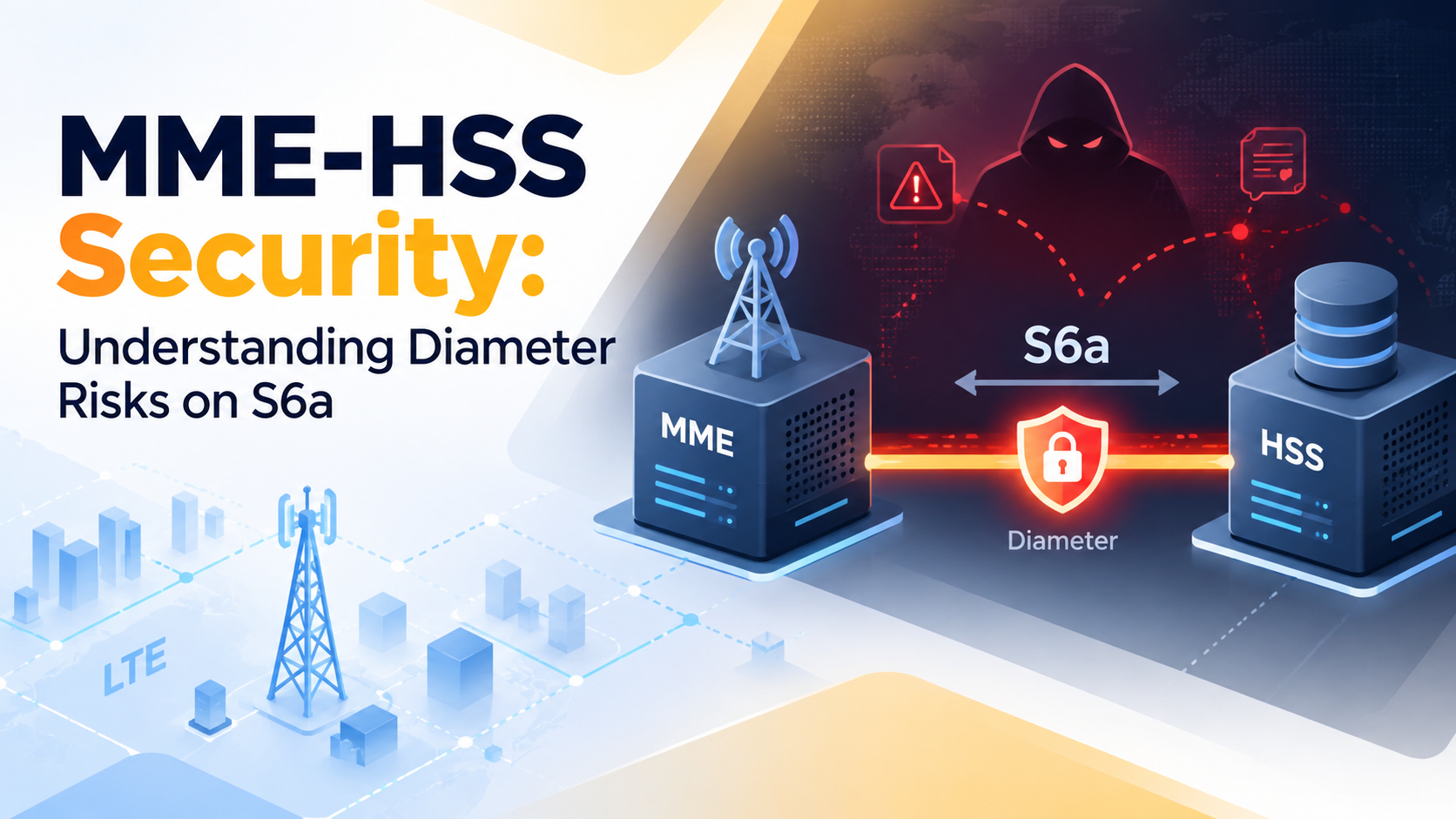

The MME-HSS relationship is one of the most important signaling relationships in a 4G/LTE core network.
The Mobility Management Entity (MME) communicates with the Home Subscriber Server (HSS) through the S6a interface, using the Diameter protocol. This communication supports functions such as subscriber authentication, authorization, mobility management, and access to subscription-related information.
Because the S6a interface carries security-sensitive signaling, weaknesses in MME-HSS communication can create broader network security concerns.
This makes MME HSS security an important component of both S6a security and broader Diameter security testing.
A structured security approach should therefore consider S6a vulnerabilities, identify relevant S6a risks, and use S6a security testing and S6a security assessment to validate the security posture of the MME-HSS environment.
MME HSS security refers to the security controls used to protect communication and trust relationships between the MME and HSS.
The MME is responsible for important mobility and access-management functions, while the HSS stores subscriber and authentication-related information.
The S6a interface enables these systems to exchange the signaling required for these functions.
From a security perspective, MME-HSS protection should address:
The objective is to ensure that only authorized systems can communicate with the MME and HSS and that signaling is handled securely.
The S6a interface connects the MME and HSS in LTE/Evolved Packet System (EPS) networks.
It is based on the Diameter protocol and supports signaling associated with subscriber authentication, authorization, and mobility.
In simplified form:
UE → eNodeB → MME → S6a → HSS
The S6a connection is therefore an important trust boundary within the LTE core.
If security controls around this relationship are weak, an attacker who gains unauthorized access to the signaling environment may have opportunities to abuse legitimate Diameter functionality.
This is why S6a Diameter security should be considered an integral part of MME-HSS security.
The MME and HSS perform different but closely connected roles.
The MME handles network-access and mobility-related procedures, while the HSS maintains subscriber-related information and supports authentication procedures.
The S6a interface allows these systems to exchange information needed for those operations.
Consequently, weaknesses in S6a security can potentially affect:
The actual impact depends on the network architecture, implementation, configuration, peer relationships, and security controls.
S6a Diameter security involves protecting the Diameter signaling exchanged between the MME and HSS.
A secure S6a environment should establish clear trust relationships and restrict communication to legitimate peers.
Key security areas include:
Peer Authentication
The MME and HSS should be able to establish communication with authorized Diameter peers.
Peer Authorization
A peer being authenticated does not automatically mean that every type of signaling should be permitted.
Authorization controls should restrict what peers are allowed to do.
Transport Protection
The Diameter transport should be appropriately protected against unauthorized access and interception.
Message Validation
Diameter messages and relevant AVPs should be validated before being processed.
Filtering
Security controls should prevent unnecessary or unauthorized signaling from reaching critical systems.
Monitoring
Suspicious signaling patterns should be detectable through appropriate logging and monitoring.
Several categories of S6a vulnerabilities can affect the security of the MME-HSS relationship.
If Diameter peer authentication is inadequately configured, unauthorized systems may have opportunities to attempt connections to S6a endpoints.
Security testing should determine:
Authentication establishes identity, but authorization determines what a peer is permitted to access.
An MME-HSS environment can therefore have strong authentication while still maintaining overly broad authorization.
An S6a security assessment should review:
S6a relies on Diameter messages containing relevant AVPs.
If messages or AVPs are not properly validated, unexpected or malformed signaling may create security or availability risks.
Testing should examine:
Transport security is another important part of S6a security.
The assessment should determine whether the MME-HSS communication path is appropriately protected and whether unauthorized systems can gain network-level access to S6a endpoints.
The MME-HSS relationship should not rely on assumptions that all connected signaling entities are inherently trustworthy.
Trust should be:
This becomes particularly important where Diameter signaling interacts with external networks or roaming partners.
The S6a interface can carry information associated with subscribers and authentication procedures.
Poor access control or excessive trust could therefore increase the risk of unauthorized information access.
An assessment should determine whether sensitive subscriber information can be accessed only through legitimate and authorized signaling procedures.
Authentication procedures are an important part of the MME-HSS relationship.
Security teams should examine whether authentication-related signaling:
S6a signaling can support mobility-related procedures and may involve information associated with subscriber location or network mobility.
Security controls should therefore restrict access to legitimate signaling use cases and provide monitoring for unusual activity.
Spoofing-related activity can involve attempts to present an unauthorized system as a legitimate Diameter peer.
S6a security testing should therefore validate:
The MME and HSS are important core-network components, so signaling availability is another consideration.
Excessive or malformed Diameter signaling could potentially consume resources or disrupt normal processing.
Relevant S6a risks include:
Testing should be controlled carefully to prevent disruption to production subscribers.
S6a security testing provides a practical way to validate whether security controls work as expected.
A typical testing process can include the following stages.
Identify:
This establishes the scope before technical testing begins.
Document how S6a traffic flows between the MME and HSS.
Review:
Validate whether only approved systems can establish Diameter relationships.
Testing can examine:
Evaluate how the MME and HSS respond to expected and unexpected Diameter signaling.
This can include controlled validation of:
Determine whether access to S6a is restricted to legitimate systems and approved signaling functions.
Look for:
Security teams should determine whether suspicious activity can be identified.
Relevant indicators may include:
An S6a security assessment takes a broader view than individual vulnerability testing.
It can examine whether the overall MME-HSS environment follows a defensible security model.
MME-HSS security should not be treated as completely separate from the broader Diameter security program.
Diameter security testing can extend beyond S6a to examine other Diameter interfaces, peers, roaming relationships, and interconnects.
A broader program may include:
S6a Security Testing
↓
Diameter Peer Security
↓
Diameter Roaming Security
↓
Diameter Interconnect Security
↓
Diameter Filtering & Monitoring
↓
Broader Telecom Signaling Security
This helps operators understand how S6a security fits into the larger signaling-security architecture.
Operators should consider the following categories when evaluating their MME-HSS environment:
Unauthorized Peer Access
Untrusted systems may attempt to communicate with S6a endpoints when peer controls are insufficient.
Signaling Manipulation
Poor message or AVP validation can increase exposure to unauthorized or unexpected signaling.
Subscriber Information Exposure
Weak access controls may increase the possibility of unauthorized access to sensitive subscriber-related information.
Authentication Abuse
Poorly protected authentication signaling may be targeted through unauthorized or excessive requests.
Location Information Exposure
Weak controls may increase privacy risks involving mobility or location-related information.
Denial of Service
Excessive or malformed signaling may affect resource availability.
Roaming Exposure
External Diameter relationships can introduce additional trust and security considerations.
Telecom operators can strengthen S6a security by combining multiple controls.
1. Restrict Diameter Peers
Maintain a clearly defined list of legitimate and authorized peers.
2. Enforce Authentication and Authorization
Use both controls rather than relying on peer connectivity alone.
3. Protect Diameter Transport
Apply appropriate transport and network-level security controls.
4. Validate Messages
Check Diameter messages and relevant AVPs before processing.
5. Apply Signaling Filtering
Restrict unnecessary or unauthorized signaling.
6. Segment Critical Systems
Limit unnecessary network access to MME and HSS systems.
7. Monitor Diameter Activity
Monitor signaling for unusual patterns and security events.
8. Conduct Regular Testing
Perform S6a testing after major architecture, configuration, roaming, or security-control changes and at an appropriate recurring interval.
9. Use Dedicated Test Subscribers
Where testing involves subscriber-related signaling, controlled test subscribers can help reduce the risk of affecting live users.
10. Retest Remediation
Security testing should not end with the initial report. Identified weaknesses should be remediated and retested.
A concise checklist for operators includes: