Blog

Telecom signaling is fundamental to how mobile networks authenticate subscribers, manage mobility, route calls and messages, and communicate with other networks. Because signaling systems support critical network functions, weaknesses in the signaling layer can create risks involving subscriber privacy, fraud, service availability, and network security.
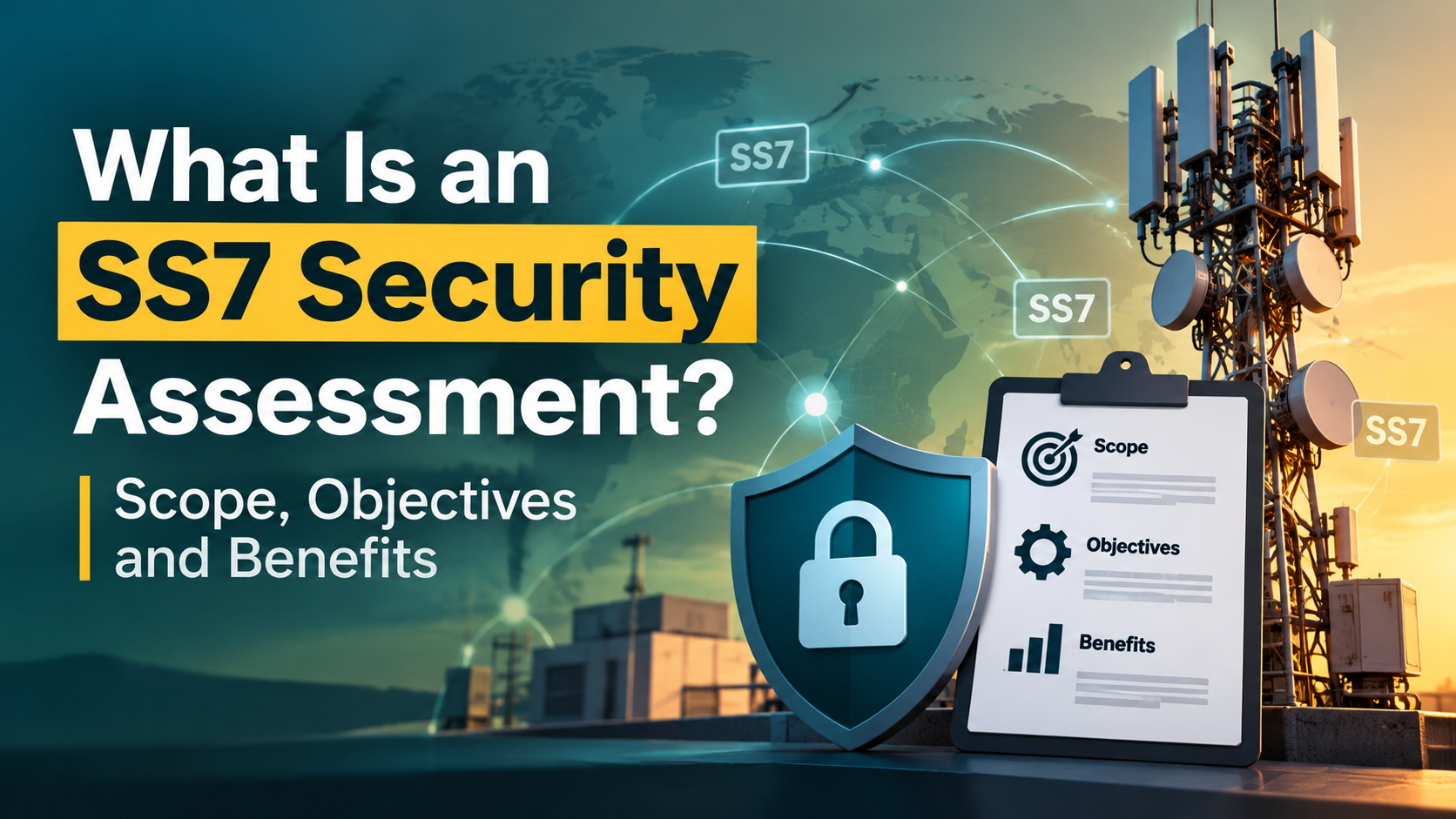
An SS7 security assessment is a structured evaluation of an operator’s SS7 environment to identify vulnerabilities, security gaps, exposure points, and weaknesses in existing controls.
Unlike a narrowly focused penetration test, an assessment can take a broader view of the signaling environment. It can examine architecture, configurations, signaling exposure, trust relationships, security controls, and potential vulnerabilities.
For telecom operators, understanding the scope and objectives of an SS7 security assessment helps establish a stronger foundation for protecting legacy signaling infrastructure.
An SS7 security assessment is a systematic review of SS7 signaling infrastructure and the security controls protecting it.
The objective is to determine whether the environment is adequately protected against unauthorized signaling activity and whether existing controls are configured and operating as intended.
An assessment may evaluate:
The assessment provides operators with a clearer understanding of their current signaling security posture and areas requiring improvement.
An SS7 vulnerability assessment focuses specifically on identifying weaknesses that could expose SS7 infrastructure, subscribers, or network services to security threats.
Potential areas of concern include excessive trust between signaling entities, inadequate filtering, weak access controls, configuration issues, and insufficient monitoring.
The vulnerability assessment component can help organizations identify where security weaknesses exist before determining how those weaknesses should be prioritized and remediated.
This makes vulnerability assessment an important part of an overall SS7 security assessment, although the two terms are not always interchangeable.
The exact scope depends on the telecom operator’s architecture, objectives, and risk profile. However, a comprehensive assessment generally covers several key areas.
The assessment begins by understanding how signaling is structured within the network.
This includes reviewing relevant signaling nodes, communication paths, interconnections, trust relationships, and security boundaries.
Architecture mapping helps identify where signaling enters, exits, and moves through the network.
External connections and inter-operator relationships can create potential exposure.
An assessment examines whether signaling interfaces are appropriately controlled and whether unnecessary or unexpected signaling paths exist.
This can be particularly important for operators with multiple roaming relationships and interconnected networks.
Security depends not only on deployed controls but also on how those controls are configured.
An SS7 assessment can examine relevant configuration areas to identify weaknesses such as inappropriate permissions, insufficient filtering policies, or security settings that do not align with the intended architecture.
Signaling firewalls play an important role in controlling and filtering signaling traffic.
An assessment can evaluate whether filtering policies appropriately distinguish legitimate signaling activity from suspicious or unauthorized requests.
It can also help identify policy gaps that could leave signaling functions unnecessarily exposed.
Security teams need visibility into signaling activity to identify potential abuse.
An SS7 security assessment can review monitoring and alerting capabilities to determine whether suspicious signaling behavior can be identified and investigated effectively.
Signaling weaknesses can potentially expose subscriber-related information or enable unauthorized tracking.
The assessment therefore considers whether appropriate technical controls exist to reduce privacy-related signaling risks.
The primary objective is to understand and reduce security risks within the SS7 environment.
Key objectives include:
An effective assessment should provide more than a list of vulnerabilities. It should help operators understand the relationship between each weakness, the affected network function, and the potential business or operational impact.
An SS7 security assessment can provide several benefits for telecom operators.
Operators gain a clearer understanding of their signaling architecture, exposure points, vulnerabilities, and existing security controls.
Identifying weaknesses proactively allows security teams to address potential issues before they contribute to fraud, privacy incidents, or service disruption.
Assessment findings can highlight opportunities to improve filtering, monitoring, access control, firewall policies, and other signaling defenses.
Not every vulnerability carries the same level of risk. An assessment helps organizations prioritize remediation according to potential impact and exposure.
By identifying signaling weaknesses that could affect availability or control-plane operations, operators can strengthen their ability to withstand abnormal signaling activity.
Assessment results can provide technical evidence for security reviews, risk-management programs, audits, and ongoing security improvement.
An SS7 security assessment and SS7 penetration testing are related but serve different purposes.
Organizations can use both approaches together. An assessment can identify and prioritize weaknesses, while penetration testing can provide controlled validation of selected high-risk findings.
Although SS7 originated with earlier generations of mobile networks, many telecom environments continue to operate legacy signaling alongside newer technologies.
Operators may have SS7, Diameter, GTP, and 5G service-based interfaces within the same broader network ecosystem.
This makes signaling security a lifecycle concern rather than a legacy-only issue.
A broader multi-generation strategy can help operators understand how signaling risks evolve across 2G, 3G, 4G, and 5G environments.
A structured assessment can identify weaknesses before they become security incidents.
For example, weaknesses in signaling controls may contribute to risks involving subscriber tracking, messaging abuse, fraud, unauthorized signaling activity, or network disruption.
Understanding these risks and validating the effectiveness of defensive controls can help operators build a stronger security posture.
For additional context, see [How Signaling Security Testing Helps Prevent Fraud and Network Disruptions].
An assessment can be performed at several points throughout the network lifecycle, including:
Recurring assessments are particularly valuable because network architectures, configurations, interconnections, and threats change over time.
An SS7 security assessment provides telecom operators with a structured way to understand the security posture of their signaling infrastructure.
By examining architecture, exposure, configurations, security controls, vulnerabilities, monitoring, and subscriber privacy, operators can identify weaknesses and prioritize appropriate remediation.
An SS7 vulnerability assessment can form an important component of this process, while targeted penetration testing can provide deeper validation of selected risks.
As telecom networks continue to combine legacy and modern technologies, integrating SS7 assessments into a broader telecom security assessment and continuous security program can help operators strengthen signaling protection, reduce exposure, and improve network resilience.

Case Study