Blog
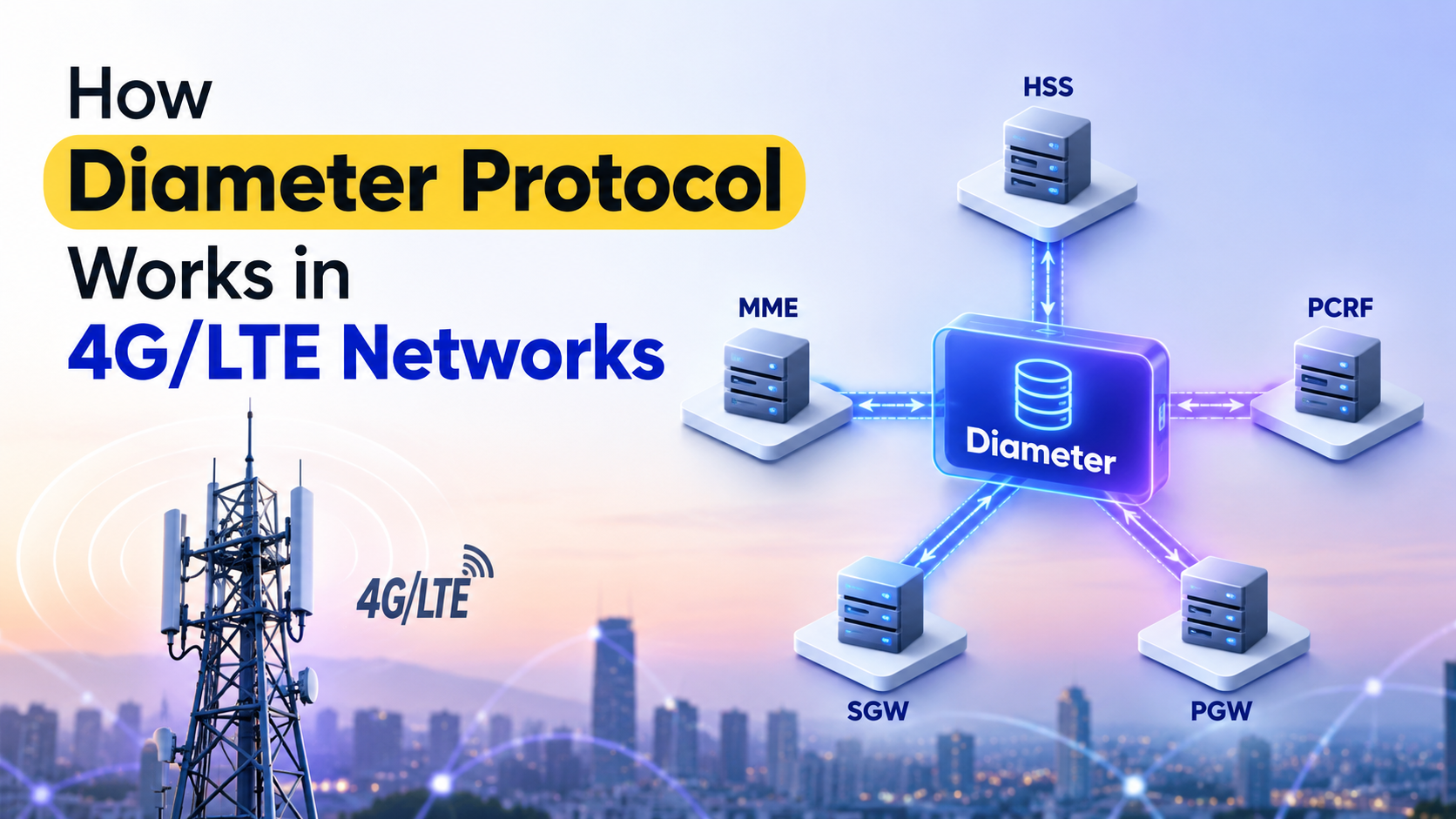

4G/LTE networks depend on signaling to coordinate authentication, subscriber access, mobility, policy control, charging, and roaming. Behind many of these processes is the Diameter protocol, an IP-based signaling framework designed for authentication, authorization, accounting, and related network functions.
But understanding the protocol definition alone is not enough. To understand LTE signaling, it is important to know how Diameter protocol works, which network elements communicate using it, how messages are structured, and how information moves between network nodes.
This guide explains how Diameter in LTE works, the role of Diameter nodes and applications, the Diameter protocol architecture, and how a Diameter AVP carries information inside a message.
So, what is Diameter protocol?
Diameter is an extensible AAA protocol framework used by network elements to exchange authentication, authorization, accounting, and application-specific information.
It was designed as a successor to RADIUS for environments requiring greater extensibility and more complex communication between network elements.
In mobile networks, Diameter became particularly important with the development of IP-based 4G/LTE core networks.
Diameter communication typically involves:
These components work together to exchange signaling information between different parts of the network.
At a simplified level, Diameter works through a request-and-answer communication model.
A network element sends a Diameter request to another Diameter peer. The receiving node processes the request and returns a Diameter answer.
The basic flow is:
Diameter Client → Request → Diameter Server → Answer → Diameter Client
The actual communication can be more complex because Diameter agents may relay, proxy, redirect, or otherwise handle messages between peers.
A typical transaction involves several steps:
This architecture allows different network functions to communicate using a standardized signaling framework.
Diameter in LTE is used across multiple interfaces connecting different network functions.
A simplified LTE architecture can be represented as:
UE → eNodeB → MME → HSS
The MME and HSS communicate through the S6a interface, which uses Diameter.
When a subscriber connects to an LTE network, the MME needs to obtain authentication and subscription-related information from the HSS.
Diameter enables this communication.
For example, a simplified authentication-related flow can involve:
MME → Diameter Request → HSS
The HSS processes the request and provides the required response:
HSS → Diameter Answer → MME
The information exchanged can include authentication data, subscriber information, and other application-specific parameters.
This is one reason Diameter 4G is so important to LTE core-network signaling.
The Diameter protocol architecture consists of multiple components that work together.
A Diameter client is typically the node that initiates a request.
In an LTE environment, an MME may act as a Diameter client for certain S6a transactions.
A Diameter server receives and processes Diameter requests.
The HSS can act as a Diameter server for relevant LTE applications.
A Diameter agent operates between Diameter peers and can perform different functions depending on its role.
Common types include:
A Diameter Edge Agent can also operate at an external network boundary and provide functions such as routing, filtering, access control, and topology protection.
Two Diameter nodes that communicate directly as part of a Diameter relationship are considered peers.
Peer configuration determines how nodes establish and maintain communication.
The Diameter framework provides the underlying protocol, while individual applications define how it is used for specific network functions.
Examples include:
Each application can define its own commands and AVPs.
A Diameter message is the basic unit of communication between Diameter peers.
A message consists broadly of:
Diameter Header + AVPs
The header provides information needed to identify and process the message.
AVPs contain the information associated with the request or answer.
Diameter messages are generally categorized into:
Request
A request asks another Diameter node to perform an operation or provide information.
Answer
An answer provides the result or response to a corresponding request.
The request and answer are associated through information in the Diameter message header.
A Diameter AVP, or Attribute-Value Pair, is one of the most important components of a Diameter message.
AVPs carry information required by the Diameter protocol or a specific Diameter application.
An AVP can contain information such as:
A Diameter message can contain multiple AVPs.
For example, a request may include several AVPs that identify the origin of the message, destination, session, application, or subscriber-related information.
The receiving node uses these values to understand and process the request.
Consider a simplified example involving an LTE subscriber.
Step 1: Subscriber Connects
A device attempts to connect to the LTE network.
Step 2: MME Handles the Request
The MME manages the mobility and access-related signaling associated with the device.
Step 3: MME Sends a Diameter Request
The MME communicates with the HSS using the S6a interface.
The Diameter request contains relevant AVPs.
Step 4: HSS Processes the Request
The HSS checks the subscriber's stored information and generates the appropriate response.
Step 5: HSS Sends a Diameter Answer
The answer contains the information required by the MME to continue the relevant network procedure.
Step 6: MME Continues the LTE Procedure
The MME uses the received information to continue subscriber authentication, authorization, or another relevant procedure.
This simplified flow demonstrates how Diameter in LTE allows core-network elements to exchange structured signaling information.
Diameter messages need to reach the correct destination.
Routing can involve information such as:
Diameter agents can participate in routing when direct communication between two nodes is not appropriate or practical.
In larger environments, this becomes particularly important when operators have multiple network elements, applications, roaming partners, or interconnection networks.
Diameter is also used when operators exchange signaling during roaming.
A roaming architecture may involve:
Operator A → Interconnect/IPX → Operator B
Diameter messages can travel across external network boundaries depending on the roaming architecture.
This introduces additional requirements around:
Consequently, understanding how Diameter works is also important for understanding Diameter roaming security and Diameter interconnect security.
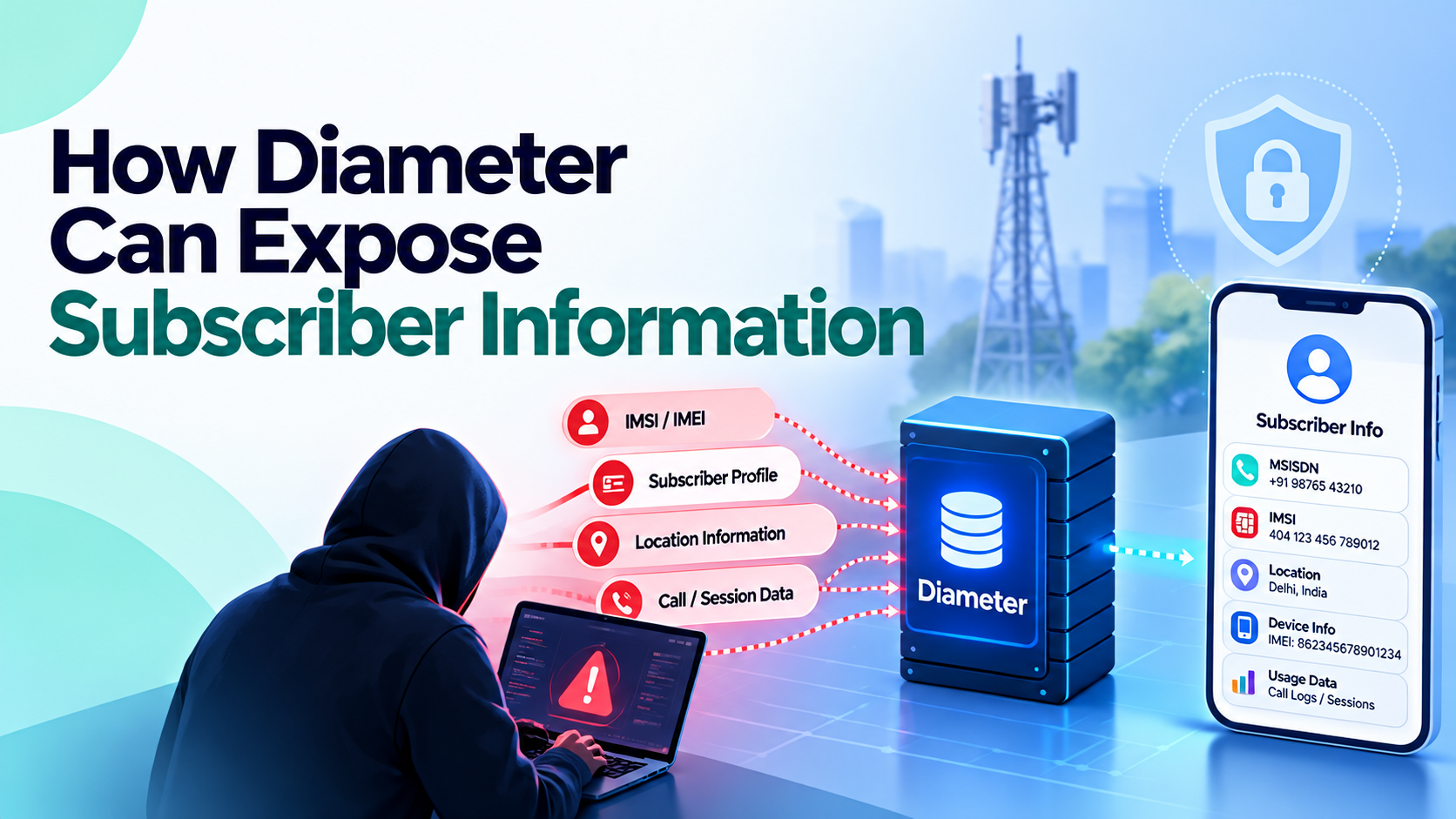
Diameter can carry information associated with authentication, subscribers, mobility, policy, charging, and other critical network functions.
Security weaknesses can therefore have significant consequences.
Operators should consider controls such as:
A properly designed Diameter environment should ensure that only authorized systems can communicate and that unexpected signaling is identified and controlled.
Understanding how Diameter protocol works in 4G/LTE networks requires looking at more than the protocol definition. Diameter provides a structured framework through which LTE network elements exchange authentication, subscriber, mobility, policy, charging, and other signaling information.
The Diameter protocol architecture brings together clients, servers, peers, agents, applications, messages, and Diameter AVPs. Together, these components enable complex signaling workflows across 4G/LTE networks.
Because Diameter supports critical network functions, its architecture also needs to be considered from a security perspective. Understanding how requests, answers, routing, peers, and AVPs work provides the foundation for assessing Diameter vulnerabilities, securing LTE signaling, and performing effective Diameter security testing.