
Blog
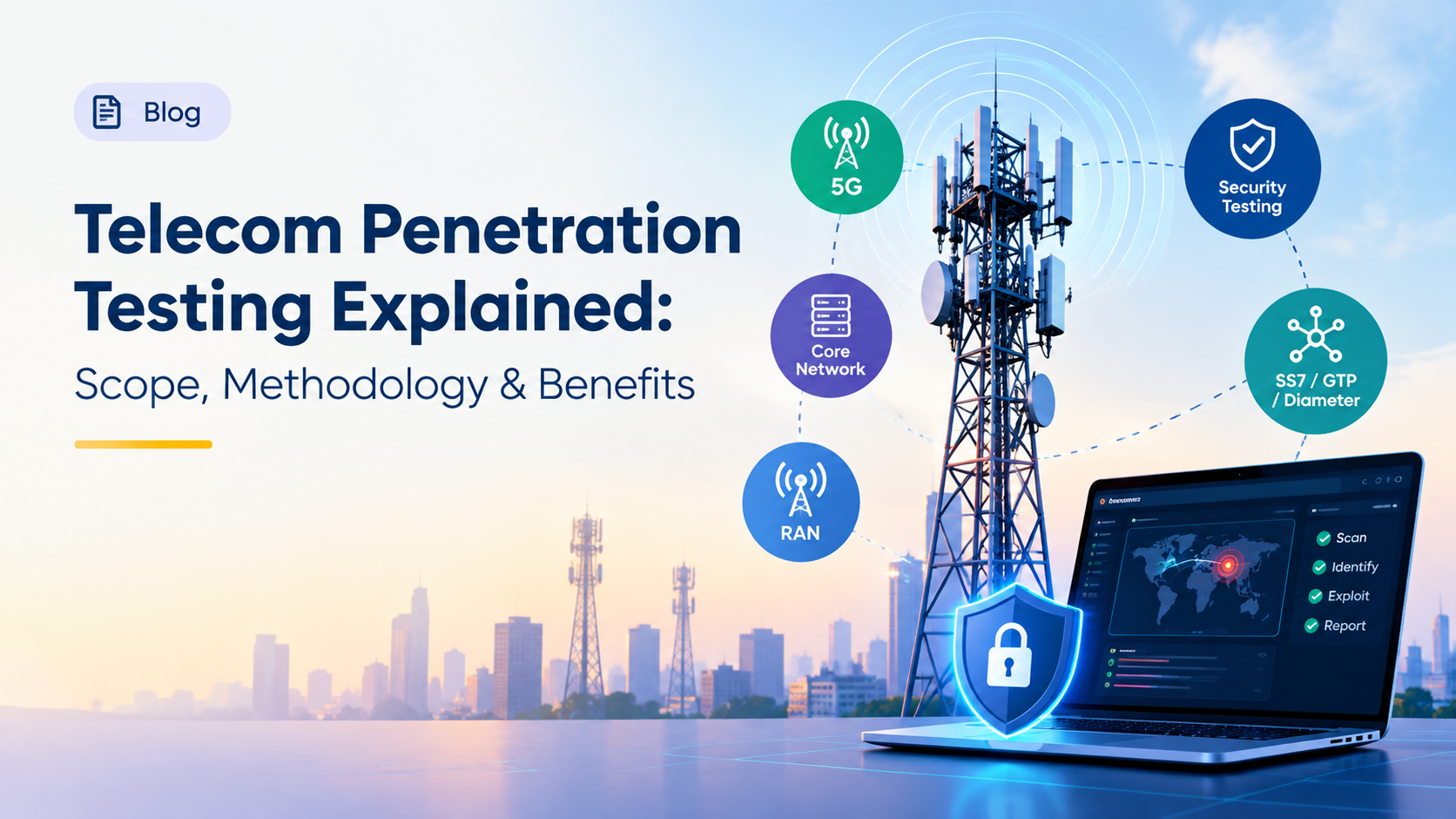

Telecommunications networks have become more interconnected, software-driven, and business-critical than ever before. From 5G deployments and cloud-native cores to roaming services and IoT connectivity, today's telecom infrastructure supports millions of subscribers and countless digital services every second.
While this evolution creates new opportunities, it also expands the attack surface. Cybercriminals are no longer targeting only enterprise IT systems—they are increasingly exploiting telecom protocols, signaling networks, subscriber identities, and mobile infrastructure.
A single vulnerability in the Radio Access Network (RAN), Core Network, SIM ecosystem, or Over-the-Air (OTA) provisioning platform can lead to service disruption, subscriber fraud, regulatory penalties, and reputational damage.
This is why telecom penetration testing has become a critical part of modern telecom cyber security strategies.
Unlike conventional penetration testing, telecom assessments focus on specialized protocols, mobile network architecture, authentication systems, and telecom-specific attack scenarios that cannot be evaluated using traditional IT security tools.
This guide explains the scope, methodology, and business value of telecom penetration testing, helping operators understand how proactive security assessments strengthen network resilience and subscriber trust.
Telecom penetration testing is a structured security assessment designed to identify vulnerabilities across telecom infrastructure before they can be exploited by attackers.
Rather than focusing only on servers or applications, telecom penetration testing evaluates security across the entire mobile ecosystem, including:
The objective is not simply to identify weaknesses, but to validate whether existing security controls can withstand realistic attack techniques.
The NIST Technical Guide to Security Testing and Assessment (SP 800-115) recommends penetration testing as an effective method for evaluating real-world security controls beyond automated vulnerability scanning.
Telecom operators operate one of the world's most complex digital infrastructures.
Unlike traditional enterprise networks, telecom environments support:
As networks become increasingly virtualized and software-defined, security risks evolve just as quickly.
According to the ENISA 5G Security Threat Landscape, cloud-native architectures, virtualization, API exposure, and supply-chain complexity introduce new attack vectors that require continuous assessment.
Regular telecom security assessments help operators:
Most importantly, penetration testing shifts organizations from reactive incident response to proactive risk management.
Effective telecom penetration testing follows a structured methodology rather than relying on isolated vulnerability scans.
Although individual projects differ depending on network architecture and business objectives, most assessments follow six key phases.
The engagement begins by identifying:
This phase ensures testing focuses on the systems that present the highest business risk.
Next, security specialists evaluate:
Threat modeling helps prioritize testing activities based on realistic attack scenarios.
Security analysts review:
The objective is to identify weaknesses before active exploitation begins.
Only after appropriate authorization, security specialists attempt controlled exploitation to validate whether identified weaknesses are genuinely exploitable.
Unlike malicious attackers, penetration testers carefully document every activity to avoid operational disruption.
Successful exploitation is analyzed to determine:
This helps operators prioritize remediation based on actual business risk rather than theoretical severity.
Finally, findings are documented with:
The end goal is practical improvement—not simply producing a vulnerability list.
One of the biggest differences between traditional penetration testing and telecom security assessments is protocol coverage.
Modern telecom networks rely on specialized protocols that require dedicated testing methodologies.
Although considered a legacy signaling protocol, SS7 remains widely deployed for roaming and inter-network communication.
Testing focuses on risks such as:
Diameter replaced many SS7 functions within LTE networks.
Security assessments evaluate:
The GPRS Tunneling Protocol (GTP) enables data transport across mobile core networks.
Assessments typically validate:
5G introduces Service-Based Architecture (SBA), where APIs become essential components of network communication.
Security testing focuses on:
The 3GPP TS 33.501 specification outlines security requirements for 5G Service-Based Architecture and authentication mechanisms.
The Radio Access Network represents the first point of interaction between subscribers and the telecom network.
A RAN security assessment evaluates:
As Open RAN adoption grows, securing these distributed environments has become increasingly important.
The telecom core processes subscriber authentication, mobility management, session establishment, and policy enforcement.
A comprehensive assessment typically reviews:
Because the core network manages sensitive subscriber information, weaknesses here can have widespread operational consequences.
Subscriber identities remain one of the most valuable assets within telecom environments.
Security testing evaluates:
Operators increasingly perform these assessments as eSIM adoption expands across enterprise mobility and IoT deployments.
Over-the-Air (OTA) platforms enable operators to remotely manage SIM and eSIM profiles.
Because these platforms directly influence subscriber identities, they require dedicated security validation.
Typical OTA assessments examine:
Protecting OTA environments helps prevent unauthorized profile changes and strengthens subscriber trust.
The value of telecom penetration testing isn't measured by the number of vulnerabilities discovered.
It's measured by how effectively those findings can be translated into measurable security improvements.
A mature assessment report should provide:
This enables security, operations, and executive stakeholders to make informed decisions based on practical risk rather than assumptions.
Organizations that perform regular telecom security assessments gain more than improved technical security.
They strengthen business resilience.
Key benefits include:
Identify weaknesses before they can be exploited to compromise subscriber identities or authentication systems.
Support alignment with GSMA guidance, 3GPP security specifications, and regional telecom security expectations.
Reduce the likelihood of service disruptions caused by exploitable vulnerabilities.
Demonstrate a proactive commitment to protecting subscriber information and network integrity.
Deploy 5G, Open RAN, cloud-native infrastructure, and IoT services with greater confidence through validated security controls.
Modern telecom networks operate in one of the most complex cybersecurity environments in the world.
Supporting millions of subscribers, multiple network generations, cloud-native services, Open RAN deployments, and international roaming means the attack surface is constantly evolving.
Traditional IT penetration testing alone cannot identify telecom-specific risks.
Specialized telecom penetration testing provides operators with the visibility needed to validate protocol security, strengthen authentication systems, protect subscriber identities, and reduce operational risk before attackers exploit vulnerabilities.
For operators across Europe, France, the Middle East, and Africa, proactive telecom security assessments are no longer optional—they are an essential part of maintaining resilient, compliant, and trusted mobile networks.
The most secure telecom networks are not those that experience no attacks—they are the ones that continuously assess, validate, and improve their security posture.





