Blog
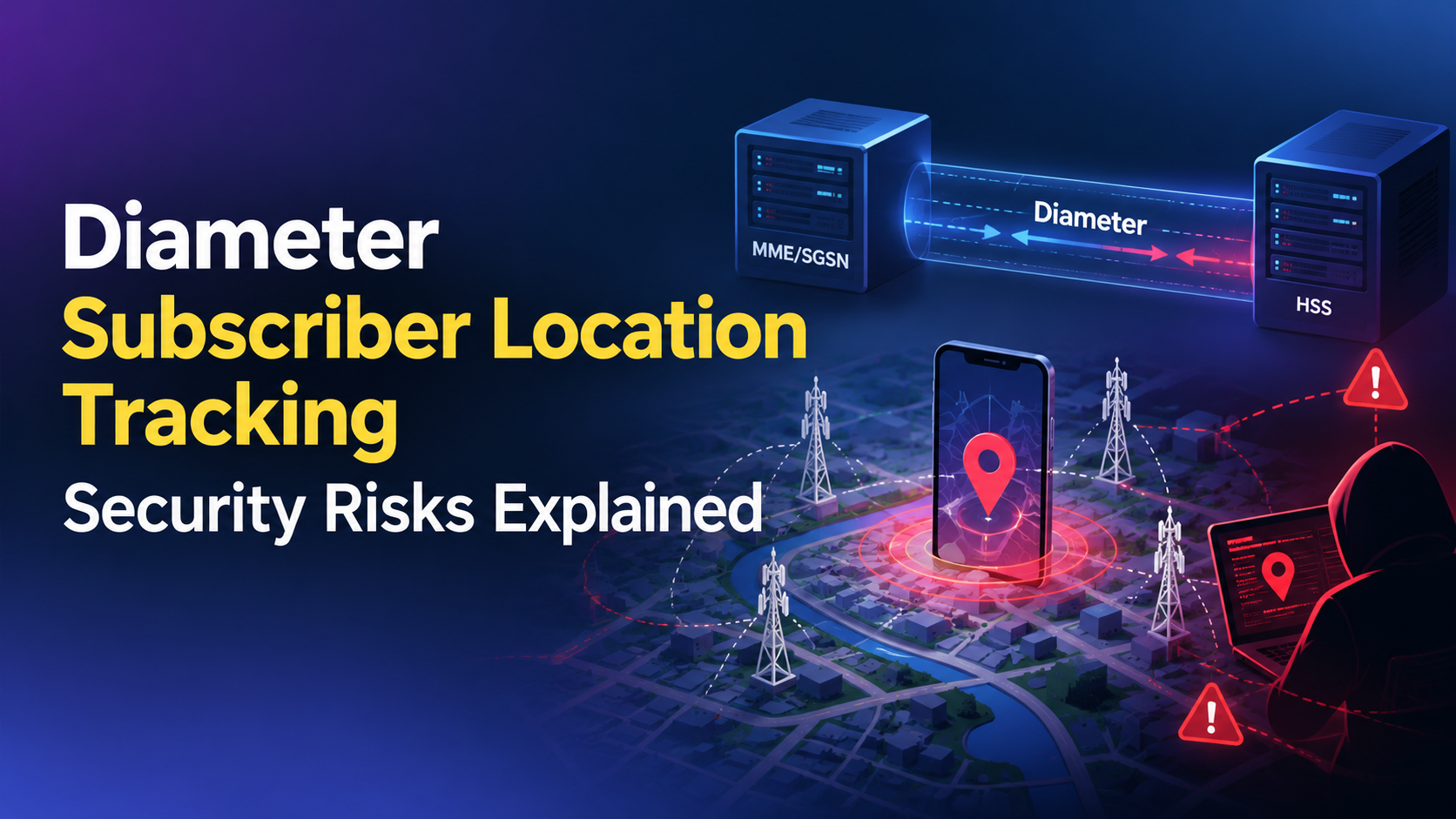

Mobile networks need location-related information to deliver connectivity, manage mobility, authenticate subscribers, and maintain reliable services. In 4G/LTE networks, Diameter signaling supports several of the core functions involved in this process.
However, the same signaling that enables legitimate network operations can become a security and privacy concern if it is improperly exposed or accessed.
Diameter subscriber location tracking is therefore an important topic for telecom operators. Unauthorized access to signaling can potentially provide information that helps determine a subscriber's network location, movement between network areas, or related activity.
The risk does not exist in isolation. Diameter authentication attacks, weak Diameter subscriber data security, poor location privacy controls, and subscriber profile manipulation can all contribute to a broader signaling security problem.
This article explains how location-related risks can arise, why they matter, and how operators can strengthen the security of subscriber information.
Diameter location tracking refers to the potential misuse of Diameter signaling to obtain or infer information about a subscriber's network location or mobility.
Location-related information is legitimately required by mobile networks. For example, the LTE core needs to know where subscribers are attached to support mobility management and network services.
The security concern arises when an unauthorized party gains access to signaling information or is able to make requests that reveal information beyond what the party should legitimately access.
Depending on the network architecture and available access, location-related information could potentially help reveal:
The exact information available varies by implementation and security controls.
Location privacy is a major consideration because location information can reveal patterns about a person's movements and activities.
Even relatively broad location information can become sensitive when combined with other information.
For example, repeated observations over time could potentially provide insights into:
For operators, protecting location privacy therefore means ensuring that location-related signaling is accessible only to authorized systems and legitimate network functions.
Diameter itself is not designed as a location-tracking mechanism. It supports legitimate network signaling, some of which can involve mobility and subscriber-related information.
Security risks can emerge when the surrounding controls are weak.
If an unauthorized system can establish a Diameter relationship or exploit an improperly protected signaling path, it may gain access to information that should be restricted.
Strong peer authorization is therefore a fundamental component of Diameter subscriber data security.
External or roaming peers may be trusted for legitimate business and network functions.
However, trust should be limited to the applications, commands, destinations, and information actually required.
An overly broad trust relationship can increase the potential exposure of subscriber-related signaling.
Without appropriate signaling filtering, unnecessary requests may reach sensitive network functions.
A Diameter firewall or security gateway can help restrict traffic based on factors such as:
A network element should not automatically have access to every type of subscriber information simply because it is a Diameter peer.
Least-privilege access helps reduce unnecessary exposure.
Diameter authentication attacks can have implications beyond authentication itself.
Authentication-related signaling is closely associated with subscriber identity and network access. If attackers abuse authentication-related requests or gain unauthorized access to relevant signaling, they may potentially obtain information that could contribute to subscriber profiling or location-related analysis.
Potential warning signs include:
Authentication security should therefore be considered part of the broader subscriber privacy strategy.
Strong Diameter subscriber data security requires protecting both the confidentiality and integrity of subscriber-related information.
Operators should consider security controls across:
The objective is to ensure that subscriber information is exposed only where required for legitimate network operations.
Subscriber profile manipulation is another risk that operators should consider.
Subscriber profiles can influence authentication, service authorization, policy decisions, and other network functions.
If unauthorized parties can manipulate subscriber-related information, the consequences may include:
Profile manipulation does not necessarily result directly in location tracking. However, compromised subscriber information can make it easier to abuse legitimate network functions or create misleading signaling conditions.
Protecting profile integrity is therefore an important part of overall subscriber security.
1. Restrict Diameter Peers
Maintain a clear inventory of authorized Diameter peers and restrict access to approved systems.
2. Apply Least-Privilege Policies
Give each peer access only to the applications and signaling functions it legitimately requires.
3. Filter External Signaling
Apply appropriate filtering to roaming, interconnect, IPX, and other external Diameter connections.
4. Validate Diameter Messages
Validate requests, commands, and relevant AVPs before allowing them to reach sensitive network functions.
5. Protect Location-Related Information
Limit access to signaling that can reveal subscriber location or mobility information.
6. Monitor Signaling Behavior
Look for unusual requests, unexpected peers, abnormal traffic volumes, and repeated subscriber-related activity.
7. Protect Interconnects
External signaling relationships should have clearly defined security policies rather than relying solely on organizational trust.
8. Conduct Regular Security Testing
Security testing can help identify weaknesses that could potentially allow unauthorized access to subscriber or location-related information.
A practical monitoring strategy should look for behavioral changes rather than simply collecting large volumes of logs.
Correlation is particularly important.
For example, an unexpected peer combined with unusual authentication requests and repeated subscriber-related queries represents a stronger security signal than any one event by itself.
Monitoring can highlight suspicious behavior, but security testing can help determine whether an operator's controls actually prevent unauthorized access.
A controlled Diameter security assessment may evaluate:
Testing should be conducted in a controlled environment or against approved test subscribers and systems to prevent impact on live subscribers.
Operators should periodically verify that:
Diameter subscriber location tracking is primarily a security and privacy concern that emerges when legitimate Diameter signaling is improperly exposed, accessed, or abused.
Because Diameter supports authentication, mobility, subscriber management, and other LTE functions, weaknesses in the signaling environment can potentially expose information that contributes to subscriber profiling or location-related analysis.
Strong Diameter subscriber data security requires layered protection across peers, messages, applications, routing, firewalls, monitoring, and external interconnects.
Operators should also pay attention to Diameter authentication attacks, location privacy, and subscriber profile manipulation, as these areas can overlap and create broader risks when multiple controls fail.
The objective is not to prevent legitimate use of subscriber and mobility information. It is to ensure that the information is available only to authorized network functions, for legitimate purposes, and under appropriate security controls.