
Blog
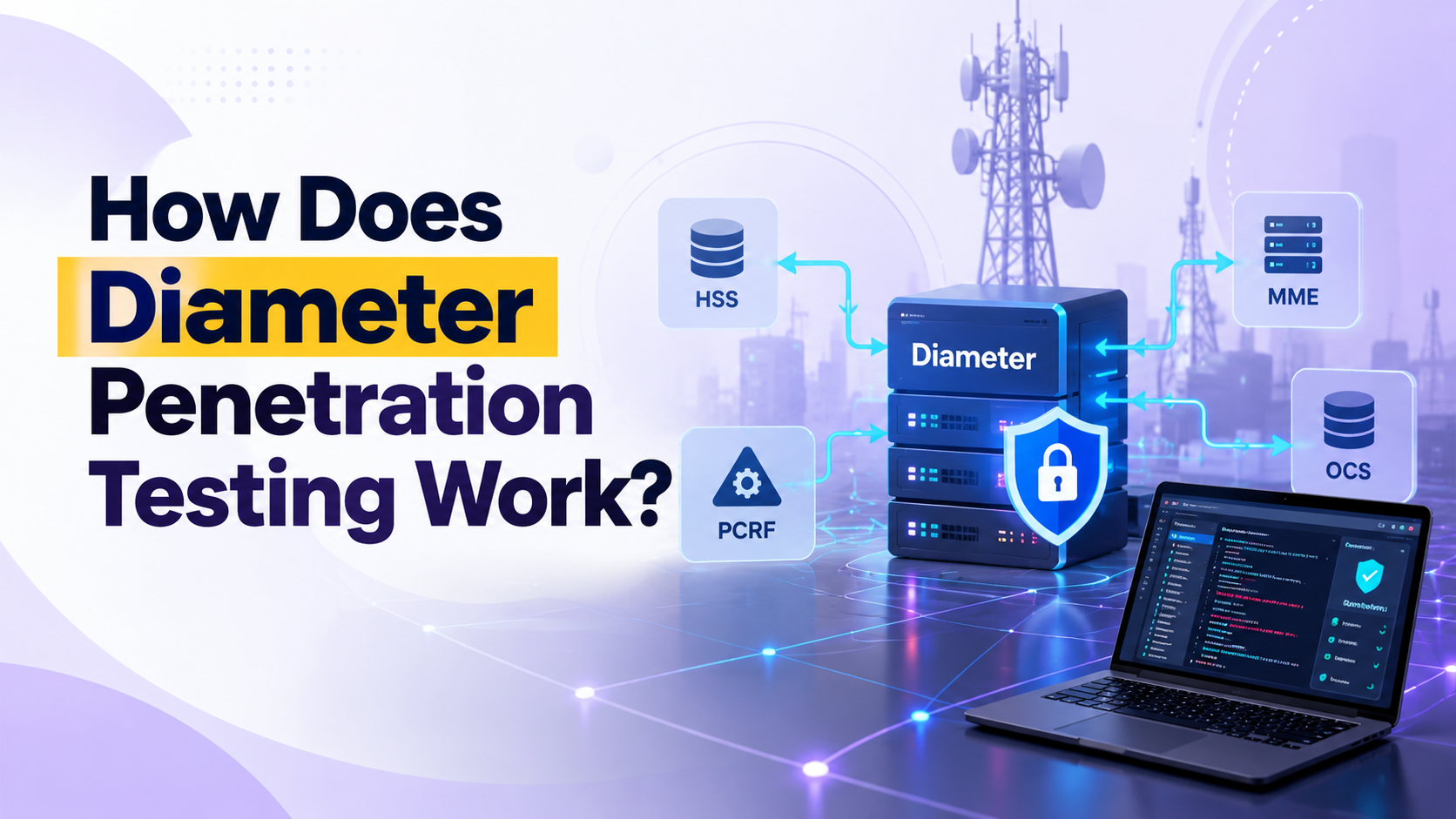

Diameter is a critical signaling protocol used in 4G/LTE networks for authentication, authorization, mobility management, subscriber services, accounting, and roaming. Because Diameter signaling can operate across operator and interconnect boundaries, security weaknesses can expose sensitive signaling functions and create risks for subscribers and network infrastructure.
This is where Diameter penetration testing becomes important.
But how does Diameter penetration testing work? What does a telecom operator actually test, and how is a Diameter pentest different from a conventional network penetration test?
A properly scoped Diameter security assessment combines architecture review, configuration analysis, vulnerability identification, security-control validation, and controlled attack simulation to determine whether Diameter infrastructure can withstand realistic threats.
GSMA specifically maintains guidance for Diameter Interconnect Security covering potential Diameter-based attacks and countermeasures for LTE and 5G interconnection environments.
Diameter security testing is the process of evaluating Diameter signaling infrastructure to identify security weaknesses, configuration issues, unauthorized access paths, and exploitable attack scenarios.
A typical assessment can include:
The objective is not simply to determine whether Diameter is functioning correctly. It is to determine whether the signaling environment is adequately protected against unauthorized or malicious activity.
RFC 6733 defines Diameter as an AAA framework used in local and roaming environments and specifies security requirements for protecting Diameter communications.
A Diameter pentest normally follows a structured process. The exact methodology depends on the operator's architecture, interfaces, testing scope, and security requirements.
The first stage is defining exactly what will be tested.
The security team identifies:
This is particularly important for telecom environments because uncontrolled testing against production signaling can potentially affect network services.
A clearly defined scope separates legitimate security testing from activity that could disrupt operational infrastructure.
The next step is understanding how Diameter signaling moves through the network.
The assessment team maps:
Diameter Client → Diameter Agent → Diameter Server
and identifies relevant interfaces and trust relationships.
The review can include:
RFC 6733 describes Diameter clients, agents, servers and peer relationships, making understanding the deployed architecture an important foundation for security testing.
Diameter relies heavily on trusted relationships between peers.
During Diameter security testing, the tester evaluates whether:
This is an important distinction: successfully authenticating a system does not automatically mean that system is authorized to perform every Diameter function.
RFC 6733 requires Diameter peers to verify that other peers are authorized to act in their claimed roles.
Transport security is another major component of a Diameter security assessment.
The assessment can review:
RFC 6733 specifies that Diameter must not be used without TLS, DTLS, or IPsec protection.
The purpose of testing is to determine whether the deployed implementation actually follows the intended security configuration.
Diameter messages contain Attribute-Value Pairs (AVPs), which can carry security-sensitive and subscriber-related information.
A Diameter vulnerability assessment should therefore examine how network elements handle:
The tester can send carefully controlled test messages to determine whether the network accepts, rejects, logs, or filters unexpected signaling.
This is an important part of identifying protocol-level weaknesses.
For LTE networks, the S6a interface can be an important component of Diameter security testing.
The assessment can evaluate whether unauthorized or manipulated signaling could affect:
Other interfaces can also be included depending on the operator's architecture, such as S6d, S9, Gy and external Diameter interconnects.
The exact interfaces tested should always reflect the actual production or test architecture rather than applying the same checklist to every network.
Roaming introduces another important layer of risk because Diameter signaling can cross administrative and network boundaries.
A Diameter security assessment should therefore evaluate:
GSMA identifies Diameter interconnect security as a specific area of concern and provides guidance addressing Diameter attacks and countermeasures for LTE and 5G interconnections.
A Diameter security audit should not stop at identifying technical weaknesses. It should also verify whether deployed security controls work as intended.
Testing may cover:
Diameter Firewall
Can unauthorized or prohibited messages be blocked?
Message Filtering
Can suspicious Diameter messages and unexpected AVPs be detected?
Access Control
Are only approved systems allowed to communicate with Diameter nodes?
Monitoring
Are abnormal signaling patterns logged and alerted?
Rate Controls
Can excessive signaling activity be detected or restricted?
These controls form an important layer of defense around Diameter infrastructure.
This is where Diameter penetration testing differs from a purely documentation-based audit.
A controlled Diameter pentest can simulate approved scenarios such as:
The purpose is to determine whether identified weaknesses can actually lead to a security impact.
Testing should be performed within an approved scope and, where appropriate, against dedicated test subscribers and controlled environments.
Penetration testing is only one component of a complete security review.
A Diameter vulnerability assessment can identify weaknesses that may not be directly exploited during the pentest.
The assessment can examine:
This provides operators with a broader view of their Diameter security posture.
Although they are related, these activities have different purposes.
In practice, telecom operators can combine these activities into a broader security program.
A practical Diameter assessment checklist can include:
This checklist can be adapted according to the operator's network architecture and security requirements.
Diameter remains an important component of many LTE and roaming environments. GSMA's security resources specifically address Diameter interconnect threats and recommend security controls for signaling environments.
A structured Diameter security testing program helps operators answer practical questions:
These questions help move Diameter security from a configuration exercise toward continuous security validation.
Diameter penetration testing is a structured process that combines architecture review, security configuration analysis, vulnerability identification, protocol testing, and controlled attack simulation.
A comprehensive approach should cover peer security, transport protection, Diameter messages, AVPs, S6a and other interfaces, roaming, interconnects, filtering, monitoring and attack scenarios.
For telecom operators, combining Diameter security testing, a Diameter security assessment, Diameter security audit, Diameter vulnerability assessment, and controlled Diameter pentest activities can provide a more complete understanding of signaling security.
Recommended internal links
For the published version, I recommend adding these two internal links:
These links create a natural SEO path:
How Diameter Pentest Works → Diameter Security Assessment → Diameter Security Testing Service
I have not invented the URLs because the exact Matrix Shell page URLs were not provided.





