
Blog
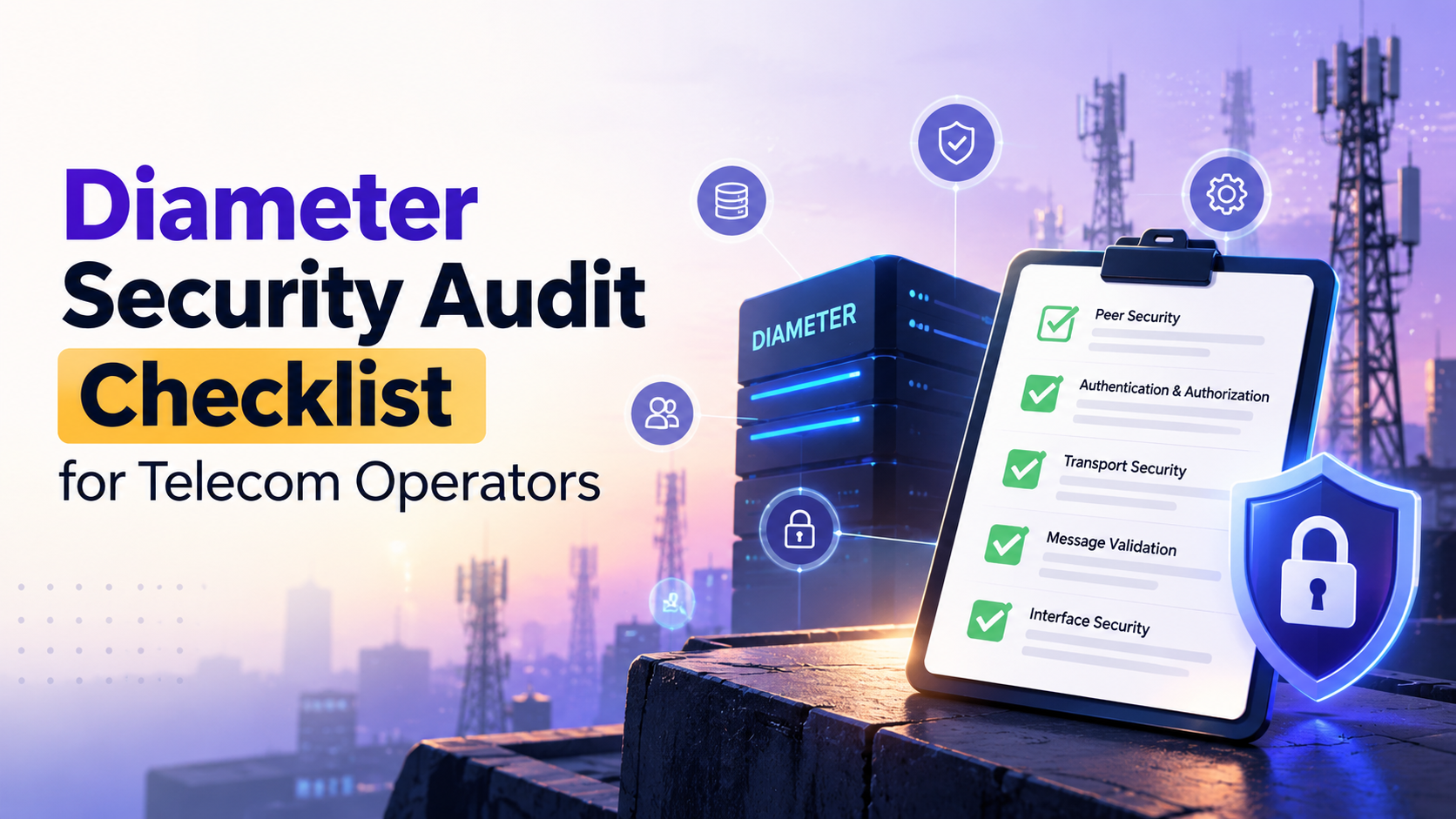

Diameter is a core signaling protocol used extensively across 4G/LTE networks for authentication, authorization, mobility management, subscriber services, and roaming. Because Diameter signaling can cross network and operator boundaries, weaknesses in configurations, trusted relationships, interfaces, or message handling can introduce significant security risks.
A structured Diameter security audit checklist helps telecom operators systematically review these areas and identify gaps before they become exploitable.
But what is Diameter security testing, and what should a telecom operator actually include in a Diameter security audit?
A comprehensive Diameter security assessment should cover peer security, transport protection, signaling messages, interfaces, roaming, access controls, monitoring, vulnerabilities, and controlled attack scenarios.
Diameter security testing is the process of evaluating a Diameter-based signaling environment to identify security weaknesses, misconfigurations, unauthorized access paths, and potential attack scenarios.
Unlike a basic configuration review, Diameter security testing can combine:
The goal is to determine whether Diameter signaling is adequately protected against unauthorized access and manipulation.
The IETF Diameter specification requires implementations to support protected transport mechanisms such as TLS/TCP or DTLS/SCTP, with IPsec also specified as a protection mechanism.
A practical Diameter assessment checklist should cover the following areas.
Diameter relies on relationships between trusted peers. Therefore, the first step in a Diameter security audit should be reviewing how those relationships are established and controlled.
Check whether:
An important consideration is that authentication and authorization are not the same thing. A peer may successfully authenticate but still need to be authorized to perform a particular Diameter role.
The next area in a Diameter security audit checklist should be transport protection.
Review:
This becomes especially important when signaling crosses organizational boundaries.
GSMA's Diameter interconnect security guidance addresses threats associated with Diameter-based interconnections and provides security measures for protecting LTE/5G signaling environments.
Diameter messages contain Attribute-Value Pairs (AVPs) that carry information between network elements.
A Diameter vulnerability assessment should determine whether the network properly validates:
Weak message validation can create opportunities for signaling manipulation or unexpected network behavior.
The objective is to confirm that network elements process only legitimate and expected Diameter messages.
S6a is an important Diameter interface in LTE networks and should be included within the scope of relevant Diameter security testing.
The assessment should consider whether unauthorized signaling could affect:
Operators should also verify that appropriate controls exist between relevant network elements and that unexpected requests cannot easily reach sensitive signaling functions.
Roaming introduces additional security considerations because Diameter traffic may cross different operator environments and interconnection networks.
A Diameter assessment checklist should therefore include:
GSMA's LTE roaming guidance discusses Diameter security in roaming environments and identifies additional security measures for inter-operator signaling.
This makes roaming security an important component of a broader Diameter security assessment.
Where Diameter firewalls or filtering mechanisms are deployed, auditors should validate whether they actually enforce the intended security policies.
Check:
The objective is to determine whether unwanted Diameter traffic can be detected and blocked before reaching critical network elements.
A Diameter vulnerability assessment should also examine the network exposure of Diameter interfaces.
Review:
Unnecessary network exposure can increase the attack surface of Diameter infrastructure.
Operators should verify that only required systems and services can communicate with Diameter network elements.
Security controls are more effective when suspicious activity can be detected.
A Diameter security audit should verify whether relevant events are logged and monitored, including:
The assessment should also determine whether alerts are actionable and whether security teams have sufficient visibility into Diameter signaling activity.
A Diameter penetration testing engagement, also referred to as a Diameter pentest, can validate whether identified weaknesses are actually exploitable.
Controlled testing can simulate scenarios such as:
Testing should always be conducted within an approved scope and preferably against dedicated test subscribers or controlled environments to avoid affecting live customers.
A Diameter vulnerability assessment complements penetration testing by identifying weaknesses that may not necessarily be exploited during a controlled pentest.
The assessment can examine:
This creates a broader picture of the operator's Diameter security posture.
There is no single frequency that applies to every telecom operator. The appropriate schedule should consider changes to the network architecture, new roaming relationships, new Diameter peers, major configuration changes, newly identified vulnerabilities, and the operator's security requirements.
A Diameter security assessment should also be considered after significant infrastructure changes or when new interconnects and services are introduced.
Regular testing helps ensure that security controls remain effective as the signaling environment evolves.
A Diameter security audit checklist should go beyond checking whether Diameter traffic is encrypted.
A complete Diameter security assessment should examine peer authentication, authorization, transport security, message validation, S6a security, roaming and interconnect security, filtering, access controls, monitoring, penetration testing, and vulnerability assessment.
Combining Diameter security testing, a structured audit, Diameter penetration testing, or Diameter pentest, and a Diameter vulnerability assessment gives telecom operators a more complete understanding of their signaling security posture.
For a commercial service page, this article can naturally link to your Diameter Security Testing service and your broader Diameter Security Vulnerabilities pillar.
Recommended internal links
I have kept these as anchor recommendations rather than inventing URLs because your actual Matrix Shell URL structure was not provided.





