Blog
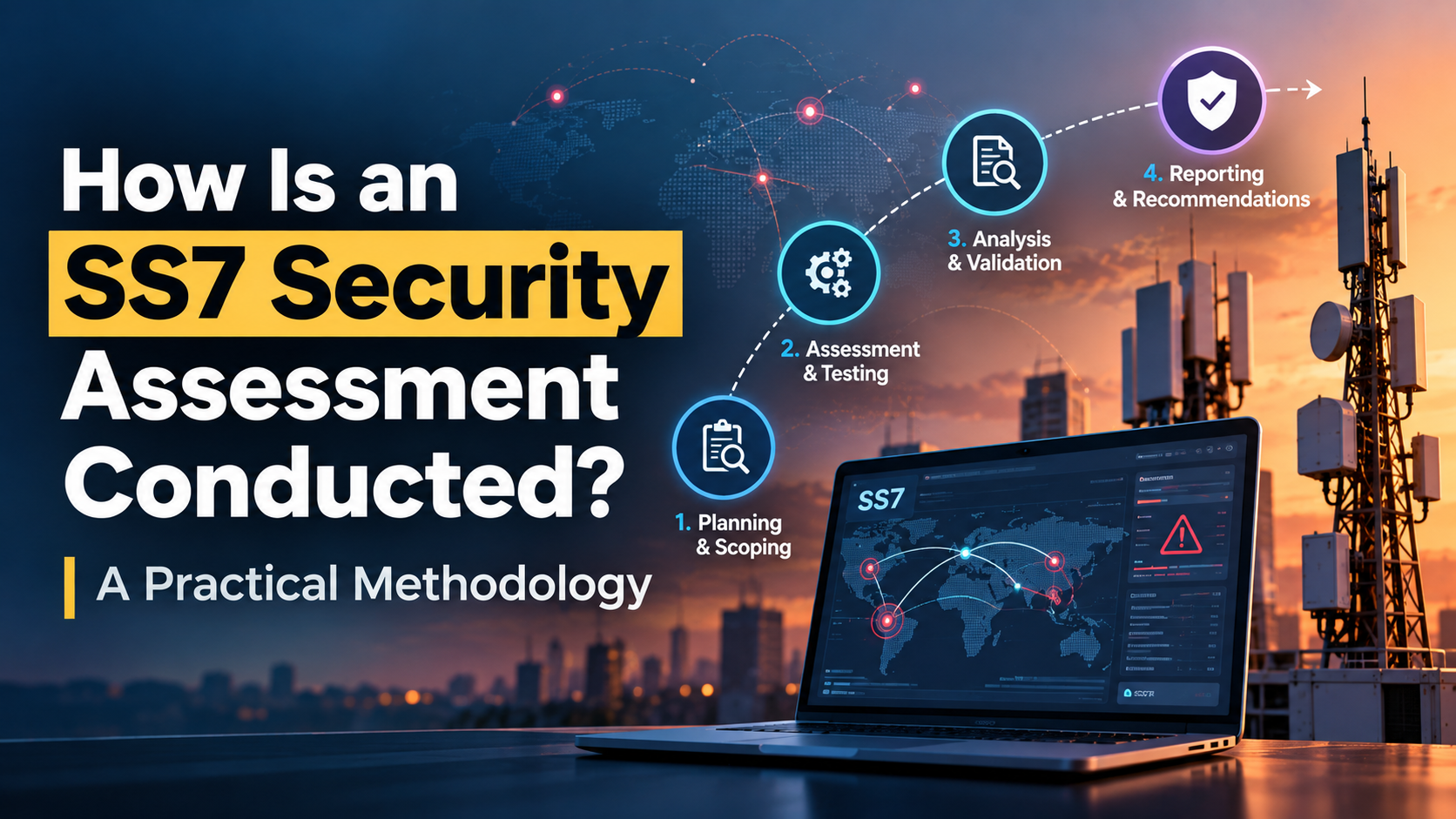

An SS7 security assessment is a structured evaluation of telecom signaling infrastructure designed to identify vulnerabilities, security gaps, configuration weaknesses, and exposure points that could affect subscribers or network operations.
Because SS7 supports important functions such as subscriber mobility, authentication, call routing, messaging, and communication between networks, an assessment needs to go beyond a basic configuration review. A professional approach combines architecture analysis, exposure assessment, vulnerability identification, security-control validation, risk analysis, and remediation planning.
Understanding the SS7 assessment methodology helps telecom operators establish a repeatable process for evaluating their signaling security posture without unnecessarily disrupting live network services.
The SS7 assessment methodology is a structured sequence of activities used to evaluate the security of an SS7 environment.
A typical assessment includes:
The exact methodology should be adapted to the operator’s architecture, network generation, interconnections, risk profile, and testing requirements.
The first step in an SS7 security assessment is establishing what will be evaluated.
The assessment scope may include SS7 signaling nodes, interfaces, interconnections, signaling firewalls, filtering mechanisms, monitoring systems, and relevant network components.
Objectives should also be defined clearly. For example, an operator may want to:
Clear objectives help ensure that the assessment produces useful and measurable outcomes.
The next stage is understanding how signaling moves through the telecom environment.
An assessor reviews relevant network elements, signaling paths, interconnections, trust relationships, and security boundaries.
Architecture analysis helps answer important questions:
This step provides the foundation for the rest of the SS7 assessment methodology.
Telecom operators may have signaling relationships with roaming partners, other operators, signaling providers, and other external entities.
The assessment evaluates these relationships to identify potential exposure points.
The objective is to determine whether signaling access is appropriately restricted and whether unnecessary trust or connectivity exists.
Exposure mapping can reveal weaknesses that may not be obvious from individual device configurations because security risk can emerge from how multiple network components interact.
The SS7 vulnerability assessment is a central component of the overall process.
It focuses on identifying weaknesses that could potentially affect signaling security, subscriber privacy, network integrity, or availability.
Areas evaluated may include:
The objective is to build a clear picture of where vulnerabilities exist and how they relate to the wider network architecture.
Identifying vulnerabilities is only one part of an SS7 assessment. Existing security controls also need to be evaluated.
These can include signaling firewalls, filtering policies, access controls, monitoring platforms, and other mechanisms designed to protect the signaling layer.
The assessment determines whether controls are:
This helps identify gaps between documented security policies and actual technical implementation.
An effective SS7 security assessment should connect technical findings to potential impact.
Signaling weaknesses can potentially create risks involving subscriber privacy, messaging, fraud, service manipulation, or network availability.
Risk analysis therefore considers areas such as:
This contextual analysis helps operators determine which findings require the most immediate attention.
Security controls are more effective when operators can identify suspicious activity.
An SS7 assessment can therefore examine whether the organization has adequate visibility into signaling behavior.
The review may consider:
The goal is to determine whether suspicious signaling activity can be recognized and investigated before it develops into a larger security or operational issue.
Not every observation has the same level of significance.
High-risk findings should be reviewed and, where appropriate, validated through controlled security testing within the agreed assessment scope.
This can help determine whether a suspected weakness represents genuine security exposure and what network functions could potentially be affected.
Controlled validation should always prioritize operational safety, particularly when assessing live telecom infrastructure.
An SS7 vulnerability assessment can produce multiple findings, but remediation should be risk-based.
Prioritization can consider:
This allows security teams to focus resources on weaknesses that present the greatest practical risk.
The final stage of the SS7 assessment methodology is reporting.
A professional report should provide a clear record of what was assessed, what was discovered, and what should be improved.
A typical report includes:
The report should be useful to both technical teams and security leadership, connecting detailed findings with broader business and network risks.
SS7 rarely exists in complete isolation within today’s telecom environments.
Operators may simultaneously manage SS7, Diameter, GTP, and 5G service-based interfaces. Consequently, signaling security needs to be considered across multiple network generations.
An effective assessment program can therefore form part of a broader signaling security strategy covering legacy and modern technologies.
An effective assessment should be:
Structured: Follow a defined methodology rather than relying on an ad-hoc checklist.
Risk-based: Prioritize vulnerabilities according to potential impact and exposure.
Architecture-aware: Consider how signaling components and interconnections interact.
Control-focused: Evaluate whether existing security mechanisms actually provide the intended protection.
Operationally safe: Avoid unnecessary disruption to production telecom services.
Actionable: Provide clear remediation and improvement recommendations.
Repeatable: Support periodic reassessment as network architecture and threats evolve.
An SS7 security assessment provides telecom operators with a structured way to evaluate the security of their signaling infrastructure.
A practical SS7 assessment methodology combines architecture review, exposure analysis, SS7 vulnerability assessment, security-control evaluation, monitoring review, risk analysis, controlled validation, and remediation planning.
The objective is not simply to produce a list of vulnerabilities. It is to help operators understand where signaling security weaknesses exist, what they could affect, and which improvements should be prioritized.
As telecom environments continue to combine legacy SS7 with newer signaling technologies, regular and methodical assessment can provide the visibility needed to strengthen signaling security and improve overall network resilience.