Blog
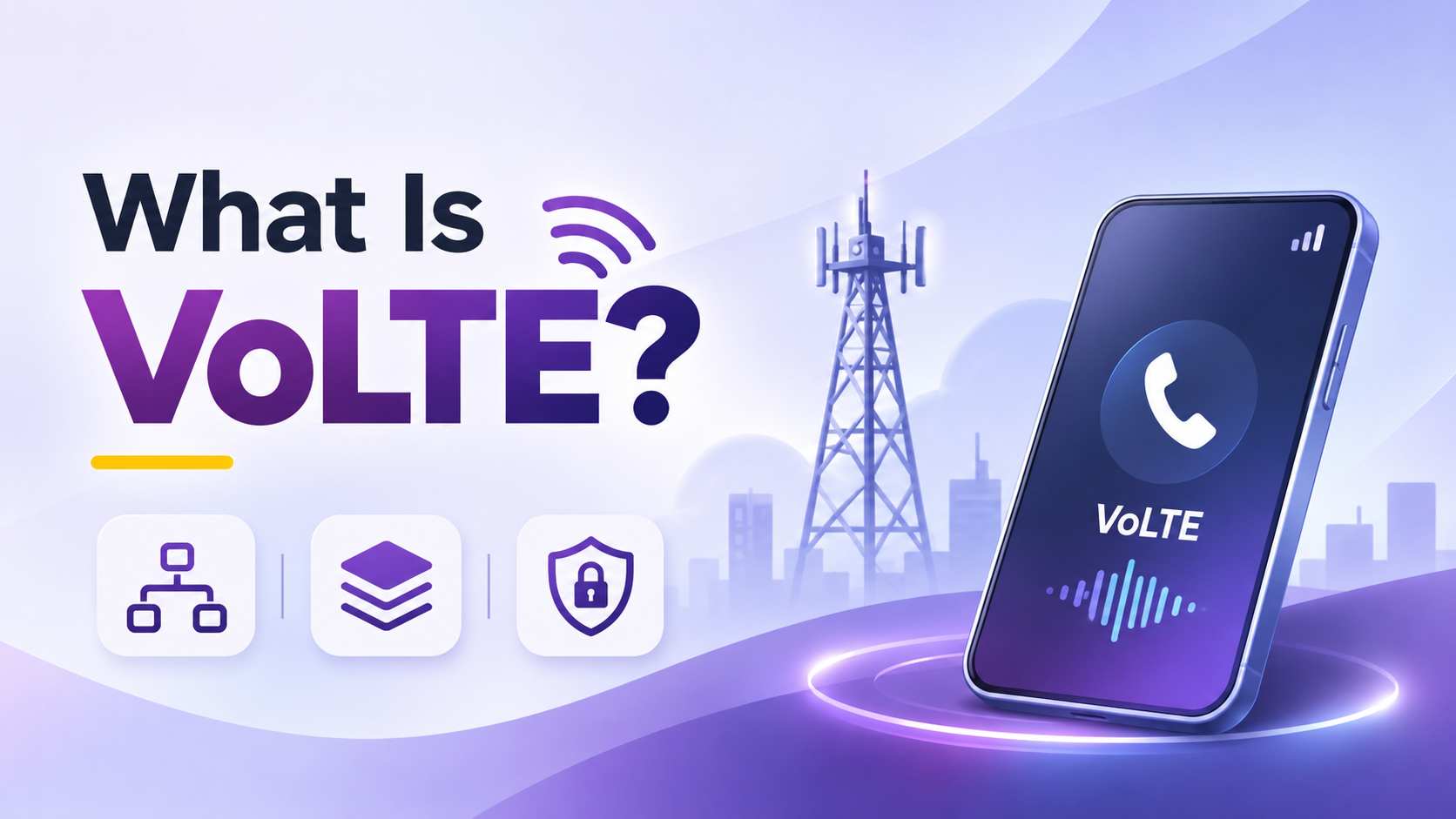

Voice over LTE (VoLTE) enables mobile operators to deliver voice calls over 4G LTE data networks instead of relying on a separate circuit-switched voice network. It supports faster call setup, clearer voice quality when network conditions allow, and simultaneous voice and data use. To understand how the service works—and where risks can arise—it helps to examine VoLTE architecture, its core protocols and the signaling that establishes and manages calls.
VoLTE is an IP-based voice service delivered over an LTE network. Unlike traditional circuit-switched voice, which reserves a dedicated path for a call, VoLTE carries voice as packet data. The LTE radio access network transports those packets to the operator’s evolved packet core (EPC), and IMS controls the voice session.
In practical terms, a compatible device registers with the LTE network and IMS. When a user places a call, signaling messages establish the session, policy and quality-of-service mechanisms allocate suitable resources, and voice packets travel between the endpoints. This is how VoLTE works: LTE provides connectivity, IMS controls the service, and media is transported using IP-based mechanisms.
A typical VoLTE network architecture includes several interconnected domains. Exact deployments differ by operator, vendor and network design, but the following components are commonly involved:
The user equipment is the handset or other compatible device containing the SIM/eSIM and VoLTE-capable software. It connects to the LTE radio network, performs network registration and initiates or receives calls. Device configuration, supported codecs and software security all affect the service experience.
The Evolved Universal Terrestrial Radio Access Network (E-UTRAN), primarily through eNodeBs, provides the radio connection between the device and the operator’s core. It transports signaling and user-plane traffic and supports mobility as subscribers move between cells.
The EPC routes packet traffic and manages connectivity, mobility and policy. Key functions include the Mobility Management Entity (MME), Serving Gateway (S-GW), Packet Data Network Gateway (P-GW), and Policy and Charging Rules Function (PCRF) in many conventional architectures. These functions help authenticate and manage subscribers, route packets, and apply policy and quality-of-service rules.
The VoLTE IMS architecture provides service control. Core elements commonly include the Proxy-CSCF (P-CSCF), Interrogating-CSCF (I-CSCF), Serving-CSCF (S-CSCF), and application servers. The CSCF functions support SIP registration and session routing, while application servers provide supplementary services such as call forwarding or other operator-specific features.
Media gateways and related interworking functions may support communication with legacy circuit-switched networks and other operators. Media resources can also support announcements, conferencing and tone generation. These functions make it possible for an IP-based call to reach users outside the operator’s IMS environment.
Several protocols work together to deliver LTE voice communication. Their roles should be understood separately because each supports a different part of the service.
Session Initiation Protocol (SIP) is central to SIP in VoLTE. It is used for registration and for creating, modifying and terminating communication sessions. SIP messages carry information used to locate users, negotiate session parameters and route calls through IMS. VoLTE signaling therefore depends on correct SIP configuration, message validation and access controls.
Real-time Transport Protocol (RTP) commonly carries voice media once a session is established. Real-time Transport Control Protocol (RTCP) provides feedback about media delivery. The media path may be direct or routed through network functions, depending on the operator’s architecture and service requirements.
Diameter supports signaling between several LTE and IMS-related network functions, including authentication, authorization, subscriber data and policy interactions. Its use depends on the interface and deployment. Because Diameter exchanges can influence subscriber access and network behavior, operators should restrict peer connectivity and validate messages.
A simplified VoLTE call flow can be understood in three stages:
After connecting to LTE, the device establishes packet connectivity and discovers the appropriate IMS service. It sends a SIP REGISTER request through the P-CSCF. IMS functions process the registration and authenticate the subscriber using the operator’s subscriber data and authentication systems. Successful registration makes the user reachable for IMS services.
When the caller dials a number, the device sends a SIP INVITE. IMS routes the request toward the destination and coordinates session negotiation. The called party is alerted, and responses travel back through the signaling path. Once the session is accepted, the endpoints agree on media parameters and the network applies the required bearer and policy treatment.
Voice packets are exchanged using the negotiated media path, commonly with RTP. When either party ends the call, SIP signaling releases the session and associated resources. This high-level IMS call flow and SIP call flow can vary depending on supplementary services, roaming, interconnects and network topology.
VoLTE security matters because the service combines radio access, packet-core connectivity, IMS session control and inter-operator signaling. A weakness in one layer can affect service availability, subscriber privacy or the integrity of call handling. LTE voice security should therefore be assessed across the full service path rather than at a single interface.
Review SIP and Diameter exposure, validate message handling, and restrict communication to trusted peers and required interfaces. Apply appropriate security protections to signaling links and avoid unnecessary network reachability.
Use role-based administrative access, secure management interfaces, hardened configurations and timely patching. Review authentication, authorization and policy rules across LTE and IMS components.
Establish baselines for signaling and media activity. Monitor unusual registration patterns, unexpected SIP requests, malformed messages, abnormal traffic volumes and unexpected communication between network elements.
A structured VoLTE security assessment should cover device-to-network access, EPC interfaces, IMS functions, signaling routes, media handling, roaming and interconnect exposure. Testing should be authorized, scoped and conducted in a controlled manner to avoid disrupting live services.
VoLTE carries voice as IP packets over LTE, while circuit-switched voice reserves dedicated resources. VoLTE uses IMS and supports simultaneous voice and data.
VoLTE combines LTE connectivity with IMS service control to deliver IP-based voice. Understanding its architecture, protocols and signaling flow helps operators design, troubleshoot and secure deployments. Regular reviews and authorized testing help identify weaknesses before they affect subscribers.