Blog

Telecom signaling networks control critical functions such as subscriber authentication, mobility management, call routing, messaging, and communication between network operators. Because these functions depend heavily on signaling protocols, weaknesses in signaling infrastructure can create significant security and operational risks.
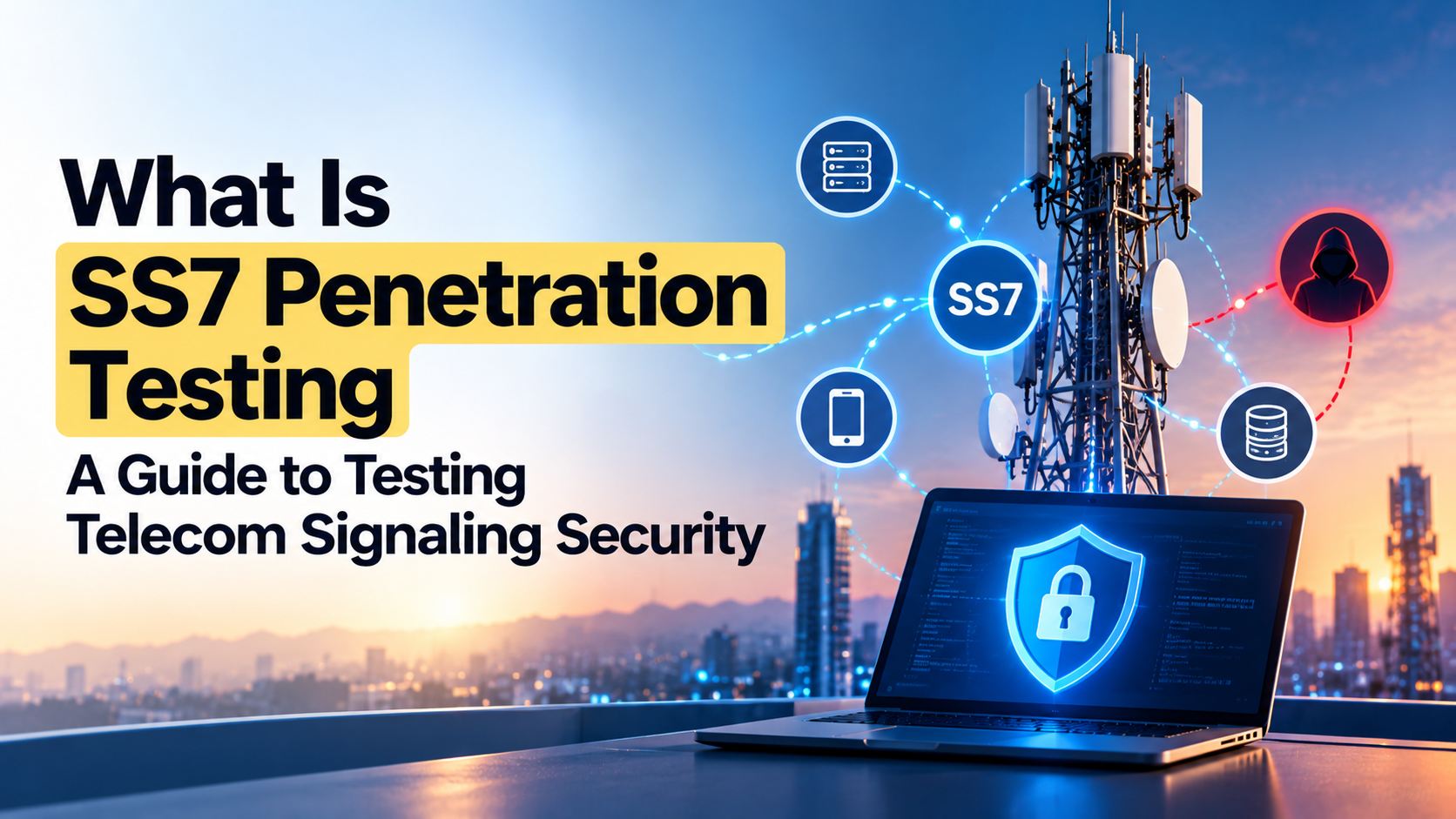
SS7 penetration testing is a specialized security assessment designed to evaluate how an SS7-based telecom environment responds to unauthorized, abnormal, or potentially malicious signaling activity.
Unlike a conventional IT penetration test, SS7 pentesting focuses on telecom signaling protocols, network relationships, trust assumptions, filtering controls, and signaling behavior. The objective is to identify security weaknesses before they can be exploited against subscribers or telecom infrastructure.
SS7 penetration testing is the controlled security testing of Signaling System No. 7 (SS7) infrastructure to identify vulnerabilities that could expose subscribers, services, or network functions to unauthorized signaling activity.
The assessment evaluates how the network handles different signaling scenarios and whether security controls effectively restrict suspicious or unauthorized requests.
Depending on the environment, testing can examine areas such as:
The goal is not simply to find technical weaknesses but to understand their potential impact on the telecom environment.
SS7 pentesting and SS7 security testing are closely related, but the terms can describe different levels of assessment.
SS7 security testing is a broader activity that can include vulnerability assessment, configuration validation, security-control testing, protocol analysis, and security posture evaluation.
SS7 penetration testing places greater emphasis on controlled adversarial validation. It assesses whether identified weaknesses could realistically affect the security of signaling functions when subjected to simulated attack scenarios.
In practice, organizations may combine both approaches as part of a broader telecom signaling security program.
SS7 was designed around trusted relationships between network operators and signaling entities. Modern telecom environments, however, operate within much larger and more interconnected ecosystems.
This can create opportunities for abuse when signaling controls are weak or incorrectly configured.
Potential risks associated with signaling weaknesses include:
A structured SS7 penetration testing program helps operators discover these weaknesses through controlled security validation rather than waiting for real-world incidents.
For a broader view of the risks, telecom operators can also review the major signaling security risks affecting modern telecom networks.
The exact scope depends on the operator’s architecture and objectives, but a typical assessment may examine several important areas.
Testing identifies where SS7 signaling is exposed to external or interconnected environments and evaluates whether those exposure points are appropriately controlled.
Security controls should distinguish legitimate signaling activity from suspicious or unauthorized requests. Testing helps determine whether filtering mechanisms enforce the intended security policies.
SS7 environments often depend on relationships between network entities and operators. Testing evaluates whether those trust assumptions create unnecessary security exposure.
SS7 weaknesses can potentially expose sensitive subscriber-related information. Testing therefore evaluates whether controls adequately protect subscriber privacy and restrict unauthorized access.
Signaling is essential to many network functions. Testing can assess whether abnormal signaling activity could create excessive signaling load or affect service availability.
An effective defense requires visibility. Penetration testing can help determine whether suspicious signaling behavior is detected and whether appropriate security controls respond to it.
The value of telecom penetration testing extends beyond identifying individual vulnerabilities.
A properly scoped assessment can help telecom operators understand the relationship between technical weaknesses and business impact.
For example, a signaling weakness may not appear critical when viewed in isolation. However, if it can affect subscriber privacy, authentication-related functions, messaging, or network availability, its overall business risk may be significantly higher.
Testing can therefore help organizations prioritize remediation based on actual exposure and potential impact.
Signaling penetration testing is a broader term for security testing that evaluates telecom signaling environments against controlled attack scenarios and security requirements.
It can encompass multiple signaling technologies depending on the network architecture.
For example, a modern telecom environment may contain:
This means SS7 pentesting can form one component of a broader signaling security assessment covering multiple generations.
A professional assessment generally follows a controlled lifecycle rather than immediately testing production systems.
The process typically includes:
Testing should always be conducted under an authorized scope and with appropriate safeguards to prevent disruption to live telecom services.
SS7 penetration testing can be particularly valuable:
Recurring assessments are important because telecom networks evolve, interconnections change, and new security risks can emerge over time.
Traditional penetration testing commonly focuses on assets such as web applications, servers, endpoints, APIs, and corporate networks.
SS7 penetration testing addresses a different environment.
Because telecom signaling directly supports network operations, testing requires specialized knowledge of telecom architecture and signaling protocols.
SS7 penetration testing provides telecom operators with a specialized way to validate the security of critical signaling infrastructure. By examining signaling exposure, trust relationships, filtering, subscriber privacy, monitoring, and network availability, operators can identify weaknesses before they become significant security incidents.
SS7 pentesting should be viewed as part of a broader telecom cybersecurity strategy rather than an isolated technical exercise. As networks evolve across 2G, 3G, 4G, and 5G, combining specialized signaling assessments with continuous security validation can help operators maintain stronger protection across their telecom environment.