Blog
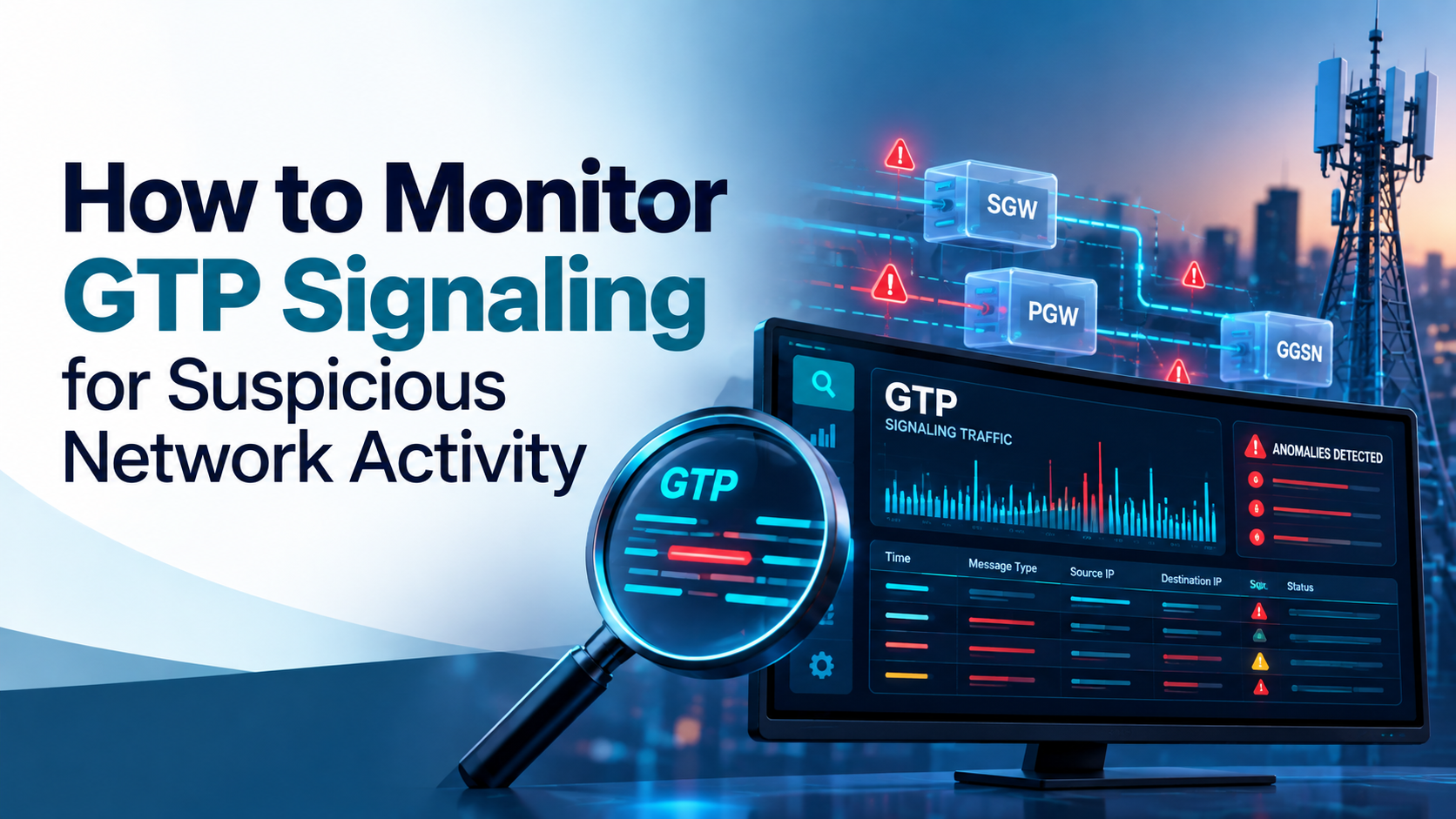

Mobile networks depend on reliable signaling to establish subscriber sessions, manage connectivity and deliver data services. The GPRS Tunneling Protocol (GTP) supports these functions across relevant mobile core network interfaces. However, unexpected signaling patterns, unauthorized traffic and weaknesses in security controls can expose telecom operators to operational and security risks.
GTP traffic monitoring helps operators understand how signaling behaves, identify suspicious activity and investigate potential threats before they cause significant disruption. By combining traffic analysis, logging, alerting and security validation, operators can improve visibility into their mobile core infrastructure.
This guide explains how to monitor GTP signaling, recognize potential anomalies and strengthen telecom threat detection.
GTP traffic monitoring is the process of observing and analyzing GTP communications to understand network behavior, detect policy violations and investigate unusual activity.
Depending on the available tools and deployment, monitoring may include examining message types, traffic volumes, source and destination peers, protocol errors, session-related events and firewall alerts.
GTP is used for different purposes across mobile networks. GTP-C supports control-plane signaling, including session management, while GTP-U carries user-plane data. Monitoring requirements therefore depend on the interfaces, protocol versions and network functions in scope.
Effective monitoring does not simply collect large volumes of traffic data. It establishes what normal activity looks like, identifies meaningful deviations and gives security teams sufficient context to investigate them.
Insufficient visibility can make it difficult to distinguish legitimate signaling changes from suspicious activity. Potential warning signs include unexpected communication from a peer, unusual message rates, repeated validation failures and traffic that violates established security policies.
GTP signaling monitoring helps operators investigate these patterns and identify potential issues such as:
These indicators are not proof of an attack on their own. Network changes, maintenance, roaming activity and legitimate traffic surges can also produce anomalies. Operators should correlate alerts with network context before taking action.
A useful monitoring strategy starts by understanding normal GTP behavior.
Operators should identify expected peers, typical traffic volumes, commonly observed message types, normal signaling rates and relevant operational patterns. Baselines should account for differences across interfaces, time periods, network functions and service conditions.
For example, a temporary increase in signaling during a planned network change may be legitimate, whereas a sustained increase from an unexpected source may require investigation.
Baselines should be updated when network architecture, traffic demand or service configurations change. Without this context, GTP anomaly detection may generate excessive false positives or fail to identify meaningful deviations.
Logging provides the evidence needed to investigate suspicious activity. Operators should determine which GTP events and security-relevant details their monitoring tools can capture.
Useful data may include:
Collection should follow applicable privacy, data-retention and operational policies. Where full packet capture is unnecessary, metadata and security event logs may provide useful visibility with lower storage and processing requirements.
Consistent timestamps and reliable log correlation are important for reconstructing events across multiple network elements.
A mobile core firewall can provide an important source of security telemetry when it supports GTP-aware inspection and logging.
Operators should monitor whether traffic is accepted or rejected according to configured policies. Repeated attempts from unapproved peers, unexpected message types and recurring protocol validation failures may indicate misconfiguration or suspicious behavior.
Review the effectiveness of:
These checks help operators determine whether GTP firewall security and existing GTP security controls are working as intended.
Monitoring should complement configuration reviews and authorized testing rather than replace them.
Monitoring systems should convert relevant events into actionable alerts. Possible detection scenarios include sudden changes in signaling volume, repeated policy violations, unexpected peer activity, unusual message distributions and persistent protocol errors.
GTP anomaly detection can compare current activity against established baselines, configured thresholds or supported behavioral analytics.
Alert rules should account for the operator's environment. A single threshold may not work equally well across every interface or network function. Teams should tune detection logic using historical data and investigate false positives.
Alerts should also include enough context to support triage, such as the time of the event, affected interface, observed behavior, relevant peer information and the rule that triggered the alert.
When an alert is triggered, analysts should determine whether the activity reflects a legitimate operational change, a configuration issue or a potential security incident.
A structured investigation can include:
GTP traffic analysis should focus on understanding the context of the observed behavior, not simply counting unusual packets. Where necessary, authorized technical investigation can help determine whether a weakness in message handling or network configuration contributed to the event.
Monitoring tools and security rules require ongoing validation as networks evolve.
Operators should periodically test whether expected events are logged, relevant alerts are generated, escalation procedures work and security teams can access the information needed for investigation.
Validation may include controlled tests of firewall policies, peer restrictions, protocol checks and alert scenarios within an approved scope. Results should be documented, gaps remediated and controls retested.
This process strengthens GTP security monitoring and supports wider mobile core network monitoring by helping teams maintain reliable visibility as network configurations and traffic patterns change.
To improve detection and response, telecom operators should:
Together, these practices help improve telecom threat detection while reducing unnecessary alerts and investigation effort.
Continuous monitoring helps identify suspicious behavior as it occurs, but it does not establish whether every interface, configuration or protocol implementation is secure.
A broader GTP security assessment can evaluate interface exposure, message handling, access restrictions and potential configuration weaknesses. Authorized penetration testing can then validate selected security weaknesses within an agreed scope.
Combining monitoring with testing gives operators a more complete view of their defenses: monitoring highlights events and behavioral changes, while assessments help identify weaknesses that may not generate an alert.
Explore GTP Security Testing Explained or learn more about Matrix Shell's Signaling Security Testing services.
GTP traffic monitoring helps telecom operators identify unusual signaling behavior, investigate policy violations and improve visibility across protected mobile core network interfaces.
By establishing normal traffic baselines, collecting useful logs, monitoring firewall filtering, configuring meaningful alerts and validating security controls, operators can strengthen their ability to detect and investigate suspicious activity.
The most effective approach combines continuous monitoring with regular configuration reviews and authorized security testing. This layered strategy helps operators identify gaps, improve response readiness and maintain a more resilient mobile core network.