Blog
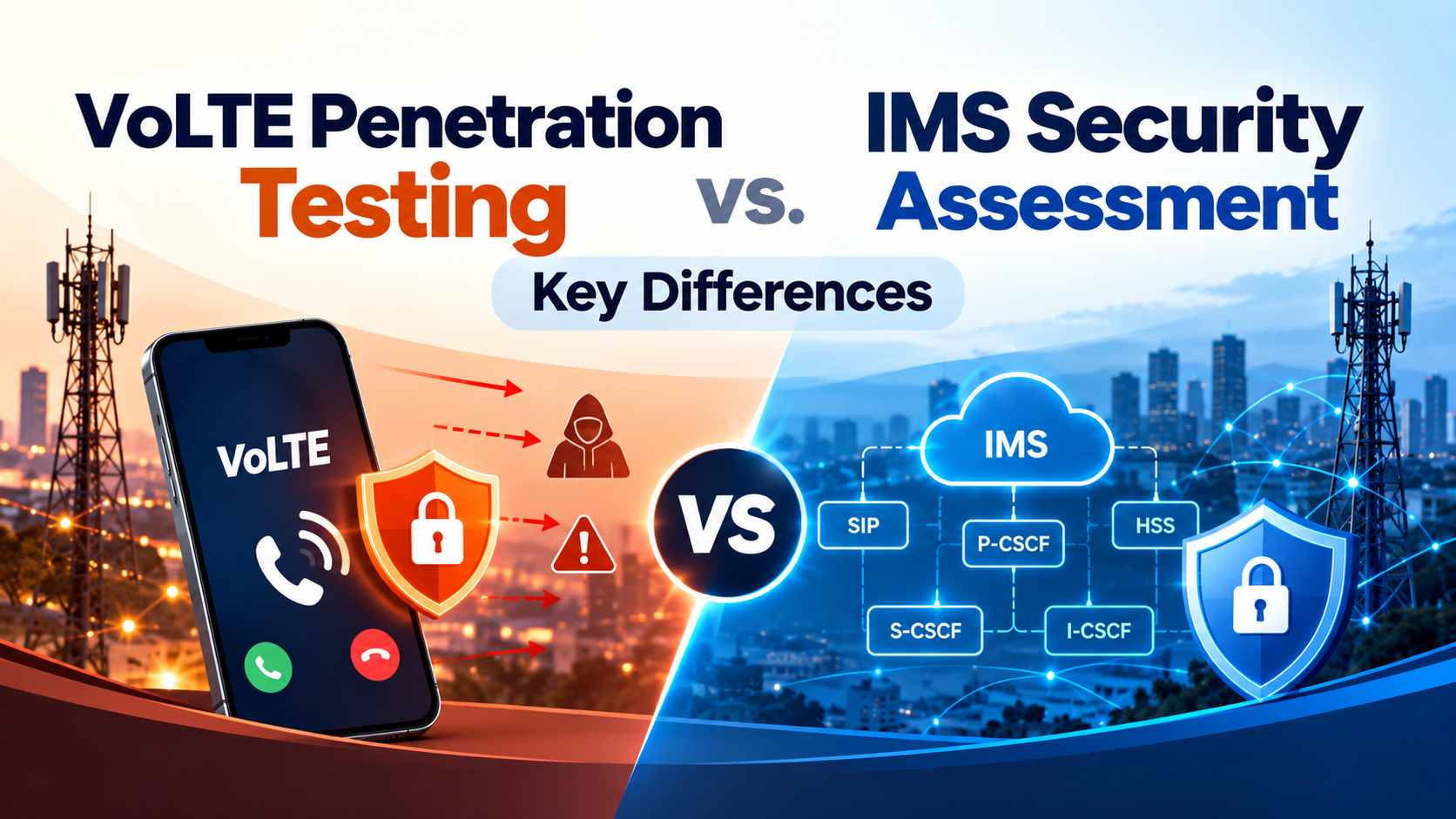

Voice over LTE (VoLTE) enables voice calls over LTE networks using the IP Multimedia Subsystem (IMS). Because these services rely on IP connectivity, signaling protocols and interconnected network components, operators need to understand whether their security controls work as intended. Two common activities are VoLTE penetration testing and an IMS security assessment. They can overlap, but they answer different questions.
This guide compares their goals, scope, methods and deliverables, and explains how to combine them within a wider telecom security testing programme. It also outlines practical checks operators can use when planning VoLTE network security testing.
VoLTE penetration testing is an authorised, controlled exercise that tests whether weaknesses in the agreed VoLTE environment can be exploited. It may examine exposed interfaces, traffic-handling rules, signaling behaviour, access restrictions and trust boundaries relevant to voice services. The aim is to validate real-world risk, demonstrate the possible impact of a weakness safely, and provide actionable remediation guidance.
The scope varies by operator and architecture. A test may focus on selected VoLTE components and interfaces, or form part of a broader telecom penetration testing engagement. Testing must be explicitly authorised, with operational safeguards, monitoring and stop conditions agreed before any activity begins.
An IMS security assessment reviews the security posture of the IMS environment that supports services such as VoLTE. It can include architecture and configuration reviews, access-control analysis, signaling-policy checks, segmentation review, logging and examination of documented security processes. IMS security testing may also include controlled technical validation, depending on the objectives and agreed scope.
An IMS security assessment is often broader than a penetration test in the areas it reviews, but it does not automatically prove that every weakness is exploitable. Its purpose is to understand whether the architecture, configuration and operational controls are appropriate, identify gaps and prioritise improvements.
VoLTE penetration testing asks: can an identified weakness be used to cross a security boundary or affect a service within the approved test scope? An IMS security assessment asks: are the IMS architecture, configurations and controls designed and maintained securely? The first emphasises controlled exploitation and validation; the second emphasises the overall security posture.
VoLTE penetration testing usually concentrates on selected assets, interfaces and attack paths that could affect VoLTE services. An IMS security assessment may review a wider set of IMS components, trust relationships, configurations, operational practices and supporting controls. Define the VoLTE assessment scope in advance so stakeholders know which systems, environments, interfaces and exclusions are covered.
Penetration testing uses approved test cases to validate how the environment responds to realistic, bounded attack scenarios. An assessment can combine document review, interviews, configuration analysis, architecture review and technical checks. Both should rely on verifiable evidence, but the evidence differs: a penetration test may demonstrate a reproducible weakness, while an assessment may identify a control gap or insecure configuration that requires correction.
A penetration test report typically describes validated findings, affected assets, evidence, impact, severity and recommended fixes. An IMS security assessment report can additionally document architecture or policy gaps, control maturity, risk themes and prioritised improvement actions. Effective VoLTE security reporting should clearly state methodology, limitations, scope, findings, remediation guidance and retest status where applicable.
Choose VoLTE penetration testing when the priority is to validate exploitability of specific risks, test selected boundaries or confirm whether controls withstand authorised technical testing. Choose an IMS security assessment when reviewing a new deployment, major change, configuration baseline, security programme or wider set of controls. Many operators benefit from using both: the assessment identifies and prioritises gaps, and penetration testing validates selected risks.
Use the following points to plan a proportionate review. This IMS security checklist can be adapted to an operator’s network design and risk requirements:
Confirm the VoLTE assessment scope, objectives, exclusions, authorisation and rules of engagement.
Map relevant IMS components, interfaces, external connections, trust boundaries and management paths.
Review SIP signaling handling, authentication, input validation, rate limiting and relevant logging.
Examine routing, filtering, access permissions and segmentation between critical components.
Review secure configuration, administrative access, credential handling and change management.
Consider subscriber privacy, service integrity, monitoring and incident escalation.
Agree severity criteria, remediation owners, reporting format and retesting requirements.
A VoLTE security audit checklist can help establish repeatability, but it should not become a substitute for risk-based testing. Include VoLTE security controls relevant to the actual implementation and verify them using suitable evidence.
A practical VoLTE security testing methodology begins with scoping and operational planning, followed by information gathering and architecture discovery. The team then performs the agreed review and controlled technical tests, analyses evidence, prioritises findings and prepares the report. Remediation and retesting help confirm whether corrective actions have addressed the original risk.
The IMS security assessment process should be tailored to the operator’s architecture, vendor implementations, interconnections and operational constraints. A telecom network security assessment may include other network domains, but those assets should be explicitly included rather than assumed to be covered. Testing on production systems requires additional coordination to protect service availability.
VoLTE penetration testing and IMS security assessment are complementary, not interchangeable. Penetration testing validates selected weaknesses through authorised technical tests, while an IMS assessment examines the broader security posture and control environment. Combining them can help operators prioritise risk, strengthen VoLTE network security testing and make remediation more effective. Matrix Shell can support telecom operators with a tailored assessment aligned to their architecture, service requirements and agreed scope.